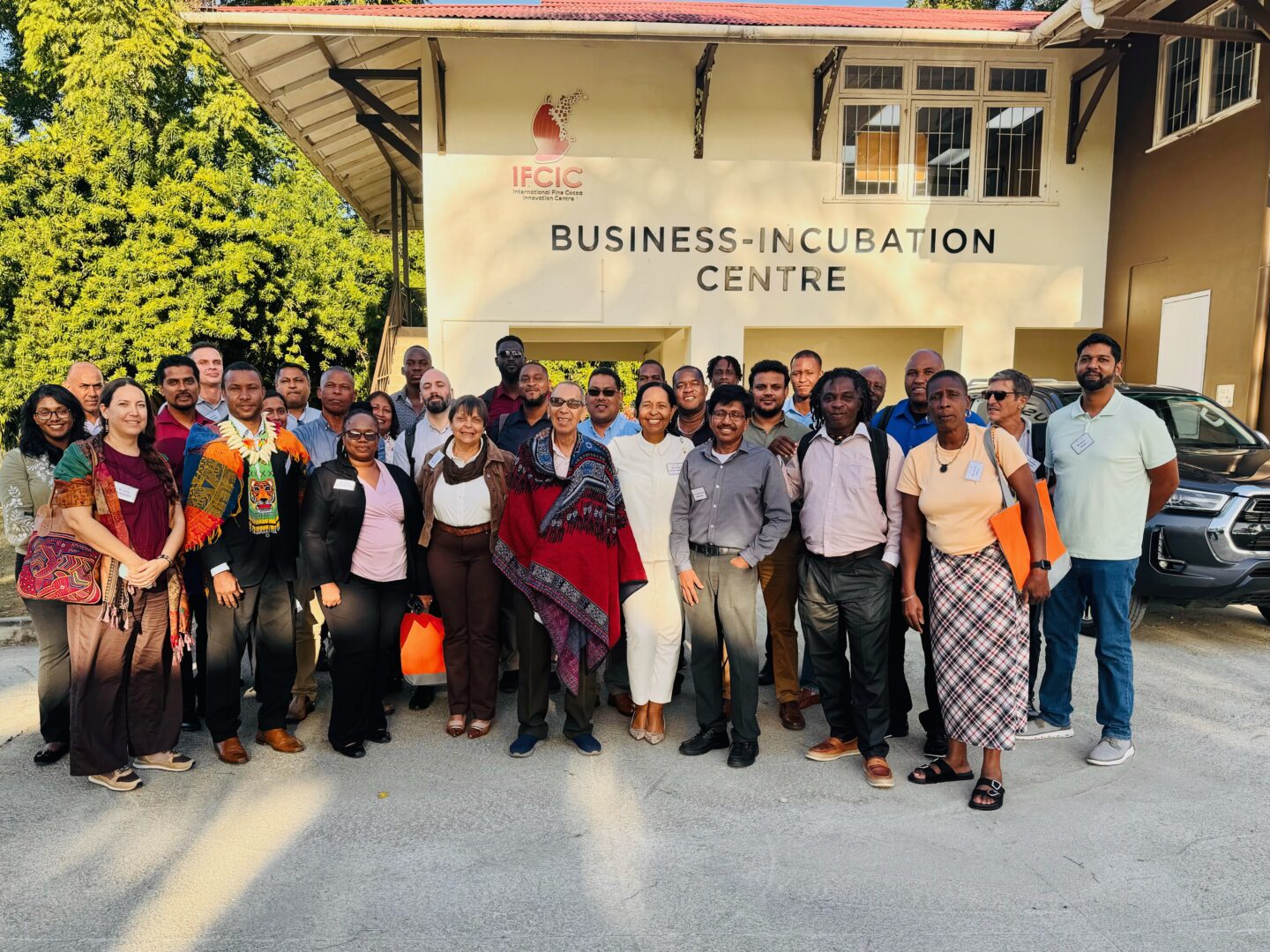
Grenada participated in the Sub-Regional Validation Workshop on the Caribbean Cocoa Industry Development Agenda held on 13 and 14 November 2025, at The University of the West Indies, St Augustine Campus, Trinidad.
The workshop was organised by the Cocoa Research Centre (CRC) and the Food and Agriculture Organisation of the United Nations (FAO), and brought together cocoa-producing countries across the OECS, along with Trinidad and Tobago, for 2 days of technical exchanges, roadmap refinement, and regional collaboration.
Over the past year, FAO and CRC have been working closely with Caribbean countries to identify the constraints affecting their cocoa sectors and to outline the elements needed for a structured roadmap to support sustainable development. This ongoing project involves technical assessments, farmer and institutional consultations, and analysis of genetic material, field practices, and post-harvest systems. The workshop allowed countries to review the findings to date, discuss their challenges in depth, and contribute directly to shaping their national priorities within the emerging regional framework.
L-R: Andrew Hastick, Shadel Nyack Compton and Kason Charles. Photo: Shadel Nyack Compton
Grenada’s delegation included Andrew Hastick, General Manager of the Grenada Cocoa Association; Kason Charles, Agronomist with the Ministry of Agriculture, Lands, Fisheries and Cooperatives; and Shadel Nyack Compton, Managing Director of Belmont Estate, representing the private sector. The team participated in sessions focused on planting material pipelines, genetic improvement, top-working, climate resilience, pest and disease management, cocoa quality, cadmium mitigation, European Union Deforestation Regulation (EUDR), and market opportunities for fine-flavour cocoa. These discussions highlighted the importance of coordinated approaches to strengthen cocoa production and value-added development in Grenada.
Cocoa remains one of Grenada’s most significant agricultural assets, valued both for its reputation as a fine-flavour export crop and for the growing domestic tree-to-bar industry. Local processors continue to expand their production of chocolate, cocoa balls, cocoa powder, artisanal foods, and natural beauty and wellness products. Strengthening production systems, increasing national output, and improving quality are therefore essential for supporting rural livelihoods, export earnings, value-added industries, tourism, and entrepreneurship.
Reflecting on the discussions, Hastick shared that the sessions provided an important opportunity to assess Grenada’s current position and to identify areas requiring urgent focus. He emphasised that strengthening field practices, improving farmer support, and expanding processing capacity must remain national priorities. He also noted that external investments in the cocoa sector and further downstream value addition are critical areas for Grenada as it works toward building a resilient and competitive cocoa industry.
Ministry of Agriculture’s representative Charles stated that the workshop offered valuable insight into both the opportunities and challenges facing the region and underlined the need to enhance local capacity, improve productivity, attract youth into the sector, and expand innovation. He expressed sincere thanks to the CRC and FAO for their continued support and reiterated the commitment of the Government to advancing a modern and vibrant cocoa industry in Grenada.
L-R: Dr Pathmanathan Umaharan (CRC), Andrew Hastick, Anne Desrochers (FAO), Gustavo Ferro (FAO), Shadel Nyack Compton, Dr Darin Sukha (CRC) and Kason Charles. Photo: Shadel Nyack Compton
During the breakout sessions, the Grenada team collaborated to develop and present its national cocoa roadmap. Priority areas include restoring more than 2,000 acres of abandoned cocoa lands, improving innovation and farm management practices, enhancing prices and income stability for farmers, strengthening youth participation, and expanding value addition. Rehabilitating abandoned lands represents one of the most immediate opportunities for growth and could potentially double national production as Grenada works toward its long-term vision of reaching 1,000 metric tonnes.
At the close of the workshop, Nyack Compton expressed sincere thanks on behalf of the Grenada delegation to FAO and CRC for their continued leadership and commitment to the development of the regional cocoa sector. She noted that the workshop was extremely encouraging and reaffirmed Grenada’s readiness to strengthen its cocoa industry through collaboration, innovation, and renewed national focus. She emphasised that Grenada possesses the heritage, expertise, and potential needed to build a stronger cocoa future and looks forward to the next stages of roadmap development with partners and stakeholders.
Grenada remains committed to advancing a resilient, modern, and competitive cocoa industry, aligned with its national vision to increase production to 1,000 metric tonnes, position the island as a globally competitive fine-flavour origin, and build an industry driven by quality, innovation, value addition, and meaningful engagement of farmers and youth. The delegation looks forward to continued collaboration with regional and international partners as the roadmap process moves forward and as Grenada works to strengthen its cocoa heritage and secure a thriving future for the sector.
NOW Grenada is not responsible for the opinions, statements or media content presented by contributors. In case of abuse, click here to report.