Tomb of the Leopards, Tarqunia, fifth-century BCE, showing what Etruscan musicians and dancers looked like with their distinctive clothing. Credit: Wikimedia Commons, public domain
The Etruscans were the mysterious neighbors of the Romans in ancient Italy. They do not exist as a distinct people today, having died out in the early days of the Roman Empire. What do we know about what the Etruscans looked like?
The appearance of the Etruscans according to their origins
The first clue about what the Etruscans probably looked like comes from their origins. They lived in Italy, but the evidence suggests they came from elsewhere. Archaeological evidence, and ancient historical testimonies, indicate that they came from western Anatolia in c. 700 BCE.
Furthermore, genetic evidence shows that the Etruscans predominantly match Iron Age southern European DNA, such as that from Greece and Croatia.
Thus, it is reasonable to infer that the Etruscans likely resembled other Mediterranean populations, much like modern-day Greeks. This makes sense when we consider that the Greeks today are broadly similar in appearance to modern-day Italians from Tuscany. Although the Etruscans disappeared as a distinct people, their descendants continue living in Tuscany.
Etruscan votive heads IV-II century BC / Public Domain
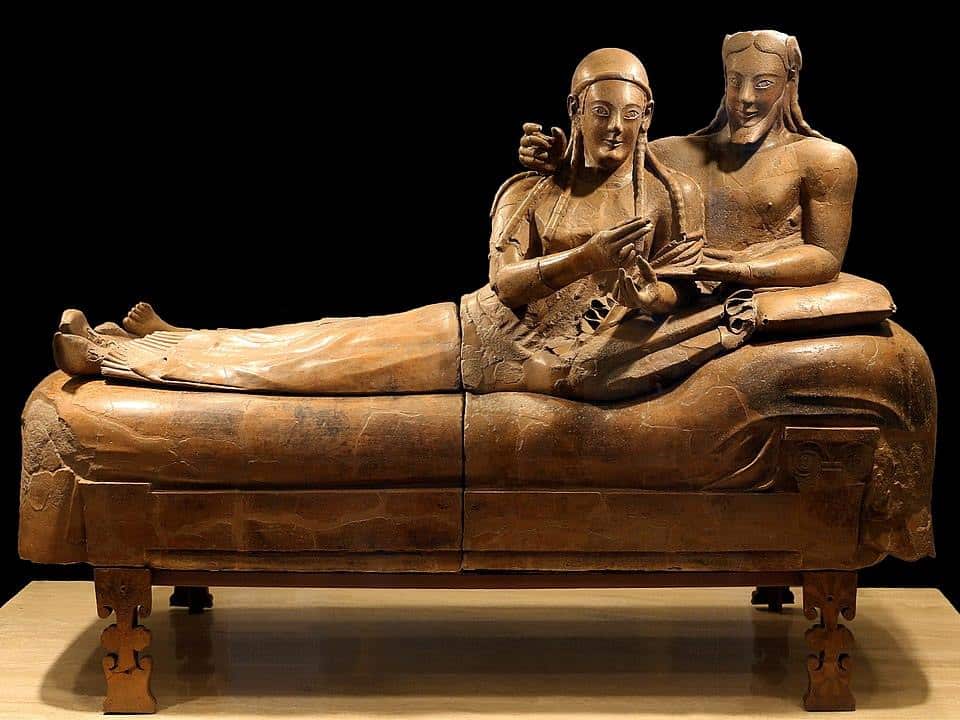
From their statues, the Etruscans generally seem to have had fairly elongated faces and thin noses. A good example of this is in the upper-left votive head in the above image. We can also see these same facial characteristics in the famous sixth-century BCE Etruscan sarcophagus from Cerveteri.
Furthermore, this sarcophagus shows the Etruscan couple as having relatively high foreheads. This is also what we see in the lower-center votive head in the above image.
Etruscan Sarcophagus of the Spouses from Caere. Credit: wikimedia commons / Sailko CC BY-SA 4.0
What did Etruscan clothing look like?
What about the clothing of the Etruscans? Do we have any information about what this looked like? First, we should realize that the ancient Greeks deeply influenced the Etruscans, so we see many similarities between Etruscan and Greek cultures.
Therefore, it is no surprise that Etruscan clothing resembled Greek clothing. For example, the Etruscans wore a simple garment called a himation, draped over the shoulders. Another example is the chiton, which was a more elaborate tunic and would often go down to the feet. Both of these garments are believed to have come from the Greeks.
The tebenna was similar to the himation, but more rounded than the himation. This seems to have become the most popular type of Etruscan clothing for men by the fifth century BCE, if not before. Scholars generally agree that this was the origin of the Roman toga.
However, Etruscan clothing was also distinctly different from that of the Greeks in some senses. For example, it was more extravagant. The Etruscans seemed to have enjoyed colorful clothing more than the Greeks and were more interested in experimenting with a larger variety of stylistic ideas.
Etruscan statue of a mother with her child from 500-450 BCE. Credit: Wikimedia Commons, CC-BY 3.0
Near Eastern influence on how the Etruscans looked like
As noted, the Etruscans appear to have come largely from western Anatolia. Therefore, it makes sense that they would show some Near Eastern influence in their choice of dress and grooming.
One example is the Etruscans’ use of highly decorative patterns, which some scholars have interpreted as an example of Western Anatolian influence.
Even the chiton, which the Etruscans may have gotten from the Greeks, appears to be Near Eastern-influenced. This is seen in the tunic’s length, shorter than the one the Greeks normally used.
Another example of influence from the Near East is that the Etruscans used soft conical hats, called pileus. This type of hat appears to have originated in Syria as early as circa 2000 BCE and continued to be used in Syria and other Near East regions throughout ancient times.
Man wearing a pileus/pilos hat depicted in the red-figure style. Third quarter of the 4th century BC. Credit: Louvre Museum / Wikimedia Commons CC BY 2.5
Yet another example involved Etruscan hairstyles. These hairstyles should clear Near Eastern influence. Therefore, the Etruscans must have looked like an extravagant cross between Greek and Near Eastern cultures.