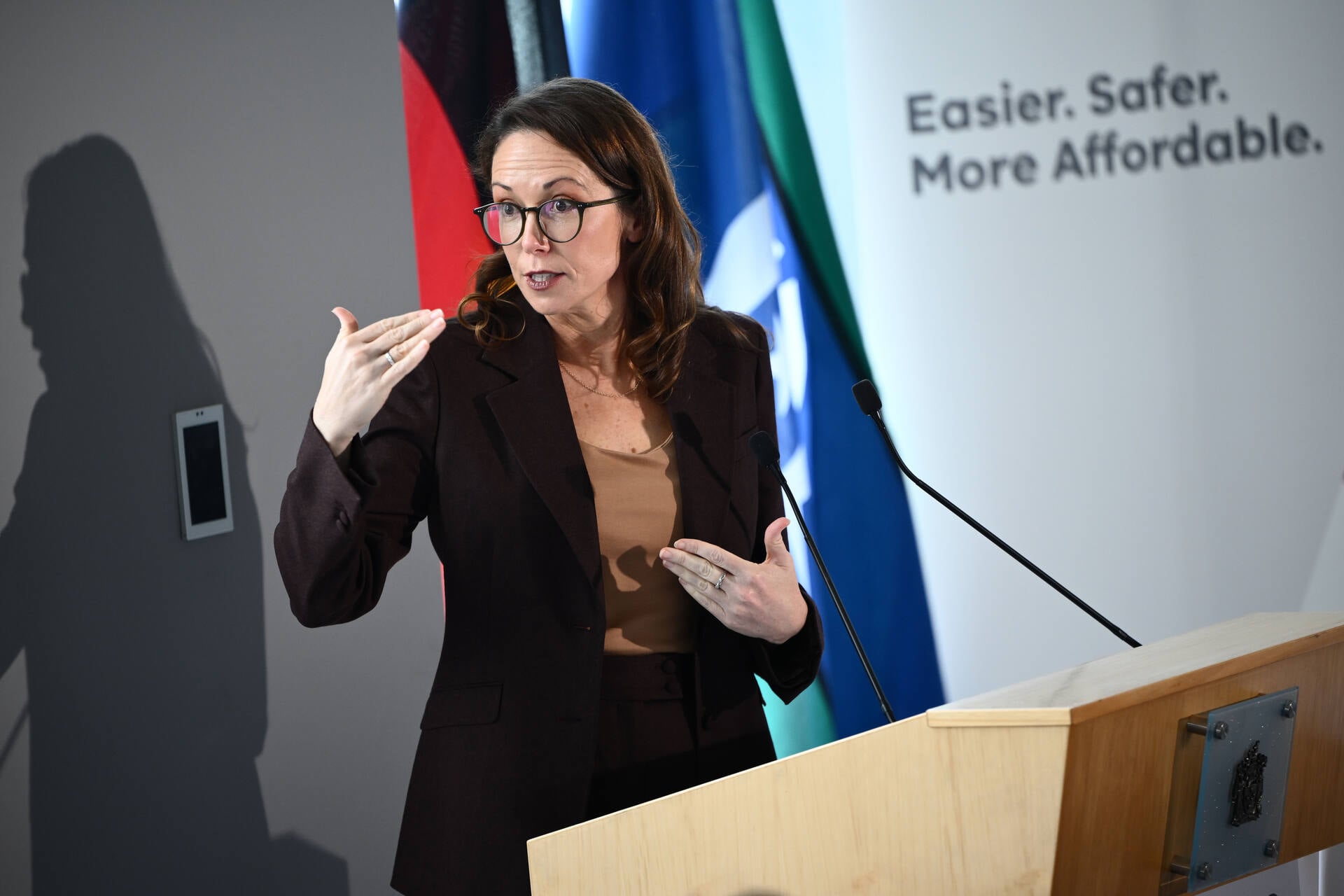
At today’s budget lock-up, Victorian Treasurer Jaclyn Symes handed down an election budget, which was branded as Easier. Safer. More Affordable, which, as one journalist said, was “based on what seems like a rosy assumption”.
The Victorian government unveiled the state’s first surplus in seven years. More than $1 billion has been spent on free public transport and car registration rebates as cost-of-living relief ahead of the November state election.
Treasurer Jaclyn Symes called it a “disciplined” budget and played down concerns about the state’s expenditure on debt repayments.
With just over 200 days until the state election, the Victorian government has again been criticised for not doing enough to rein in rising debt, instead concentrating on cost-of-living relief and service delivery measures.
Most of the new spending outlined in today’s budget had already been flagged by the Allan government in previous announcements.
State debt is now forecast to reach $199.3 billion by 2029–30, with interest repayments expected to exceed $11 billion in that year. While for many the risks to Victoria’s economy are elevated, given the uncertain times, the economy, according to the Victorian budget, is set to grow by 11.5 per cent, then 2.5 per cent, and in year three another 2.5 per cent. It seems Symes is banking on economic growth, which no one else is banking on, with fiscal sustainability based on what seem to be glowing numbers.
Symes rejected any such assertion and said the government used a sensitivity analysis and has been extremely “rigorous”.
“Also, the budget was finalised a couple of weeks ago”, Symes said.
Neos Kosmos at the Budget lockup as Victorian Treasurer Jaclyn Symes addresses the Victoria State Budget 2026/27 in Melbourne, Tuesday, May 5, 2026. Photo: AAP /Joel Carrett
At that time, the Victorian Treasurer said the price of a barrel of oil was set to fall by December to around USD 70.
“We assume that average world prices are gradually declining to 70 US dollars a barrel by December, and this is not a unique assumption in Victoria, but of course, we have allowed in a sensitivity analysis for a less rosy outcome if the war were to continue in the Middle East.”
“All the input, all the information, all the considerations are generally pretty good, and if not, they usually have better outcomes than what they have to cost because they do produce rather conservative numbers because I have to.”
Neos Kosmos asked the Treasurer how comfortable she was with relying on stamp duty on commercial and private property to keep funding such high levels of expenditure. Neos Kosmos said that these taxes seem to be increasing consistently.
Symes said that the government has downgraded its expectations for tax revenue from the property sector next year.
“We have downgraded our expectations in taxation revenue in relation to the property sector for next year. That is a result of interest rate changes and volatility driven by the uncertainty everyone expects.
Symes said that they have “anticipated a reduction of almost $900 million. We are expecting a downturn in revenue in relation to property as less of it moves when people are feeling uncertain.”
“We have downgraded our expectations in taxation revenue in relation to the property sector for next year. That is a result of interest rate changes and volatility driven by the uncertainty everyone expects.” Victorian Treasurer Jaclyn Symes
The key aspects of Victoria’s 2026/27 State Budget. Photo: AAP Image/Susie Dodds
Did anyone say election?
Key Takeaways from 2026/27 Victorian Budget
There is no doubt that there is an election looming, as Victoria’s budget, while branded as “responsible”, is laden with cash splashes. Education and crime stand out as recipients of the biggest splashes.
Net operating surplus: $1 billion in 2026/27, $2 billion in 2029/30
Net cash deficit: $7.7 billion in 2026/27, $8.1 billion in 2029/30
Net debt: $175.6 billion in 2026/27, $199.3 billion in 2029/30
No completion date given for Melbourne Airport Rail Link
Cost-of-living measures:
$278 million to halve the price of public transport until January 1, 2027
Almost $780 million allocated for registration rebates for light vehicles
$11 million for food security and grants for community organisations to deliver food relief
Health:
$95 million allocated for Werribee Mercy Hospital emergency department expansion
$45 million to open expanded acute care capacity at Angliss Hospital
$35 million to uplift Cranbourne Community Hospital, and an additional $11 million for dialysis beds
Almost $10 million to continue pill testing at fixed sites and festivals
Education:
$222 million into the Victorian Curriculum and Assessment Authority to deliver a root-and-branch review
$180 million to deliver 27 new and expanded kindergartens and childcare centres
At least $420 million to build four new schools across the city’s outer suburbs
$26 million to deliver a Rapid Child Safety review on childcare
$16 million to continue the Glasses for Kids program
More than $1 billion to fix potholes and resurface roads
$92 million for train services, including nine daily services on the Shepparton line
$76 million to take next steps for electrification of the Melton line
Justice and crime:
More than $230 million to increase capacity for corrections, including youth justice
$117.5 million to deliver a specialised, fast-tracked youth court list in the County Court
$125 million for more mental health beds at the medium-security forensic mental health hospital, Thomas Embling
$62 million to recruit 200 police reservists for police station counter duties
$9.5 million for the BlueLight Victoria program to mentor children and young people at risk
$3.2 million to stamp out anti-Semitism and hate
Almost $3 million for an independent Sentencing Act review
Disability:
More than $40 million for advocacy, support and liaison services
$20 million to support people in home and aged care with a disability outside of the NDIS
Emergency and disaster:
$422 million for recovery after the January 2026 bushfires and floods
$147 million for specialised aerial firefighting fleet
$100 million for new CFA trucks and pumpers
More than $25 million to build new CFA stations across regional Victoria
Housing:
$16 million to protect consumers and raise building industry standards
Almost $100 million to deliver housing reform in the building industry
Energy:
$124.5 million to progress activities for a Victorian renewable energy terminal at the Port of Hastings
Multicultural:
$49.5 million which is a drop from the revised revised $67.2 million for 2024/25 which included many one-offs post Bondi Massacre and anti-racism
INDIGENOUS AFFAIRS SPENDING:
Almost $40 million for specific First Nations-led outreach, monitoring and health-led response to public intoxication
$13.2 million for pilot program The Nest, an Aboriginal-designed and led service for children experiencing emotional and behavioural challenges
$860,000 for cadetships and scholarships for Aboriginal students
Copies of the Victoria State Budget 2026/27 lockup in Melbourne, Tuesday, May 5, 2026. Photo: AAP /Joel Carrett