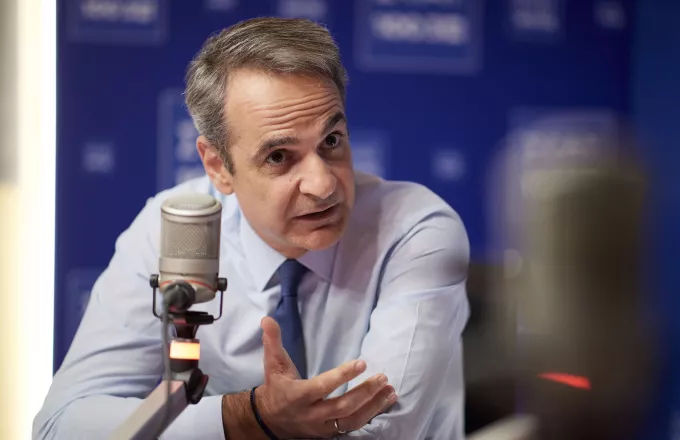
The so-called legitimacy crisis leads to a “collapse” in the ratings of ruling New Democracy. Citizens disapprove the conservative government and its policies including those in geopolitics.
These are the results of a public pinion poll conducted between April 21-27, 2026, by Metron Analysis on behalf of MEGA TV.
Despite the government’s effort to convince that it maintains control of political developments, the Metron Analysis poll, which was presented on the evening bulletin of MEGA TV on April 29, shows that New Democracy is already paying a high electoral price for both the state of the economy and the institutional crisis to which the successive revelations of scandals with leading “blue” MPs and ministers have led.
At the same time, the political scene remains in a transitional state, as this survey adheres to the rule of not including in the measurement the parties that are expected to be announced in the near future. Which means that at the moment the disapproval of the government is being measured, but not which formation will ultimately be the rival to New Democracy.
For citizens, things are getting worse
The poll shows that 66% of citizens believe that things in the country are getting worse, with only 28% claiming that they are going in a positive direction.
Correspondingly, only 16% believe that their personal financial situation has improved, while 49% state that they are in a worse financial situation, belying the government rhetoric that citizens see their financial situation improving.
Correspondingly, in terms of the cause of citizens’ dissatisfaction and disappointment, economic problems and the cost of living crisis remain at the top, without this meaning that citizens underestimate the institutional crisis and corruption.
As a result, the government receives a particularly negative rating in all areas of government work, with the exception of diplomatic initiatives where the assessment is relatively more positive.
5 most significant problems in the country
- High prices 46%
- Economy 36%
- Institutions crisis 20%
- Corruption 17%
- Insecurity/Government Insufficiency 10%
Against this background, negative opinions about the government and the prime minister are particularly high: 71% negative opinions about the government and 69% negative opinions about the prime minister.
At the same time there is a slight improvement in the rating of PASOK. The poll shows positive opinion of 14% for the main opposition party and 16% for Nikos Androulakis.
Citizens’ opinion on Greece’s participation in the European Public Prosecutor’s Office (EEPO) that revealed the OPEKEPE EU agricultural subsidies scanda is particularly positive with a rate of 78 %
While New Democracy officials, led by the Minister of Health, Mr. Adonis Georgiadis, have harshly criticized the European Public Prosecutor’s Office, the vast majority of citizens have a positive opinion on the country’s participation in it. It is particularly interesting that this positive opinion is recorded across a wide age and political spectrum.
Geopolitics
Positive opinions on France with 68% approval ratings, and China with 55%, disapproval of the US with 26% and Israel’s war against Iran.
Regarding geopolitical issues, citizens seem to insist on the “Greece – France – alliance”, with France being the most popular foreign power in the country. The only other country that has more positive than negative opinions is China.
On the contrary, the opinion on the US is negative, while the vast majority considers the US and Israel’s attack on Iran unjustified.
At the same time, most citizens believe that the US and the EU will not go their separate ways in the end, but a significant percentage believes that a rupture will occur in the end
In the popularity of state institution and political party leaders winner is “Nobody” with 30%
Voting intention shows significant decline of ND
ND 21.5% SYRIZA 4% PASOK 11.3% KKE 6.3% Greek Solution 7.7% Freedom Course 7.8%, MeRA25 2.3% Voice of Reason 2.6%
Threshold for parties to enter the Parliament is 3%.
What is highly interesting is that the number of those who would vote other parties 8.1%, Vote blank/invalid 3.2%, Won’t vote 8.7%, Undecided 10.7% and Don’t know/Won’t answer 4.2% sums up to 34.9%.
The poll reflects a significant decline in the polls of New Democracy. In voting intention, it falls to 21.5%, i.e. 2.3% less compared to the previous poll in March. PASOK, Greek Solution and the “undecided vote” are strengthening their position.
In this context, in terms of vote estimates, Metron Analysis estimates that ND will not exceed 28.6%, that is, it will remain well below not only any possibility of self-reliance but also the “psychological” threshold of 30%.
Strong current in favor of political change, early elections, and coalition governments
Indicative of the willingness of citizens to see things change politically is the fact that a significant percentage of citizens want early elections.
Correspondingly, especially among Center, Center-Left and Left voters, the current in favor of coalition governments is particularly strong, which probably also reflects the desire to overcome the current fragmentation of the broader democratic progressive space.
For this reason, a particularly strong demand for political change is reflected, very intense in all political self-definitions with the exception of the Center-Right.
The popular strata feel “outside the walls”
As for the question of whether they feel inside or outside the “castle”, the poll shows that the majority of the working class, farmers and small & medium enterprises feel outside the walls par excellence.
A society that seeks political change
The Metron Analysis poll for MEGA makes it clear that the government is currently facing a real crisis of legitimacy. The combination of economic problems and the barrage of scandals is alienating part of the New Democracy’s electoral base and in fact canceling the scenarios that would have liked New Democracy to be at the center of post-election developments. Which means that the era of Kyriakos Mitsotakis is coming to an end.
Of course, at the same time, in the face of ambiguity, it is clear that the current opposition formations cannot constitute a formidable opponent. On the contrary, both Alexis Tsipras and his emerging party formation, as well as Maria Karystianou – although with a distance between popularity and electoral influence – appear to have considerably stronger electoral dynamics.
source: MEGA TV via in.gr (and more charts in Greek)