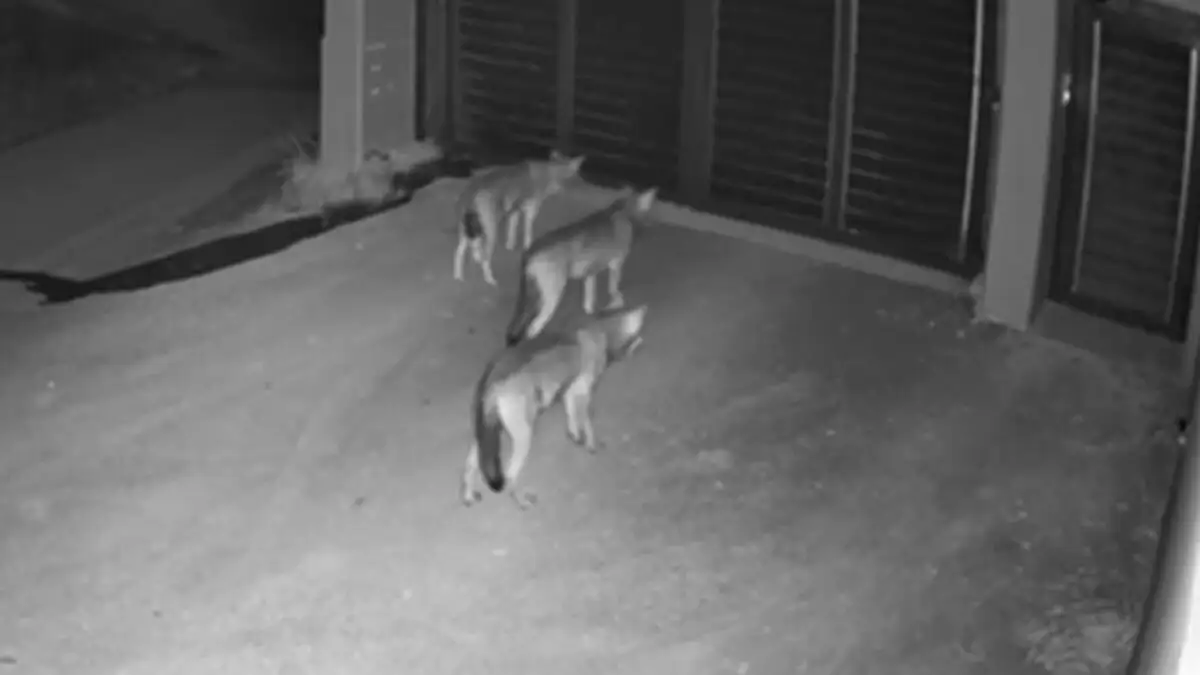
A pack of wolves was seen outside the entrance of a residential property in Panorama suburb of Thessaloniki, northern Greece, raising safety concerns and prompting intervention by environmental authorities and local forest officials.
The pack consisting of four to five wolves appeared outside a home at night, stayed for a while as the house dogs barked at them and quietly left the area.
According to information, the same animals visited the specific spot twice on the same day, once in the morning and once in the evening.
The pack of wolves was capture by the security camera oppose the house they were spotted.
Video
The appearance of wolves in the specific site which is called for a good reason “Lykorema” – or Wolves Stream – is not rare.
Wolves were spotted around also a month ago.
According to state broadcaster ERT, on Thursday, January 22, officials from the local forestry department were in the area, in collaboration with the environmental organization “Kallisto”, in order to locate the wolves and take the necessary actions to remove them.
It is recalled that a few days ago, a camera had recorded a wolf in Chaidari, western Athens, with the municipality issuing relevant instructions to citizens for their protection.
Wolves, wild boars and bears in the cities – What’s going on?
In recent years, incidents of wild animals appearing in cities and settlements have been increasing: wolves in Halkidiki, foxes in Egaleo, bears in Zagori, and even herds of them in Hippocrates’ Politiea alsoin western Athens. What exactly is happening? Is this a natural “invasion” or a belated reminder that we are not alone on this planet?
“It goes without saying that we do not live alone on this planet,” the Secretary General of Forests of the Ministry of Environment, Stathis Stathopoulos, told daily tanea.gr
“The return of wildlife to areas where it had disappeared for decades is the result of many factors – and, in a sense, it is also an optimistic sign that ecosystems are regenerating.”
Behind the “visits” of wildlife to the cities, there are specific causes:
First, the desolation of the countryside. Villages are abandoned, agricultural activities are reduced, herds are dwindling, and thus the natural feeding grounds of wildlife are limited.
Second, the regeneration of ecosystems. After decades of intensive exploitation, many forests are finding their pace again – and with them their old inhabitants are returning.
Third, the three-year ban on hunting during the pandemic. “It was a good measure to protect public health,” the Secretary-General admits, “but it led to an explosive increase in some populations, such as the wild boar.”
And, fourth, climate instability. The successive dry, mild winters of recent years have lengthened the breeding season for animals. “When there are no severe weather conditions, species move more and reproduce more often,” he explained.