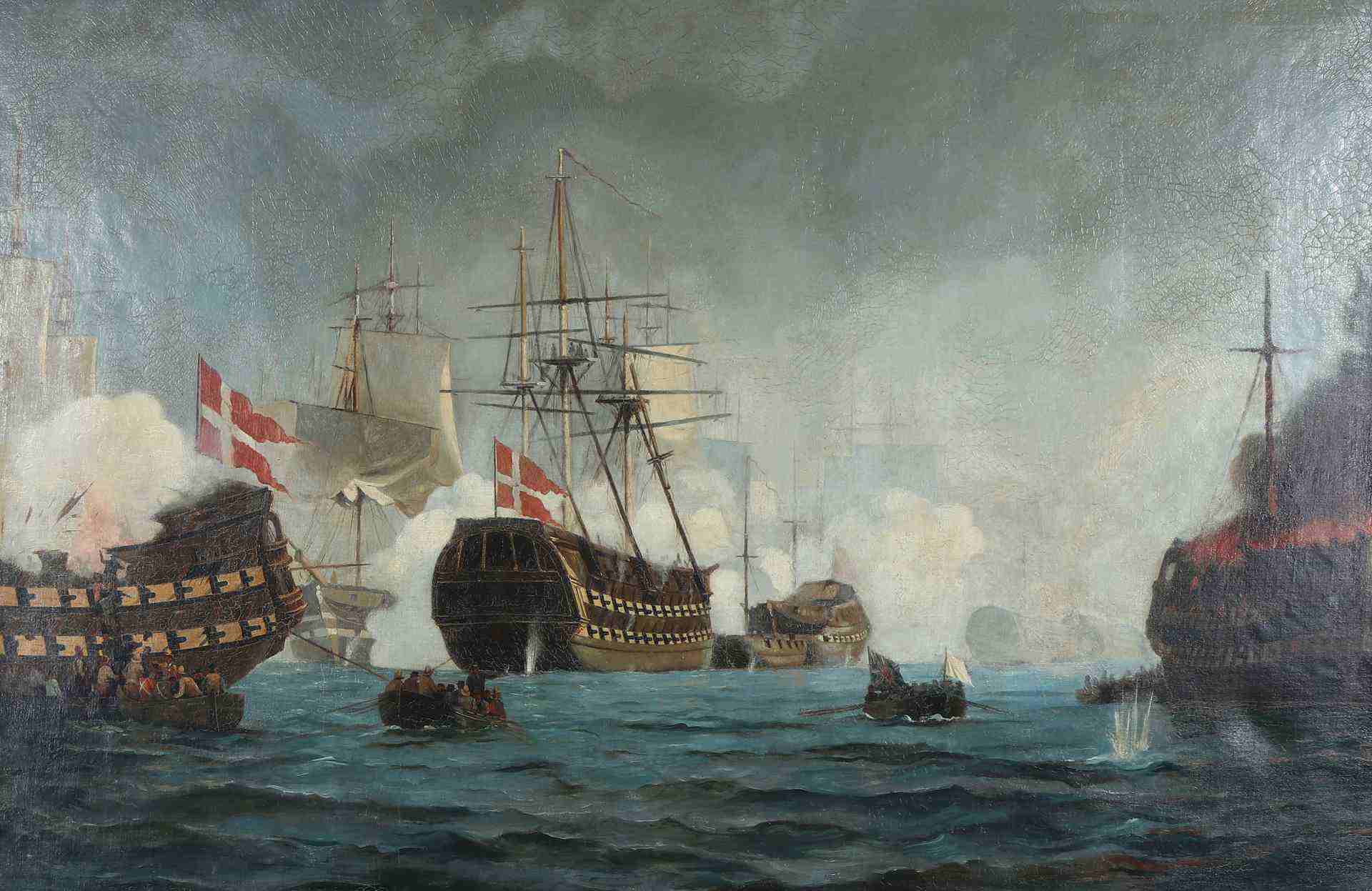
The Battle of Copenhagen by Christian Mølsted. Credit: Christian Mølsted / Wikimedia Commons / Public Domain
Maritime archaeologists in Denmark say they have identified the wreck of the warship Dannebroge, a command vessel and flagship in the Battle of Copenhagen that exploded and sank on April 2, 1801.
The find gives researchers the first direct archaeological evidence from the battle of Copenhagen, a major clash between the Danish-Norwegian fleet and the British Royal Navy led by Horatio Nelson.
The wreck was found in Copenhagen Harbor by maritime archaeologists from the Danish Viking Ship Museum, which is responsible for seabed archaeology in eastern Denmark. The excavation is part of the required archaeological work linked to the construction of the artificial island of Lynetteholm.
Researchers said the evidence points overwhelmingly to Dannebroge. Otto Uldum, a maritime archaeologist at the museum who leads the excavation, said the size of the ship’s timbers matches surviving drawings of the vessel, while tree-ring dating matches its 1772 construction date.
He said the identification is as close to certain as possible. Archaeologists also found cannonballs, a bar shot, and two cannons near the wreck.
Lost flagship from the Battle of Copenhagen discovered
The ship lay at the center of the Danish defense and served as a key command vessel during the battle. Within hours of the first shots, it caught fire, exploded, and sank in the King’s Deep.
3D model of the wreck of Dannebroge. Credit: The Viking Ship Museum in Roskilde
Uldum said the excavation is breaking new ground because no archaeological investigation directly tied to the Battle of Copenhagen has been carried out before. He said the work gives researchers a physical source base for an event long known from written accounts, paintings, and national history.
The battle took place on the Copenhagen Roads, a shallow anchorage outside the city, where Danish sailors faced a larger British force with far more guns. For more than four hours, the fighting turned the area into smoke, fire, and flying shrapnel.
Records cited by researchers show that 53 people died aboard Dannebroge, three later died of wounds at the naval hospital Søkvæsthuset, 48 survived with injuries, and 19 crew members were listed as missing.
Human remains and sailors’ items recovered
Archaeologists said the wreck is also offering a rare view of the ordinary sailors who fought there. Uldum said researchers have recovered shoes, clothing fragments, clay pipes, uniform insignia, and weapons, items often missing from museum collections that usually preserve officers’ belongings and ceremonial objects.
Researchers also found a clearly human lower jaw, along with other bones, including ribs, that may also be human. Uldum said analysis is still underway, but all material is being recovered from the site.