
From omogenia (oμογένεια) to homosexual: When algorithms misread Greek
Something happened on the way from Greek to English this week — omo (όμο), homo, genus and sexual became a little muddled in social media automatic translations.
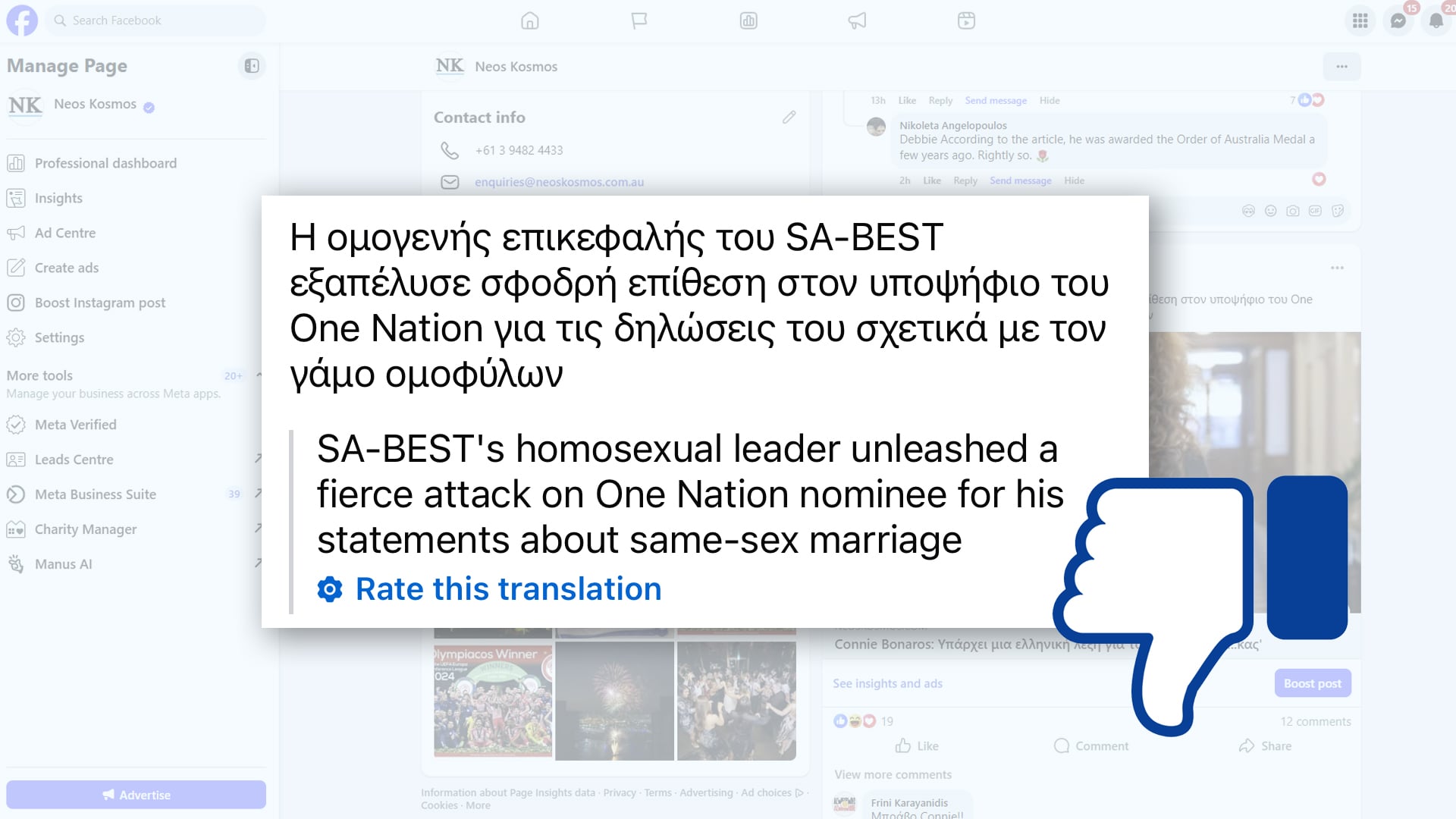
Yesterday, on our Neos Kosmos social media post, the Greek Australian politician Connie Bonaros – the leader of SA Best -was described as “homosexual”. This blunder is caused by Facebook’s automatic translation of a Greek-language report. Neos Kosmos had reported on Connie Bonaros’ statement here Υπάρχει μια ελληνική λέξη για τον Bernardi: ‘μ….κας’ and here in English.
So, the bad English translation of the Greek subhead on Facebook became, “SA-BEST’s homosexual leader unleashed a fierce attack on One Nation nominee for his statement about same sex marriage”.
The original post in Greek (left) and the aotomatically translated into English version on the right. Image: Neos Kosmos
It seems it’s all Greek to Facebook, yet the explanation is simple. Omo (όμο), which means “the same” in Greek was translated to “homo”. In Greek we commonly refer to the Greek diaspora community outside Greece as the omogenia (ομογένεια), meaning “of the same genus” or same birth – i.e. we’re all Hellenes.
When a social media post written in Greek is automatically translated by a platform, the omogenia (ομογένεια) is often rendered as “homosexual”, or “of the same sex”. In that algorithmic confusion, genus — or gena (γένος) in Greek — becomes “sex” in the muddled logic of social media translation programs.
It is the sort of translation challenge that can have unexpected consequences regardless of modern technology. Michelangelo’s famous sculpture of Moses, where the tablets-bearing prophet appears with horns instead of rays of light coming from his head, is a blunder of language translation. Michelangelo read a Latin — translated from Greek, itself translated from Aramaic— where “rays” had been rendered as “horns”.
In any case, Neos Kosmos would never highlight anyone’s gender or sexuality. Whether someone is same-sex attracted — or, literally, omophilophilos (ομοφιλοφίλος), meaning philos (φίλος), a friend of omo (όμο), “the same” — is not something we emphasise.


