
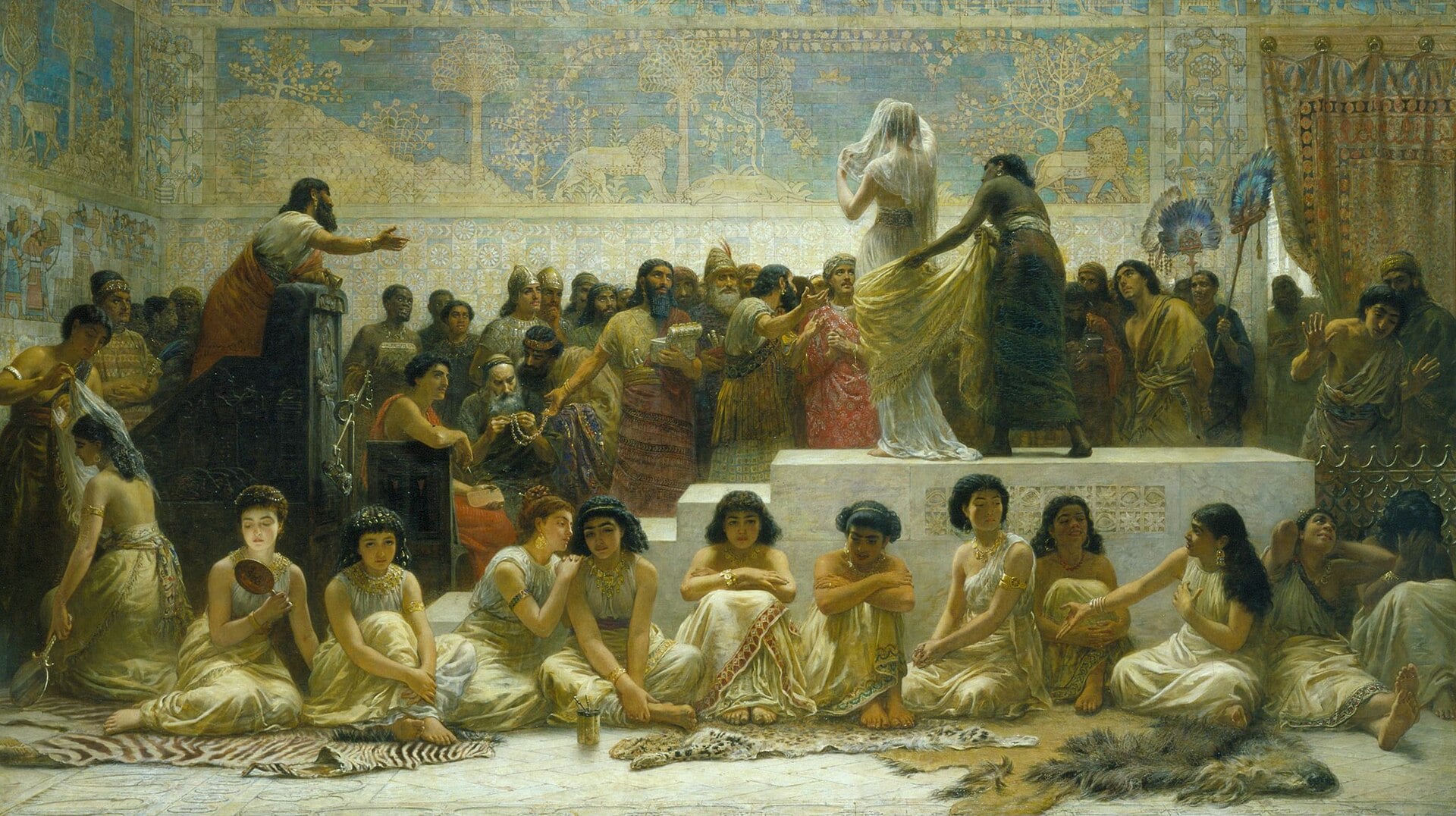
Greek historian Herodotus wrote about young women auctioned as brides in 5th century BC Babylon. Inspired by the story, English artist Edwin Long (1829-1891) painted “The Babylonian Marriage Market” Public Domain
The Babylonian bridal auction, described by Greek historian Herodotus in the 5th century BC, is considered one of the earliest—if not the earliest—recorded auction practices in history.
Auctions were not unknown in antiquity. Ancient peoples regularly sold livestock and goods to the highest bidders, and auctions were also common in the slave trade. However, scholars such as Ralph Cassady (1967), as well as Paul Milgrom and Robert Weber (1982), who wrote extensively on auctions and bidding, note that Herodotus’ account of the 500 BC Babylonian bridal auction stands out as one of the earliest recorded instances of an auction.
At that time, Babylon was under Persian control, an affluent city following Cyrus the Great’s conquest in 539 BC. Later historians have questioned whether Herodotus actually visited Babylon or relied on secondhand accounts for his descriptions.
In Histories 1.196, the Ancient Greek historian recounts what he described as an old Babylonian marital custom, considered superior to the ritual prostitution prevalent among Babylonians of the 5th century BC. Each year, the most beautiful women in each village were auctioned to the highest bidder, with the proceeds used to provide dowries for poorer, less-favored brides.
An auction of brides in Babylonia, according to Herodotus
Herodotus described the Babylonian bridal auctions, in which young women were gathered and an auctioneer would present each one individually for sale. According to the English historian George Rawlinson’s 1885 translation, the Ancient Greek historian wrote about the these marriage markets of Babylonia, then under the control of the Persian Achaemenid Empire, in his Histories (Histories 1.196):
“Once a year in every village all the maidens, as they came to marriageable age, were collected and brought together in one place, with a crowd of men standing around. Then a crier would display and offer them for sale one by one, first the fairest of all; and when she had fetched a great price, he put up the next comeliest, selling all the maidens as lawful wives.
Rich men of Assyria who desired to marry would outbid each other for the fairest; the common people, who desired to marry and cared nothing for beauty, could take the less attractive damsels along with the money; for when the crier had sold all the comeliest, he would put up the least beautiful or crippled, offering her to whoever would accept the lowest sum. The money from the sale of the comely damsels was then used to provide the dowries for the less favored and the disabled.
But a man could not give his daughter in marriage to just anyone, nor could the person bringing the girl take her away without guaranteeing he would make her his wife. If they could not agree, the law required that the money be returned. Men could also come from other villages to buy if they wished.”
Marriage in the Code of Hammurabi
While the auction of unmarried women may seem inhumane, roughly thirteen centuries before Herodotus, Babylon’s Code of Hammurabi (c. 1772 BC) granted women rights and protections that were remarkable for the time. In contrast, women in Ancient Greece did not enjoy comparable legal protections.
Regarding marriage, the Code of Hammurabi established that marriage among Babylonians was a legal contract designed to protect a woman’s right to her dowry (shiriktu). A marriage was not considered valid without a written contract. Dowries held significant importance in Babylonian society. Although men held primary authority, women were entitled to retain their dowry in the event of divorce—if they were not at fault—or widowhood. The dowry was inherited by their children rather than their husbands.
The dowry, provided by the father, remained the woman’s property throughout the marriage and was legally protected. If she passed away, her dowry was inherited by her children; if she died childless, it returned to her father’s household. If a marriage ended due to neglect or abuse by the husband and the wife had borne children, he was obligated to return her dowry and provide a portion of his property for their upbringing. If the wife was childless, the husband had to return both the dowry and the bride-price as a gift to her father.
Conversely, if a marriage ended because the wife neglected her household, failed in her maternal duties, or acted against her husband, she could forfeit her dowry upon divorce. If the husband died, the widow retained her dowry and could continue to live in his home. In cases of illness, the husband was not permitted to divorce his wife; he was required to care for her in the household. The law also allowed a married woman to manage her own business if she owned one. Priestesses could enjoy additional property rights and special privileges.


