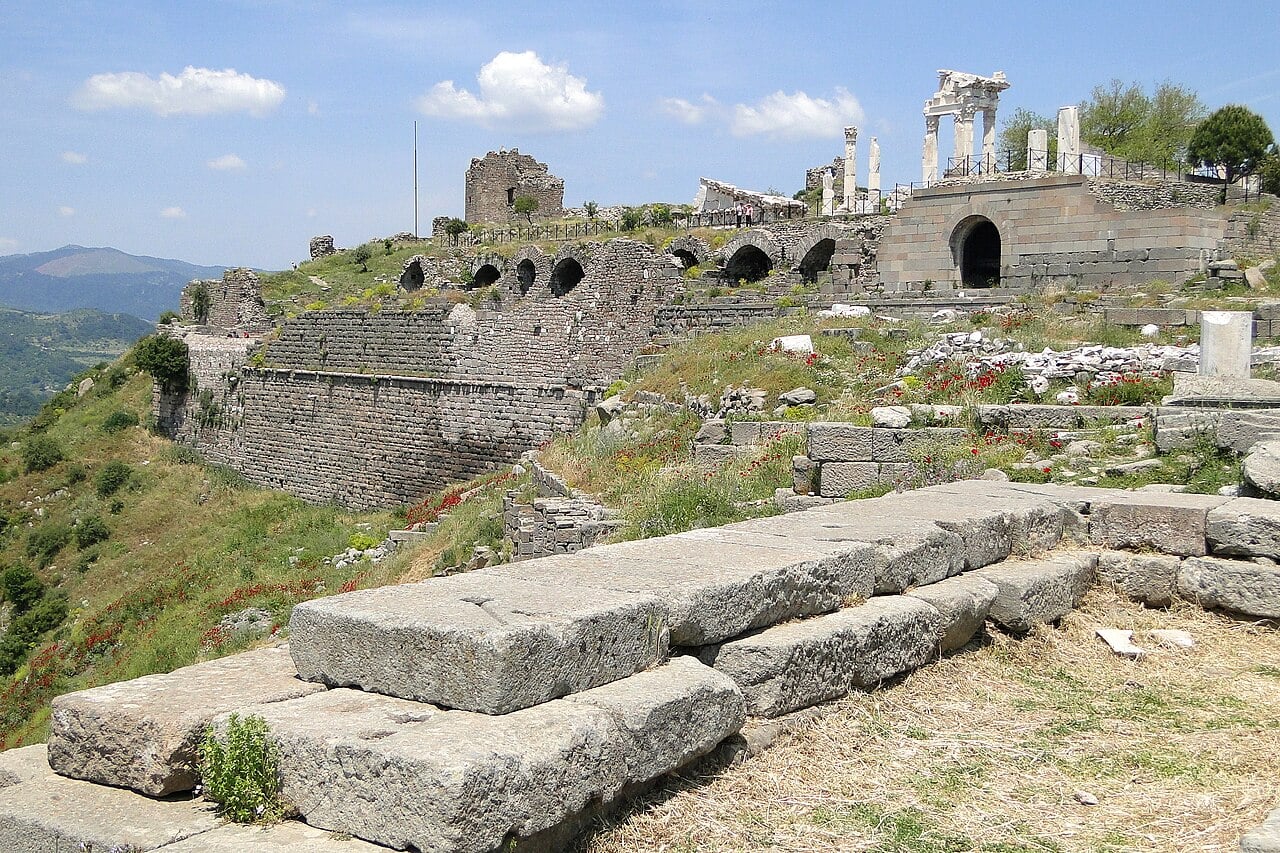
Ruins of Pergamon. Credit: Adam Jones / Wikimedia Commons / CC BY-SA 2.0
Archaeologists and scientists say a small Roman glass flask found at an ancient medical center has confirmed a medical use of feces long debated by historians. Treatments described in Greco-Roman texts were not just theoretical. They were actually prepared and used.
The object was recovered from Pergamon, in what is now Bergama, Turkey. In antiquity, Pergamon was one of the most important centers of medicine in the Mediterranean world. It was home to physicians, healing sanctuaries, and medical schools that shaped Roman healthcare.
The flask, a candelabrum-shaped glass unguentarium, is now housed at the Bergama Archaeological Museum under inventory number 4027. For decades, similar vessels were classified as containers for perfumes, oils, or cosmetics. New scientific analysis has changed that view.
A vessel from an ancient medical center
Pergamon’s reputation in antiquity rested on its role as a hub of medical learning. Physicians trained there treated patients across the Roman Empire. Objects recovered from the site often reflect this clinical environment.
The unguentarium’s form and material made it suitable for storing liquid or semi-liquid substances. Researchers say it could easily have been used to transport prepared medicines, not just scented products.
Chemical evidence preserved inside the flask
Researchers analyzed brown residue preserved on the neck and base of the vessel. They carefully collected about 14.6 grams of material without damaging the glass.
A candelabrum-shaped Roman glass unguentarium from Pergamon, cataloged as inventory no. 4027 at the Bergama Archaeological Museum, contained chemical evidence of a compound medicine described in ancient medical texts. pic.twitter.com/nDiBAswV2w
— Tom Marvolo Riddle (@tom_riddle2025) January 23, 2026
Laboratory testing identified two compounds, coprostanol and 24-ethylcoprostanol. Scientists widely recognize both as biomarkers of fecal matter. Their ratio points to an omnivorous source and matches established chemical profiles of human feces.
The analysis also detected carvacrol, a strong aromatic compound found in thyme and oregano. These plants grow naturally across Anatolia and appear frequently in ancient medical recipes. Researchers say this combination rules out accidental contamination. The mixture was placed in the flask deliberately.
Ancient medical texts support the findings
To interpret the chemical results, researchers examined classical medical writings. They focused on works by Dioscorides, Pliny the Elder, and especially Galen of Pergamon, who practiced during the second century A.D.
These texts describe the use of animal and human excrement to treat infections, inflammation, skin conditions, and reproductive disorders. They also show that physicians understood patient discomfort.
Medical manuals repeatedly recommend mixing fecal matter with aromatic plants, wine, or vinegar to reduce strong smells and tastes. The chemical profile from the Pergamon flask closely matches these instructions.
Rethinking cosmetics and medicine in antiquity
Researchers say the vessel did not hold perfume or waste alone. It contained a compound medicine. Human fecal matter, believed to carry therapeutic value, was intentionally blended with aromatic plants to make the remedy acceptable.
The findings challenge long-held assumptions about unguentaria. These objects may have served broader medical purposes than previously thought. Similar vessels in museum collections may now need reexamination, researchers say.
An unexpected echo in modern medicine
The study also notes a cautious parallel with modern fecal microbiota transplantation. Today, doctors use the procedure to treat certain intestinal diseases by restoring microbial balance.
Ancient physicians did not know about microbes. Still, both systems recognized therapeutic value in substances from the human body. Researchers stress that this reflects observation, not scientific continuity.
Turning ancient theory into physical proof
The conclusions are clear. The study confirms, at the molecular level, a medical practice once known only from texts. It also reshapes the understanding of everyday medical objects in the Roman world.
According to the researchers, the Pergamon flask turns long-debated descriptions into material evidence. Ancient physicians did what their books said they did. With modern science, the history of medicine has gained a tangible chapter.