Kyle Runion has spent hundreds of hours in Georgia’s salt marshes, battling the tall blades of Spartina alterniflora grass that sticks up past rain boots and into pants.
Unbothered by the spikes, Runion kneels into the mud and takes out a hollow tube, then pushes it a foot into the ground. Out comes mud full of tangled roots and rhizomes — black, white and purple.
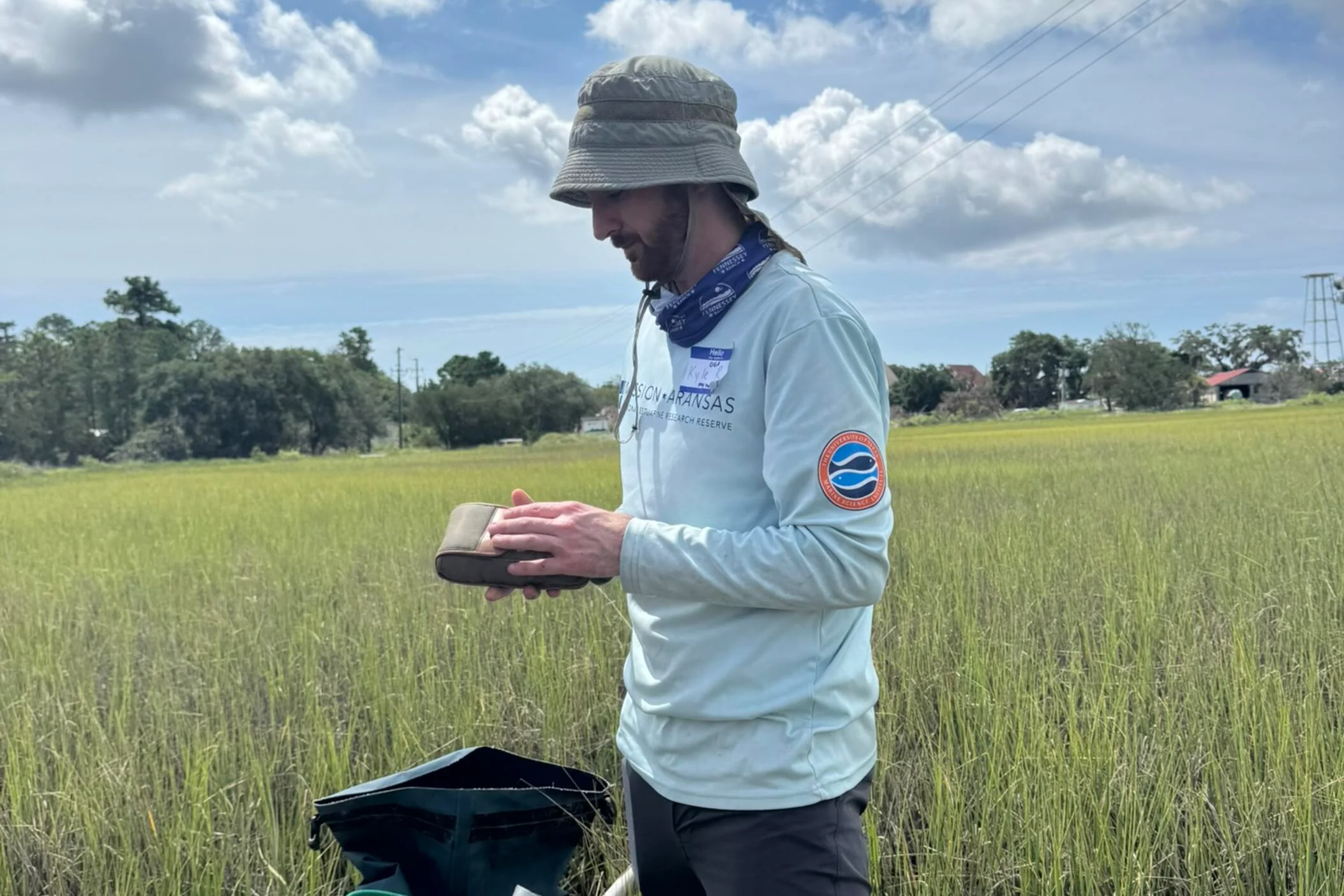
Merryl Alber (left), director of the University of Georgia Marine Institute on Sapelo Island, and researcher Kyle Runion (right) record leaf height, chlorophyll and other measurements in a marsh on the south end of Sapelo Island in Coastal Georgia. Credit: Jillian Magtoto/GPB News
Runion looks like a doctor performing a checkup on a healthy patient. The grass is long and lush. In fact, the state’s iconic marsh grass has increased in cover over the past decade.
But by now, Runion knows there’s more than meets the eye.
“It’s really tempting to take a look at the marsh and to make a sort of visual assessment, but the data can tell you totally different things,” Runion said.
Over the past few years, Runion has punched over a thousand holes like this one along the Georgia coast, expanding on decade-long work by the University of Georgia. Last year, he published his findings: that about three-fourths of the Spartina was losing its belowground biomass.
Now, he’s back at Sapelo Island to figure out why that is. Or rather, test a theory.
The underground city
Most of Georgia’s marsh exists in the mud.
Belowground biomass makes up four-fifths of the entire plant, Runion’s study estimates.
The roots hold the plant up, preventing the grass from being waterlogged by flooding and high tides. That web of thin, thready fibers are key to the grass’ defense against rising seas.
“It’s really critical for building up organic matter and literally raising the marsh elevation so it can just keep pace with sea level rise,” Runion said.
But if inundated too frequently —that is, if sea water floods the area — the grass can lose its roots. And when it loses its roots, it sinks further into the mud. These are the beginnings of a cycle known as marsh drowning.
Soggy, squishy and sulfurous
Runion found that a quarter of his study area is vulnerable to marsh drowning.
The marsh on the south end of Sapelo Island may already be feeling the pressure, where UGA estimates that sea level could rise by up to 6 feet here by the end of the century.
It feels evident in every step we take as our boots glug and gurgle in the mud.
“You can feel it when you’re walking — all of a sudden it starts to feel really soft and you sink,” Runion said. “These areas are flooding more and more frequently and are producing less and less root material.”
It can also be smelled at every breath. Waves of a sulfur odor hit as Runion unearths soil core after soil core.
The eggy smell is hydrogen sulfide, released by microbes that multiply in soggy environments. That chemical inhibits Spartinagrowth—producing yet another cycle that digs the marsh into a deeper hole.
Credit: Kyle Runion et al. 2025 via GPB News
Where the grass is greener?
Just a trudge away lies an entirely different story.
Here, the ground is firmer, and smells less like sulfur. It sits on a slightly higher elevation, and therefore floods less frequently.
Here, Runion takes another soil core. And rinsing, drying, and weighing all the roots and rhizomes (for his published study — hours amounting to six weeks), he begins to slowly confirm his theory.
His data confirmed that Spartina growing on higher elevations indeed carried more belowground biomass.
“These data are a nice validation of that effort,” wrote Runion in an email.
Runion will also revisit other sites in Georgia to investigate more relationships between plant productivity, microbial communities, and soil conditions. His efforts have inspired researchers in other states to begin documenting their own belowground biomass, too.
Runion doesn’t know exactly what can be done to save Georgia’s marshes. But now, he said, at least we now know where they need the most help.
This story comes to The Current GA through a reporting partnership with GPB News, a non-profit newsroom covering the state of Georgia.