by Caitlin Philippo, The Current
January 23, 2026
While it is true that with each new literary season there seems to appear another book about the role of the resistance in World War II, only a cynic would lump Christopher C. Gorman’s Matisse At War: Art and Resistance in Nazi Occupied France with those efforts. At times a spy thriller, and others a nuanced portrait of the immense toll of creating art in a time of war, Gorman’s intimate portrait honors the artist during one of the most distinctive occupations in European history.
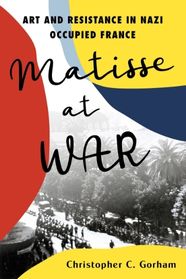
Matisse at War: Art and Resistance in Nazi Occupied France by Christopher C. Gorham
- Finalist for The Marfield Prize, National Award for Arts Writing, 2025
$29; Hardcover, 320 pages; Citadel Press (Kensington Publishing Corp.) ISBN: 9780806544168
Christopher Gorham
3:40 p.m. – 4:35 p.m., Saturday, Feb. 7, 2026, at Trinity United Methodist Church, 225 W. President St.
For all his fame, both during his lifetime and well into ours, knowledge of Matisse’s personal life is minimal compared to that of some of the other figures of Paris’ Lost Generation, an interwoven circle of artists that would eventually, as their moniker suggests, define an era. Pablo Picasso’s and Ernest Hemingway’s exploits during World War II have grown to near colossal heights in their retellings- but as Gorman shows us in Matisse at War, Matisse’s wartime experience is fascinating, too. The discerning reader will see it as a distinctly elegant choice to illustrate not only the burden of creating art in a period of great anguish, but also that of a family man whose social and cultural ties led him to remain steadfastly in France throughout the occupation.
While the high tension of any book set against the horrors of World War II might outplay the ability of an author to keep a smaller subject at the forefront, Gorman never loses sight of what this book is truly about., Gorman’s analytical approach to biography addresses his subject through the voices of those who knew him instead of imparting his own impressions. In an era where biographies often lean towards assessment, Gorman’s academic mindset offers a refreshing approach, letting ample research and the words of the men and women he writes about speak for themselves.
At the time of the occupation, Matisse holed up in Nice and then Vence, areas both defined by belonging to the Vichy puppet state that Italy invaded before the German takeover. Despite the opportunity to leave France, Matisse remained ardently loyal to his country, writing his son Pierre, then an art dealer in New York, that “it seemed to me as if I would be deserting. If everyone who has any value leaves France, what remains of France?” Gorman’s choice to make ample use of Matisse’s correspondence to other artists, such as Picasso and Pierre Bonnard, which often echo this patriotic sentiment, proves to be a sterling example of just how powerful archival material can be when used to full effect. Matisse’s choice seems all the more daring as Gorman ensnares us in evocative descriptions of France under German rule.
Matisse shared his patriotic devotion with his children, and the more harrowing sections of the book detail the profound involvement of his daughter, Marguerite, and his son, Jean, in the French Resistance, with all the taught energy of a seasoned spy novelist. Both children were captured and imprisoned by the Nazis, and Gorman expertly aligns Matisse’s experience to connect to the universal sensations of familial grief being experienced throughout the country. Gorman nimbly presents a portrait of a man unwilling to succumb to the immense horrors of his life, and as the reader might already know, would channel his unflinching realities into the creation of a new style that would define and revolutionize his contribution to art history.
While Matisse At War: Art and Resistance in Nazi Occupied France might run over some familiar historical terrain, it does so with a precision that will undoubtedly bring new insight to even the most experienced WWII aficionado or art history lover. Its strength lies in its wielding of fact over embellishment, and it is a prime example of just what happens when fact is indeed better than fiction.
This <a target=”_blank” href=”https://thecurrentga.org/2026/01/23/christopher-gorman-examines-wwii-art-resistance-in-matisse-at-war/”>article</a> first appeared on <a target=”_blank” href=”https://thecurrentga.org”>The Current</a> and is republished here under a <a target=”_blank” href=”https://creativecommons.org/licenses/by-nd/4.0/”>Creative Commons Attribution-NoDerivatives 4.0 International License</a>.<img src=”https://i0.wp.com/thecurrentga.org/wp-content/uploads/2020/07/cropped-TheCurrent_site-icon.png?resize=150%2C150&ssl=1″ style=”width:1em;height:1em;margin-left:10px;”>
<img id=”republication-tracker-tool-source” src=”https://thecurrentga.org/?republication-pixel=true&post=96768&ga4=G-L05EDNCRHK” style=”width:1px;height:1px;”><script> PARSELY = { autotrack: false, onload: function() { PARSELY.beacon.trackPageView({ url: “https://thecurrentga.org/2026/01/23/christopher-gorman-examines-wwii-art-resistance-in-matisse-at-war/”, urlref: window.location.href }); } } </script> <script id=”parsely-cfg” src=”//cdn.parsely.com/keys/thecurrentga.org/p.js”></script>