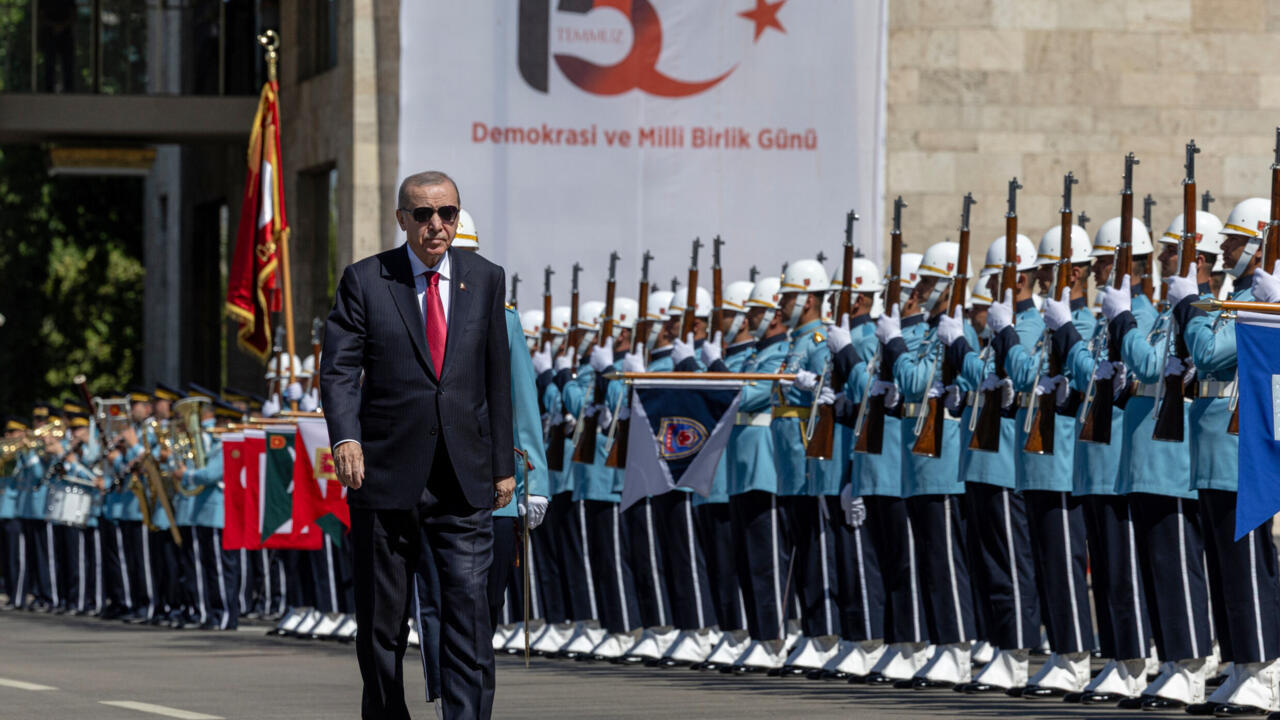
On 16 July, Turkey marked a decade since the failed coup that shook the nation. Its defeat is widely viewed as the final curtain on military meddling in politics and as the moment when President Erdogan cemented his grip on power, yet the aftershocks for human rights and foreign relations still reverberate.
On 16 July, Turkey marked a decade since the failed coup that shook the nation. Its defeat is widely viewed as the final curtain on military meddling in politics and as the moment when President Erdogan cemented his grip on power, yet the aftershocks for human rights and foreign relations still reverberate.
A decade ago, factions within the Turkish military, composed of rebellious officers and followers of the Islamic cleric Fethullah Gulen, launched a dramatic attempt to topple President Erdogan.
“I remember, as a soldier, those who started the coup,” recalls Murat Aslan, an army officer at the time. “I had no idea that there were members of this organisation (Gulen followers); they were very secretive.”
Erdogan tightens his grip
Now a security analyst at SETA, a pro-government think tank, Aslan describes the failed coup as a turning point that reshaped the course of Turkish democracy.
“The message was very clear. Turkish society collectively rejected it,” said Aslan. “Thousands took to the streets; that’s more than challenging, because you see tanks rolling and people trying to stop them, trying to capture the soldiers with their rifles. It takes more than courage.” More than 250 people died resisting the coup.
In the aftermath, Erdogan imposed emergency rule and expanded his presidential authority through a sharply contested national referendum. “This military intervention actually consolidated the Erdogan-led government,” Aslan added.
Turkey’s military, relations with US to survive failed coup, ruling party vice-president
Hundreds of soldiers and officers faced prosecution as the government declared an end to the army’s long history of political interference. Since 1960, the military had orchestrated three coups, the most recent in 1980.
A decade of purges and closures
In the wake of the failed takeover, tens of thousands were purged from state institutions, many never returning even after being cleared.
More than a thousand NGOs were shut down during two years of emergency rule. Milena Buyum, senior Turkey campaigner for Amnesty International, acknowledges the grave threat to democracy posed by the attempted coup: “The state has a responsibility to ensure the safety and security of its citizens and to investigate criminal acts like the ones carried out that night,” said Buyum.
Turkey’s Erdogan warms to Russia after West coup response
However, Buyum warns that many of the measures introduced under the state of emergency have since been written into ordinary law, permanently curtailing fundamental freedoms: “The right to freedom of expression, freedom of assembly and association: the impact on civil society was felt very sharply and starkly in the immediate aftermath of the coup, but that impact continues,” said Buyum.
Ankara’s alliances
The failed coup also drove a wedge into Turkey’s long-standing alliance with the United States. “Ankara saw the hand of the United States behind the failed coup attempt,” claims Ozgur Unluhisarcikli, who leads the Ankara office of the German Marshall Fund.
Even before the attempted coup, Erdogan’s relations with President Barack Obama had been tense. Obama’s belated support, offered only after the coup had failed, fuelled Ankara’s suspicions of US complicity, particularly as Washington refused to extradite Fethullah Gulen, whom Erdogan blamed for orchestrating the plot. Gulen denied the accusation until his death in 2024.
Turks in France divided on failed coup
Unluhisarcikli observes that US-Turkish relations remained strained for years, while Erdogan gravitated towards Russian President Vladimir Putin, whose rapid show of support stood in sharp contrast to Washington’s hesitation.
“Putin was among the first leaders, I believe even the first, to extend political support to the elected government in Ankara, and in those days I believe that support mattered greatly to President Erdogan,” Unluhisarcikli said.
Rumours still persist in Turkey today that Moscow warned Erdogan on the day of the failed coup. Unluhisarcikli says it was only with the election of President Donald Trump, who shared Erdogan’s animosity towards Obama and Joe Biden, that US-Turkish relations began to thaw, a shift highlighted at this month’s NATO summit in Ankara. Yet the wave of mass arrests during the summit, enabled by post-coup emergency powers, served as a stark reminder that the shadow of the failed takeover still looms over Turkey.