Three decades after war reduced the city of Aghdam to ruins, deminers and returning residents are laying the groundwork for its revival.
The destruction of the city of Aghdam in the contested enclave of Azerbaijan’s Nagorno-Karabakh is among the most visible signs of the decades-long conflict between Azerbaijanis and ethnic Armenians. Now efforts are underway to bring the city back to life.
A loud explosion breaks the winter silence as the latest disposal of collected mines takes place. ‘We’ve cleared three hundred thousand square meters and found more than ten thousand landmines,” proudly declares Elnur Gasimov, head of mine clearance operations in Aghdam.
The dangerous work, done in freezing weather, carries significant risk. Gasimov’s right hand is missing several fingers.
“We have more than 10 deminers who have lost their legs, and we lost two deminers during the explosive disposal,” Gasimov told RFI.
He explains that, with Aghdam once close to the frontline in fighting between Armenian and Azerbaijani forces, the area was among the heaviest mined during the conflict.
Specially trained dogs are a key part of clearing mines in Aghdam © Dorian Jones
Azerbaijan lifts Armenia border restrictions, but hurdles to peace remain
Clearing the mines
Nagorno-Karabakh was historically home to a predominantly ethnic Armenian population. In 1993, they broke away from Azerbaijan, declaring a breakaway Republic of Artsakh. But in 2023, during a lightning war, Azerbaijani forces recaptured the region.
With access to Aghdam still tightly controlled since the end of the fighting, RFI joined a small group of journalists on a trip organised by the Azerbaijani authorities.
The city of Aghdam was once home to 40,000 people, predominantly Azerbaijani. Long a cultural centre of the region, the city was also home to Azerbaijan’s most famous football club – Qarabag – which now plays out of the capital, Baku.
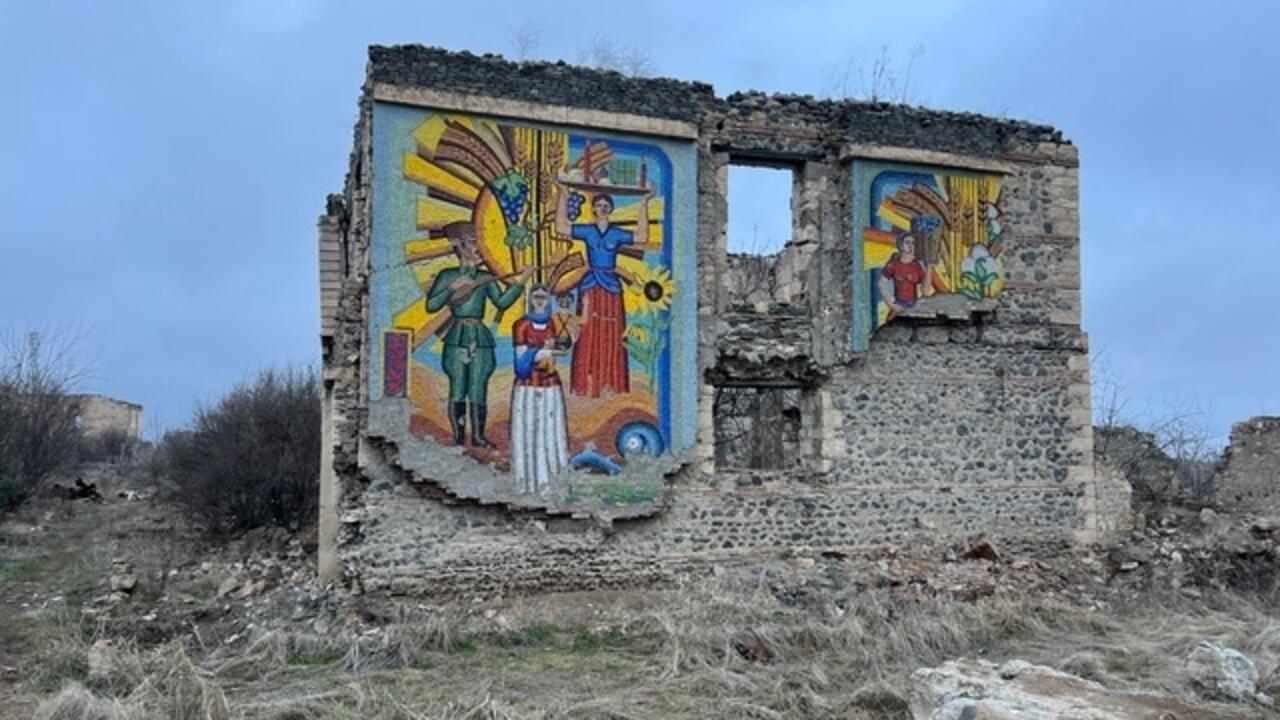
Today, not a single house remains standing – all were razed to the ground, and even the trees didn’t escape the conflict. It’s a barren wasteland.
Aghdam’s historical Juma Mosque is one of the few buildings that has been restored. © Dorian Jones
The historical Juma mosque was one of the few buildings that survived, partially intact, and was used as a shelter for farm animals by ethnic Armenians.
Imam Mehman Nesirov, 45, is the proud custodian of the fully restored mosque, where up to 100 worshippers now attend Friday prayers as life slowly returns to the city.
Nesirov fled Aghdam in 1993 as a child: “We were forced to leave because of the sound of fighting, which was getting closer and closer. Everyone was terrified and panicked.”
Nesirov explained to RFI that he and his family spent the first years of their lives living in a railway wagon. “I will never forget those years. We always prayed to God that one day we could return and pray at this mosque,” said Nesirov. “We can’t put into words how we feel that dream we had as a child, a teenager, and an adult is finally realised.”
Mehman Nesirov left Aghdam as a child but has returned as the Imam of the city’s historical Juma Mosque © Dorian Jones
Azerbaijan must allow ‘safe’ return to Nagorno-Karabakh: UN court
Returns and ruptures
Around a thousand people have returned to Aghdam, all housed in new state-built accommodation, as the city itself remains uninhabitable. While Azerbaijanis are slowly returning, ethnic Armenians from Nagorno-Karabakh have now become refugees following the victory of Azeri forces in 2023.
“What we saw within 24 hours was the forced expulsion of the remaining 110,000 Armenians from their homes in Nagorno-Karabakh,” said Richard Giragosiyan, director of the Regional Studies Center, a Yerevan think tank.
“They were leaving behind whole homes, personal possessions, family graves, and coming to Armenia, which was more of a foreign country than many people understand,” added Giragosiyan.
However, Giragosiyan claims that Azerbaijan’s forces’ success in Nagorno-Karabakh opened the door to a “diplomatic breakthrough,” with Azerbaijani President Ilham Aliyev and Armenian Prime Minister Nikol Pashinyan committing themselves to improving relations in the aftermath of the conflict. Baku in January opened its border to allow oil and grain from Kazakhstan to reach Armenia, which is important for Yerevan as it tries to rely less on Russia and move closer to Europe.
The manager of Aghdam’s newest hotel, Aykhan Jabbarov, has welcomed rapprochement efforts between Yerevan and Baku. © Dorian Jones
In Aghdam’s newest hotel, manager Aykhan Jabbarov welcomes rapprochement efforts between Yerevan and Baku.
Jabbarov, a veteran of the last Nagorno-Karabakh war whose family fled Aghdam thirty years ago, looks forward to a time when Azerbaijanis and Armenians can again live together in the city. “If we look to history, we lived together before now, every leader talks about peace … We have to build a good relationship. It will help both countries’ economy, people’s social life and the regional economy, everything.”
However, diplomatic efforts to restore relations and normalise Armenian-Azerbaijani ties still have plenty of work ahead. With repercussions of the past never far away, Ruben Vardanyan, a leading member of the breakaway Armenian administration captured by Azeri forces, was convicted this week of war crimes and sentenced to 20 years in jail by an Azerbaijani court.