After driving for several hours along a road lined with forests and lakes, you wouldn’t expect to wind up at one of the world’s leading classical music festivals. Yet every summer, Kuhmo becomes the international capital of chamber music for two weeks.
“The contrast is huge,” says festival volunteer Matti-Jussi Pollari, a former director of the Kuhmo Arts Centre. “We are by the lake, surrounded by forest. And then we have this amazing concert hall.”
Kuhmo Chamber Music Festival typically hosts about 60 ticketed concerts, as well as a couple dozen free events. The concerts attract a total of more than 7,000 unique attendees and sell a total of about 20,000 tickets. Venues include the Kuhmo Arts Centre, the local church and the village school.
Visit the friendly atmosphere of Kuhmo Chamber Music Festival with our video.
Video: Erika Benke/ThisisFINLAND
The Kuhmo Arts Centre, a striking building with a 668-seat performance hall built from local pine and stone, is the heart of the festival. “It’s one of the best halls I’ve ever played in,” says violinist Sergey Malov, widely known for his versatility, who keeps returning to Kuhmo year after year. “It may be my very favourite hall in the world. It has a wonderful look and perfect acoustics.”
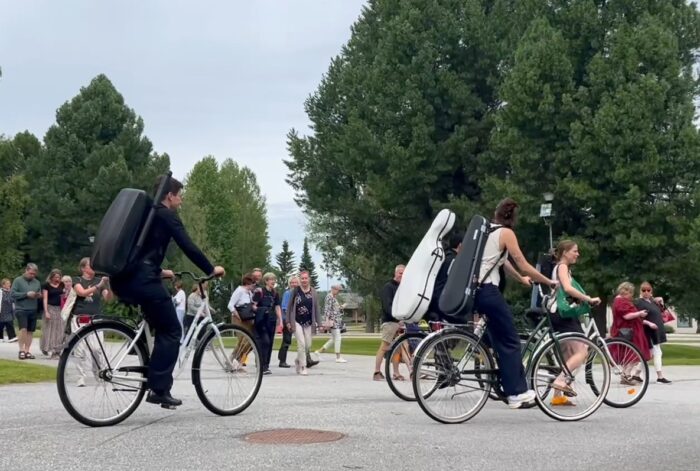
Kuhmo may be famous for world-class chamber music, but the magic also extends off-stage. Musicians and audiences become neighbours. “We haven’t got much hotel capacity in Kuhmo,” says Pollari. “Most artists and visitors rent cottages or spaces in people’s homes.”
Violist Mira Maranta (left) and cellist Nigel Thean of the Modulor Quartet chat with a festival visitor at a café in Kuhmo.
This arrangement is crucial to understanding how the festival has become part of everyday life in Kuhmo. Locals meet musicians everywhere they go, and musicians report running into members of the audience at the supermarket, mingling with them at cafés and sitting next to each other in restaurants.
“Everybody seems to be in it together,” says Beatrice Harmon, a violinist in the Modulor Quartet, which came to Kuhmo from Switzerland to play at several concerts. “When we see each other in the street, we greet each other. We go to the same shops as the audience members, and we go to the sauna with all the musicians – a Finnish experience that we haven’t got in Switzerland.”
Modular’s cellist, Nigel Thean, agrees. “We arrived two days ago, but I already feel like part of the community.”
Visiting musicians appreciate the possibility of going for a swim in the lake – and there is a dock conveniently located behind the concert hall.
Malov has fully immersed himself in the Finnish experience. “Fifteen minutes before the opening concert of the festival, I had a dip in the lake,” he says with a mischievous smile. “That could not happen in New York or London.”
Visitors feel it, too. Eberhard from Germany has attended the Kuhmo Festival 12 times since 1999. “I’ve just been to the supermarket and bumped into a man who checks the tickets at the concert hall,” he says. “He said, ‘Welcome to Kuhmo, I remember you!’”
That sense of familiarity is central to Kuhmo’s identity. For Kuhmo Chamber Music Festival artistic director Minna Pensola, those everyday encounters break down barriers between performers and audiences. “The threshold to comment on what happens on the stage is really low,” she says. “It has to do with the fact that we go around and mingle, and have equal access to concert halls, cafés, restaurants and lakes.”
During the long days of summer, Kuhmo experiences magical “white nights,” with twilight for a few hours, but not complete darkness.
I experienced that sense of belonging for myself. The first question I was asked after entering a sauna in Kuhmo wasn’t about where I came from. It was, “What instrument do you play?” I had to admit that I didn’t play anything. Nobody seemed to mind, and I still felt like a welcome part of the group.
I left Kuhmo thinking that its greatest feat, and part of what makes it so unique, is what happens in between the concerts. World-famous musicians, festival staff and concertgoers aren’t separate groups – they all belong to the same community.
Text, photos and video by Erika Benke, September 2026