The nation’s intellectuals and power brokers have too often chosen silence or complicity, leaving authoritarianism to reinvent itself in new guises.
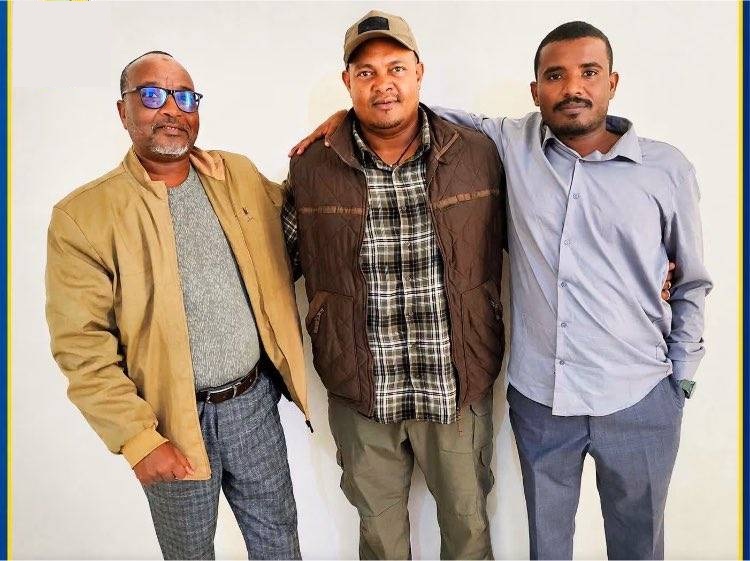
At the recent launch of Prime Minister Abiy Ahmed’s book Medemer State, one voice among the chorus of praise startled the audience. Getachew Reda—once Abiy’s most scathing critic, known for his caustic put-downs during the Tigray war—hailed the Medemer series as a “transformative model for Ethiopia’s future” and its author as a “visionary”. For observers who remembered his years of ferocious disparagement, the spectacle was utterly bewildering.
Getachew is no ordinary politician. With an MA in Law from the University of Alabama and a lecturing post at Mekelle University behind him, he carried intellectual weight rare in Ethiopia’s political class. As the polished spokesman of the Tigray People’s Liberation Front (TPLF) during its war with the federal government, he became a key face of resistance.
But after his fallout with Debretsion Gebremichael leadership and his unceremonious retreat to Addis Ababa last March, he has reemerged as a champion of Abiy and his administration, a reversal which, according to critics, is far from a matter of principled conviction.
In his volte-face, Getachew embodies a wider pattern: Ethiopia’s intellectuals are less defenders of principle than navigators of power. Their shifts are not random lapses of character but symptoms of a system that rewards compliance and punishes dissent. His case is recent, vivid, and emblematic, illustrating how, time and again, the nation’s educated voices forsake commitment in exchange for proximity to authority.
The Narrow Corridor
In The Narrow Corridor, Daron Acemoglu and James Robinson argue liberty survives only when a strong state is restrained by a strong society. The state provides order, services, and security. Society shackles it, preventing power from sliding into tyranny.
In Ethiopia, that balance has rarely existed, and intellectuals bear a share of responsibility. The monarchy endured local uprisings in Bale, Raya, and Gojjam, but rural masses, largely illiterate and bound to subsistence, remained outside the struggle.
Intellectuals did not help mobilize them into a counterweight to power. In the 1960s, students in Addis Ababa did stir change, but the people did not rise collectively; rather, they were mobilized by armed fronts such as the TPLF, Oromo Liberation Front (OLF), and Eritrean People’s Liberation Front (EPLF).
The Derg crushed the very intellectuals who might have educated and organized society. Under the Ethiopian Peoples’ Revolutionary Democratic Front (EPRDF), hopes briefly surged in 2005, when urban and rural Ethiopians voted en masse for change. But when the regime took measures to forcefully suppress the opposition, the intellectual class fractured, some silenced, some exiled, others co-opted.
Today, amid wars, unemployment, inflation, and repression, most of the public remains inert. Social media debates drift toward gossip and celebrity controversies rather than toward corruption, justice or accountability. The silence of intellectuals deepens this vacuum.
Who, then, are Ethiopia’s intellectuals? They are the writers and teachers, the academics, the diplomats, the civil servants, the people equipped with the skills to make sense of society and to hold it up to the mirror of critique.
And who are the elites? Those who wield influence: politicians, generals, business magnates, church leaders, media personalities. In Ethiopia, the two circles overlap so often that they almost become one. The educated lend their weight to the state; intellectuals drift into official posts, where privilege softens their independence.
Ideally, both groups would serve as guardians of freedom, challengers of injustice, inventors of reform, and guides for public conscience. What we have seen instead is a long habit of seeking the warmth of power.
Intellectuals, with a few luminous exceptions, bartered truth for security, and traded the hard duty of independence for the easier comfort of advancement. Each time history reached a turning point, authoritarianism was not dismantled but tightened, layer upon layer.
System of Complicity
To diagnose this recurring failure as mere moral cowardice is to mistake a symptom for the disease. The deeper ailment is structural, rooted in a political economy that functions as a closed patronage system.
As scholar E.A. Brett argues in analyzing the post-colonial state, ruling coalitions often prioritize survival over development, constructing a neo-patrimonial order where the state is the primary fount of wealth and security.
Within this framework, intellectuals, business leaders, and professionals face a brutal calculus: alignment with power grants access to influence, resources, and protection; principled opposition guarantees marginalization or worse.
This is not a simple choice between truth and comfort, but a systemic pressure that makes complicity a rational strategy for professional and physical survival, a dynamic as true under the Imperial court as it is under the EPRDF’s ethnic patronage and Abiy’s authoritarianism.
This structural engine, in turn, drives a destructive cultural cycle that erodes the very foundation of accountability. Each high-profile defection—each critic who becomes a courtier—normalizes the betrayal of principle and sets a precedent for the next generation.
The work of sociologist Pierre Bourdieu helps illuminate the consequence: when elites wield their “symbolic power” to legitimize authoritarian rule, they perform an act of “symbolic violence” that shapes public consciousness itself.
The repeated spectacle of the educated and respected aligning with power breeds a deep-seated habitus of disillusionment and cynicism among the populace. What appears as societal amnesia or passivity is, in fact, a learned helplessness—a rational response to the constant demonstration that collective action is futile and that the mirrors of society are perpetually for sale.
Thus, the state co-opts the elites, the elites’ betrayal demoralizes the society, and the society’s fractured inertia allows the state to tighten its grip, completing a self-perpetuating circuit of failure.
Imperial Submission
The early 20th century produced rare visionaries. Gebrehiwot Baykedagn, in Mengistna Yehizb Astedader (1924), argued for rational taxation, separation of royal and state revenues, schools, freedom of worship, legal reform, and a modern army. His ideas anticipated Haile Selassie’s later reforms.
Others tried bolder measures. Girmame Neway, educated in the United States, attempted to dismantle feudal rule through a coup in 1960. Ambassador Birhanu Dinke resigned in protest, urging Haile Selassie to renounce divine right and accept elected government.
But such figures were exceptions. Most educated elites, many schooled abroad at the emperor’s expense, reinforced the monarchy. They built institutions—Ethiopian Airlines, Addis Ababa University, the national broadcasters—but avoided political confrontation.
Constitutional drafts in 1931 and 1955 cloaked imperial dominance in legal form. The monarchy remained absolutist, while intellectuals and elites acquiesced.
Revolution Betrayed
The 1974 revolution toppled Emperor Haile Selassie. It could have birthed democracy. Instead, it delivered military dictatorship. Soldiers with little education or ideological clarity hijacked the uprising. Intellectuals, divided and fearful, legitimized them.
Some, like the Ethiopian People’s Revolutionary Party, resisted and called for civilian government. But internecine violence—the White Terror, assassinations, leaks—crippled opposition. The Derg unleashed purges that annihilated intellectuals en masse. Survivors either submitted, went silent, or joined guerrilla fronts.
Those fronts—TPLF, EPLF, OLF—shifted the struggle toward ethnic politics. In fighting dictatorship, they hardened divisions. The intellectual failure was stark: instead of steering public debate, they allowed low-ranking officers to rule through terror and war. Ethiopia endured 17 years of civil conflict, capped by the secession of Eritrea and the rise of the TPLF.
In 1991, the EPRDF seized power. The 1995 constitution looked dazzling on paper: civil, political, socio-economic, even third-generation rights. In practice, it was a façade. Elections were stage-managed, dissent crushed, rights ignored.
Intellectuals and elites failed once more. Some collaborated as junior partners of the TPLF, trading loyalty for patronage. Others were silenced, marginalized, or exiled. Instead of forging cross-ethnic alliances for democracy, they retreated into ethnic camps.
The principle of self-determination was legitimate. But enshrining secession in the constitution, coupled with framing Ethiopia as a “colonial empire,” destabilized the nation. Eritrea broke away, depriving Ethiopia of sea access.
Federalism hardened ethnic identities, sowed mistrust, and portrayed Amharas as perpetual oppressors. The elites and intellectuals who justified or tolerated this design bear responsibility for Ethiopia’s ongoing fragmentation.
Abiy’s Mirage
Abiy Ahmed’s rise in 2018 unleashed euphoria. The retreat of the TPLF seemed to open a new democratic horizon. That horizon quickly vanished.
Abiy centralized power while leaving much of the country ungoverned. His style—what scholar Berihun Gebeyeh calls “Syncretic Authoritarianism”—mixes military coercion, legal manipulation, and appeals to international legitimacy.
The prime minister governs through patrimonialism. Land, jobs, projects, and contracts are distributed as patronage. He invests in vanity projects—palaces, resorts, artificial parks—while neglecting jobs, rural development, and basic services. He manipulates ethnic and religious divisions, styling himself as mediator, even messiah. Wars in Tigray, Oromia, and Amhara testify to his reliance on violence over consent.
And again, intellectuals and elites have failed. Religious leaders, business magnates, media personalities, and academics have largely aligned with the regime—or stayed silent. A handful speak out. Most, however, serve power.
Anne Applebaum, in Twilight of Democracy, captured the dynamic: authoritarians rely on intellectuals to supply legal justification, media narratives, and cultural validation. Ethiopia is no exception. Figures from Daniel Kibret to Dagnachew Assefa, Gedion Timothewos to Mamo Mihretu, Solomon Kassa to Nebeyou Baye, have provided the rhetorical armor. Religious leaders, Christian and Muslim alike, bless his rule.
They justify wars against their own citizens, twist laws, and rationalize an authoritarian ambition. In doing so, they wage war not only on the public but on colleagues and classmates. Ethiopia’s intellectual and elite classes have, once more, chosen complicity.
Exceptions and Continuities
There have always been exceptions: Gebrehiwot Baykedagn, Girmame Neway, Birhanu Dinke, Getachew Maru, Berhanu Meskel Reda, and Mesfin Woldemariam. They resisted power, spoke truth, sacrificed careers—and sometimes their lives—for the possibility of freedom.
But they were islands. Across regimes, the majority of intellectuals and elites submitted. Under the monarchy, they built institutions but deferred to imperial dominance.
Under the Derg, they legitimized or were annihilated. Under the EPRDF, they entrenched ethnic federalism. Under Abiy, they lend their voices to a syncretic authoritarian.
Meanwhile, society has remained fragmented, fearful, and often inert.
A Broken Mirror
Ethiopia’s story is not simply one of ruthless rulers. It is the story of intellectuals and elites who, instead of reflecting the hopes of society, mirrored the ambitions of power. It is the story of a public too often passive, unable to mobilize, and unwilling—or unprepared—to demand accountability.
Until intellectuals speak truth without flinching, until elites choose reform over privilege, until society organizes to shackle power, Ethiopia’s long quest for freedom will remain a broken mirror: reflecting promise, refracting failure.
Query or correction? Email us
While this commentary contains the author’s opinions, Ethiopia Insight will correct factual errors.
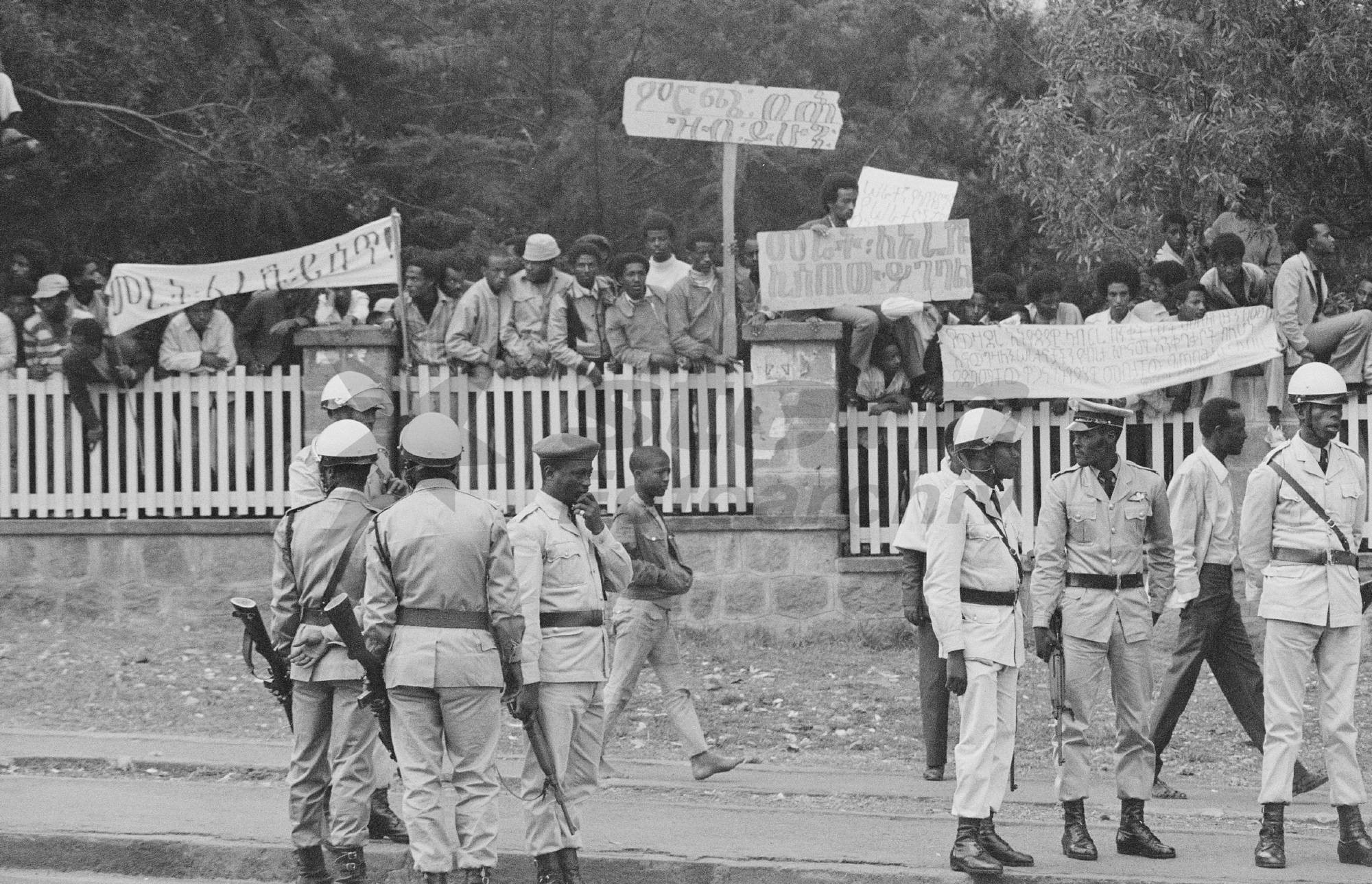
Main photo: Ethiopian Student Demonstration, March 1974, Addis Ababa. Source: Social media
Published under Creative Commons Attribution-NonCommercial 4.0 International licence. You may not use the material for commercial purposes.