
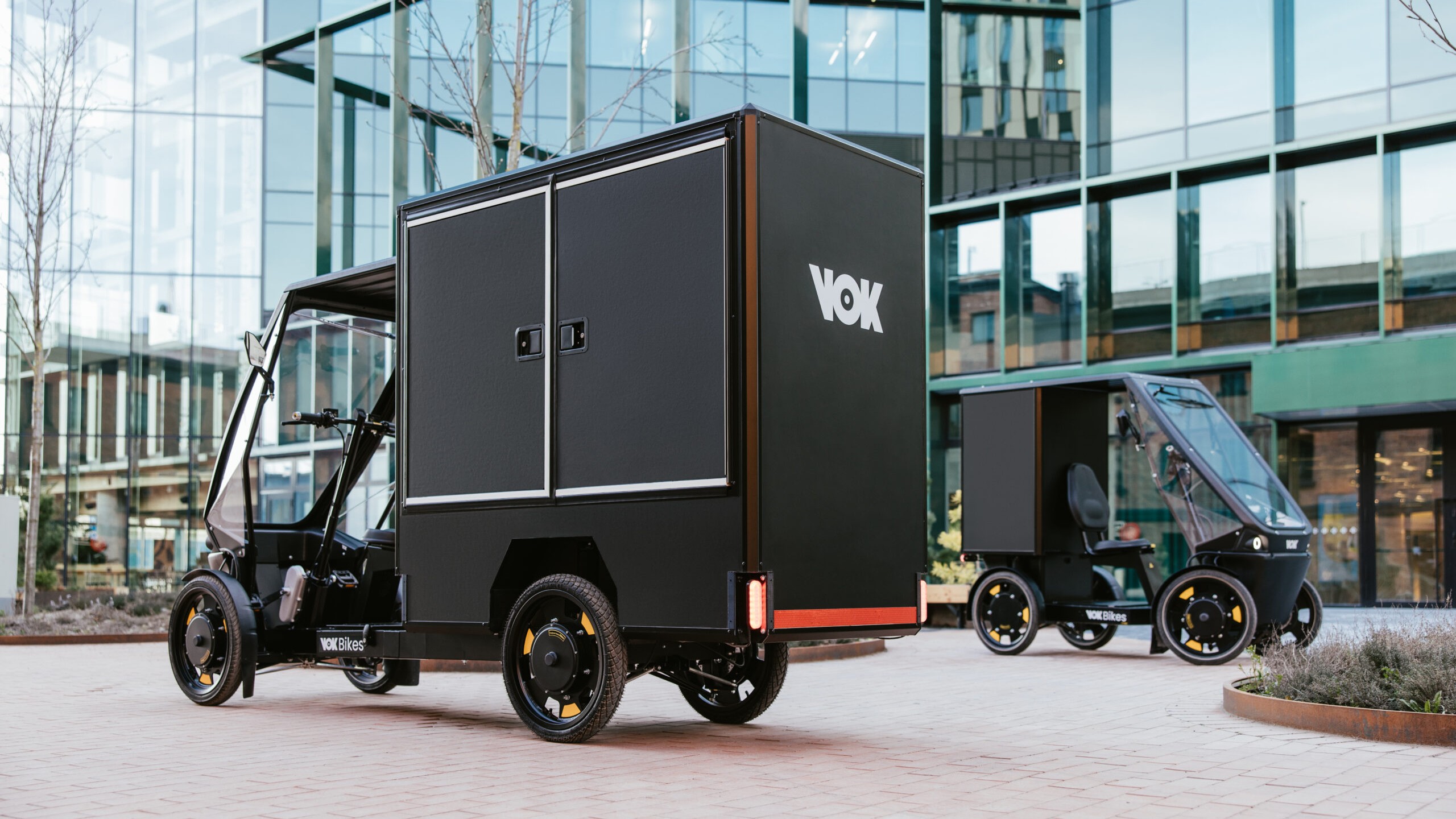
Estonia’s Vok Bikes has agreed a manufacturing partnership with Renault Group’s Refactory near Paris, a move that will expand production capacity tenfold as cargo bikes edge further into the territory once dominated by delivery vans.
Under the agreement, the Flins plant – Renault’s circular-economy hub – will begin producing Vok’s four-wheeled cargo bikes in early 2026. For the Tallinn firm, it offers something the sector has long lacked: industrial-grade output within striking distance of Western Europe’s most regulated urban markets.
“This cooperation marks a turning point for urban commuting,” Indrek Petjärv, Vok’s chief executive, said in a statement. “A startup’s pace of innovation combined with the scale of automotive manufacturing puts us in the strongest position to bring cargo bikes to the masses.” Renault officials framed the tie-up more cautiously but no less deliberately. “This agreement with Vok Bikes aligns with our ambition to support new mobility companies by giving them access to our industrial facilities,” said Stéphane Radut, director of the Flins Refactory.
Indrek Petjärv, Vok’s chief executive (right) signing the deal with Stéphane Radut, director of the Flins Refactory. Photo by Vok Bikes.
Right-sized electric vehicles attractive to logistics companies
The timing is significant. London drivers lost 101 hours to congestion last year, costing firms nearly £4 billion; from 2026 even electric vans will face the city’s congestion charge. Paris is steadily tightening access for light commercial vehicles as part of its pollution-reduction plans. Across Europe more than 360 low-emission zones are already in place, and the cost of operating traditional vans is rising accordingly.
Those pressures have made right-sized electric vehicles more attractive to logistics companies. Vok’s machines – sturdier than conventional e-bikes and designed for commercial fleets – allow operators to bypass congestion via cycling infrastructure and avoid many of the fees and restrictions applied to vans. The company’s clients now include Veolia, Wolt, McDonald’s and the City of London, alongside a growing number of smaller retailers and service providers.
A Vok’s electric cargo bike. Photo by Vok Bikes.
“In cities like Milan and Rome, commercial operators can no longer rely on vans alone,” said Vittorio Rizzato, managing director of Wings Bike, Vok’s Italian distributor. “Companies want vehicles that move faster, avoid fines and access charges, and keep costs predictable – cargo bikes are becoming central to that strategy.”
Cargo-bike market could triple
The Renault deal follows Vok’s $6 million Series A funding round in 2025, which was led by SQM Lithium Ventures. At the time, SQM executive Mark Fones argued that the Estonian firm had “raised the bar” with its in-house drivetrain and engineering approach. Vok’s founders – Estonian engineers with backgrounds in Formula Student competitions – set out to build a purpose-built logistics vehicle rather than adapt consumer bikes for commercial work, arguing that most e-bike platforms were unsuitable for the demands of city freight.
A Vok’s electric cargo bike in Tallinn. Photo by Vok Bikes.
Forecasts suggest the European cargo-bike market could more than triple by 2035, fuelled by regulation and the economics of dense cities. Yet questions remain about how far cargo bikes can replace vans at scale, and whether cycling infrastructure can absorb the high volumes associated with last-mile logistics. The Renault partnership offers Vok a chance to test that proposition: it provides the capacity to compete for larger contracts and reduces the time needed to deploy fleets in major cities.
For now, the company appears confident. “Cities have changed,” Petjärv said. “Vans are a blunt tool for a precision job – and we’re building for how urban movement works today.”


