Estonian-Swiss singer-songwriter Ingrid Lukas speaks to Estonian World about the Singing Revolution, losing and finding her voice, and her forthcoming album, Home.
Ingrid Lukas begins her day before the world has properly arrived. In her home in Zürich, the microphones are already set up, the piano is waiting and, before emails, calls or the obligations of ordinary life intrude, she sings. “Music is my breakfast,” she tells Estonian World.
For Lukas, an Estonian-Swiss singer-songwriter, pianist, bandleader and music therapist, that sentence is more than a poetic flourish. Born in Estonia in 1984 and taken to Switzerland at the age of ten, she has spent much of her life moving between languages, landscapes and ideas of home. Her music, shaped by the ancient Estonian regilaul tradition, Arvo Pärt’s sacred minimalism and years of therapeutic work with the human voice, is an attempt to locate the place where belonging becomes sound.
Speaking to Estonian World from Paradiesli, a café in Zürich, Lukas reflects on the Singing Revolution, the childhood memory of standing in the Baltic Chain, the teenage loss of her own voice and the long journey towards her forthcoming album, Home.
Estonian-Swiss musician Ingrid Lukas at Paradiesli café in Zürich, where she spoke about music, memory and the search for home. Photo by Alina Birjuk.
What did you eat for breakfast today?
I have to confess, I usually don’t eat breakfast, not until eleven or twelve, around lunchtime. But I do have a morning ritual.
I wake up at around six. As soon as I get up, I drink cold water, because the body loses so much fluid at night, and it makes the body so happy to have it back. Then comes matcha. My partner makes me a matcha latte while I’m already at the piano. Matcha doesn’t wake you the way coffee does. It comes in slowly, smoothly. It signals to the system: a new day is starting.
And then I sing. That is really my breakfast. Music is my breakfast.
I love the moment of waking up because the soul has been somewhere else all night, in another world, and when you come back, you are still partly there. The Tagesbewusstsein, the day-consciousness, has not yet arrived in the body. That in-between state is so fragile, so beautiful. I love catching it on tape, getting it into music before it disappears. I have microphones permanently set up and the piano ready, so I can walk straight from bed to the piano and record. Until noon, I don’t look at my phone. I keep that delicate hour as clean as possible.
After noon, the world arrives. The day-consciousness, the calls, the voice coaching, the music school, the people. But the mornings belong to the soul.
You moved to Switzerland at the age of ten. How did that happen?
It was because of my mother. She had done many different things in Estonia. She was a television announcer at the Estonian Television, back when there were still announcers, and she had also studied food technology. But she spoke very good German, even then.
So she worked as a translator. Some Swiss businesspeople came to Estonia around 1991 or 1992, and she translated for them. That is how she met my stepfather. It was a big love story. We moved to Winterthur in 1994.
For a ten-year-old, it was an enormous change. But I remember it being exciting more than frightening. I had already started flying alone at nine and a half, and that itself felt like a big thing. The two worlds were so different. Estonia at that time still carried the Soviet atmosphere. Switzerland had mountains. My stepfather took us hiking every weekend, to peaks of two or three thousand metres. Oh my God, I thought, the picture is so different.
Zürich, one of the places through which Ingrid Lukas traces a larger question: what it means to belong without belonging to only one home. Photo by Alina Birjuk.
You moved out of home at fifteen. That is a young age to make such a decision. Where did that certainty come from?
It was not certainty, actually. It was a crisis.
Between fifteen and eighteen, I went through a very difficult time. I left home to look for where my home actually was. I even came back to Estonia for the tenth grade, to my grandparents, my aunt, my father and his partner, and my many half-siblings, trying to find the place that felt like home. It was not anywhere. I ended up alone in an apartment in Tallinn at sixteen, going to the German Gymnasium, and I was so lonely that something broke.
I stopped speaking. Selective mutism. I could speak one-on-one, but in any group I went silent. My voice left me. The homelessness was simply too much for the soul to carry.
What saved me was music. In every break at school, I went down to the basement, where there was a piano. I sang “Let It Be” a thousand times. I started writing songs there. I expressed through music what I could not say in words. That basement piano saved my life.
So when people ask how I became a singer, it was not a career choice. It was survival. And what I learned then, I have been giving back ever since: helping other people find their voice when they have lost it.
You were five years old in 1989, standing in the Baltic Chain. What do you actually remember from that day?
Something was in the air. The whole of Estonia was vibrating. There were helicopters. I remember thinking: something is happening.
We were at our summer place near Viimsi. My family decided not to go. But our neighbours, Vello and Helgi, were going, and I had such a good relationship with them. I told them: take me with you. Please take me with you. And they did.
I remember holding hands with strangers. Singing together with thousands and thousands of people, and feeling, I don’t know how to put this into words, something much bigger than any single person. It was not me, little Ingrid, doing something. It was a power that did not belong to this world coming through and taking the lead. Singing through us.
I was verzaubert – enchanted. Completely. And I think that moment gave me my direction in life. Because what I have been chasing in music ever since is exactly that experience: the flow moment, where something larger sings through you.
Freedom and independence are my most important values in life. I was born on 20 August, the day Estonia regained its independence in 1991. Singing, for me, equals freedom. When I sing, I become free. When I help others to sing, they become free.
Ingrid Lukas says freedom and independence are among her deepest values: “Singing, for me, equals freedom.” Photo by Alina Birjuk.
You have spoken about being deeply influenced by regilaul, the ancient Estonian runo-song tradition. What is it, and what does it carry that you cannot find in other forms of music?
I am not a regilaul specialist. For that, you would want to speak to someone else. But I have used regilaul as inspiration on almost every album I have made.
These are the old songs, the way our ancestors expressed themselves: grief, joy, the rhythms that helped them work. Simple melodies, repetitive. Usually one lead singer, and then the others answer back. When I sing them, I come into contact with something very old, an ancestral knowledge.
I believe our souls choose where to incarnate, and mine chose Estonia. So when I sing regilaul, it is like opening a channel into that lineage. There is old knowledge encoded in those songs, about medicine, plants, the body and the land.
When I sing them, I don’t sing them the way an Estonian regilaul specialist would. They come out wearing an Ingrid Lukas dress, so to speak. But the people who hear me sing them in Switzerland or elsewhere in Europe feel something different. They feel it.
“Rain Spell”, or “Vihma loits”, the rain incantation, is one such song. When I sing it, my voice goes somewhere else. A secret language comes through. I channel something I don’t fully understand yet myself.
I am no longer Ingrid Lukas when that happens. I become a channel, the instrument of something older.
Arvo Pärt has been one of your major inspirations. Have you ever met him?
I haven’t met him in person, but I have spoken with him on the telephone.
He called me once. We talked about his piece “Für Alina”, which I had recorded on my first album. It was an “oh my God” moment. How is it possible that I am on the phone with Arvo Pärt? He turned 90 last year.
I first encountered his music about twenty years ago, while studying jazz and popular singing at the Zurich conservatory. I listened to him constantly. I could not have put words to it then, but the feeling was clear: his music was a bridge. To another level. A spiritual plane. It opened something in me that nothing else had – a longing, a Sehnsucht – and at the same time it felt deeply Estonian. He showed me both directions at once: the spiritual and the rooted.
His music is what I would call rein in German, pure, but more than pure. Sacred, holy. That music can transport something beyond itself. And ever since, that is what I have been searching for: the melody that is the most direct expression of my own soul.
Ingrid Lukas says music was her first home – the place where she could always seek refuge. Photo by Alina Birjuk.
In Zürich, Ingrid Lukas’s story moves between memory, music and the idea of home. Photo by Alina Birjuk.
Is there something specifically Estonian in how you hear and write music – a feeling, a rhythm, a kind of silence – that you have never managed to translate into another language?
Yes. A kind of openness, avarus in Estonian. Spaciousness. And something Nordic. When I sing in Estonian, when I sing regilaul, when I improvise, that is when I make contact with the other side. I download something. The secret language comes. I become a channel.
Swiss people don’t make this kind of music. Americans don’t either. There is something in the Estonian musical expression that I have not found anywhere else. Free, flowing, Nordic, landscape music. I think it is encoded in us, in the soil, in the songs and in the silences.
When you compose, what language do you think in: Estonian, German, English or just sound?
My first language is music. If I could, I would speak only that.
But because not everyone speaks it, I have had to learn the others: Estonian, German, Swiss German, English, as symbols, as ways to relate to people. And it is lifelong work. Even now, when I am in Estonia, it takes me two or three days to land back into the Estonian symbols. In Switzerland I dream and think in Swiss German. With my first husband, I spoke only English.
But honestly? When I listen to people, I don’t really hear the words. I hear the music behind them. The how. The tone, the rhythm, the silences. There is something in German called stimmig: when something doesn’t add up emotionally, when the words, body and voice don’t line up. I hear that more than the words themselves.
In voice coaching, that is really what I work with. Most people focus on what to say. I work with how, because the message lives in the music of the voice, not the language.
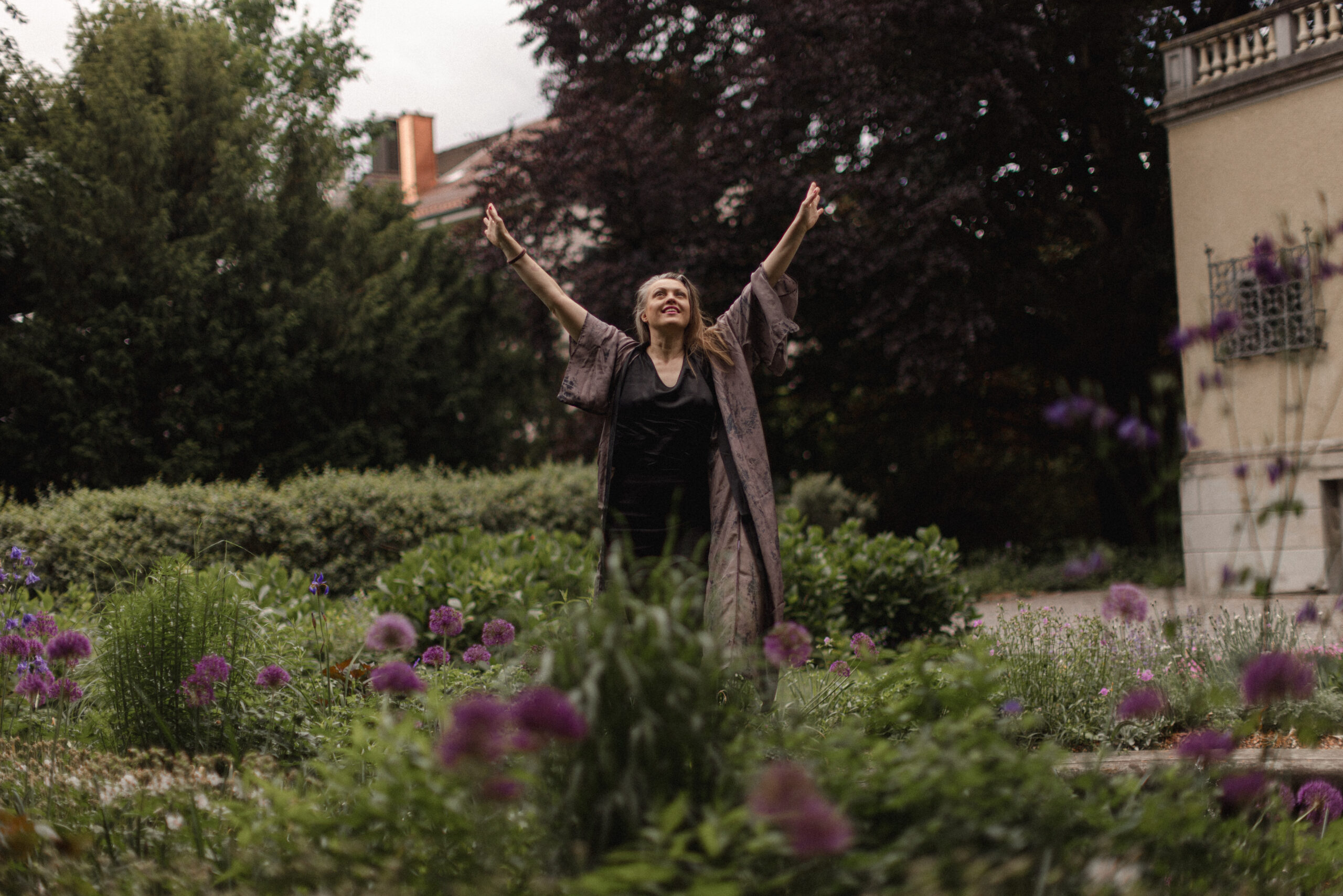
Ingrid Lukas in a quiet Zürich garden, reflecting on the long road towards her forthcoming album, Home. Photo by Alina Birjuk.
You worked closely for many years with Nik Bärtsch, the Zürich pianist and composer known for his minimalist “ritual groove music”. What is the most important thing he taught you?
Nik is a very mystical, remarkable being. He has been my mentor for years, and he produced three of my albums on his label Ronin Rhythm Records. We have shared the same music studio near Hardbrücke in Zürich for fifteen years now. His eldest daughter studied voice with me for over ten years. We are family in many ways.
He taught me the matcha ritual, actually. I took it from him.
But more than that, he taught me continuity. Presence. Showing up. Nik is an aikido master, and his wife is too. I have been training aikido with them for three years now. The whole martial-arts mindset is in everything he does. Every Monday for over twenty years, he has performed a concert at Exil in Zürich. More than a thousand concerts. Whatever happens, he shows up. He steps onto the Übungsmatte, the practice mat, again. And again. And again.
I am, by nature, more emotional, more chaotic. When I am tired, I stop, and then it is hard to begin again. Nik has taught me, by example, what it means to find your life-melody and then return to it daily, no matter what.
The musician’s life is so difficult. Hard to make a living from. Hard, full stop. Many artists fight just to exist. And Nik is living proof that it is possible, if you stay loyal to your own path.
Ingrid Lukas with fellow musician and pianist Nik Bärtsch in Zürich. Her creative life has been shaped by collaboration, discipline and a daily return to sound. Photo by Alina Birjuk.
Ingrid Lukas in Zürich, a city she calls one of her homes alongside Estonia, Berlin, music and the people closest to her. Photo by Alina Birjuk.
Most musicians chase emotion. As a trained music therapist, you also understand exactly what music does to the human nervous system. Does that knowledge get in the way of the artist in you, or does it deepen the art?
They are two different formats, but I am both, so both are always in the room.
When I work as a therapist, I am channelling what the client needs in order to learn or develop. I write individual songs for people. Songs that help express grief. Songs that help someone reconnect with their own resources when they are exhausted and depleted. Songs that bring people back to themselves.
When I work as an artist, it is different. I am channelling my own expression. But the therapist is always quietly listening to what music does to the body, to the nervous system. I know that the right tone in the right moment regulates someone’s whole system.
The format that brings the two closest is something I do with my saxophonist Diandra Russo, a project called Musik der Stille, “music of silence”. We perform in churches. A hundred and fifty people lie down on mats, with blankets. We play, and then we stop. Two or three minutes of complete silence. A hundred and fifty people, completely silent. And then more music. And then silence again.
The feedback is overwhelming. People crave that silence. We live in a society that is so loud, so full of noise and information, that silence has become a luxury. Überlebensnotwendig, even, necessary for survival. There will be five or six of these concerts again this October.
I don’t tell anyone, “this is therapy”. But people come up afterwards and say: I am not the same person I was before this concert. Each person takes from it what they need.
What similarities do you see between Estonia and Switzerland?
A lot, actually. Both are roughly the same size [by land area]. Both have a similar reservedness. Estonians and Swiss are both quiet, self-contained, not loud or pushy. Both are humble, in the best sense. Both have, historically, had to fight to hold on to their culture: the Swiss Guards at the Vatican, the Estonian resistance over centuries. Both undersell themselves and are actually deeply capable. Both have a kind of Nordic-in-the-middle-of-Europe quality. I sometimes describe Switzerland to my friends as a Nordic country surrounded by southern ones.
Where they differ is around work. Both are hardworking, but Swiss working life ends sharply at five-thirty, while Estonians start later and keep going. And the further south you go in Europe, the more emotional people become. The Italian-speaking part of Switzerland is already livelier than the German-speaking part. Northern Italy is more reserved than southern Italy. It is a whole spectrum.
Ingrid Lukas in Zürich, where she lives, teaches and continues to shape music around silence, presence and freedom. Photo by Alina Birjuk.
Zürich seen through summer leaves, a small still moment in a story about voice, freedom and finding home. Photo by Alina Birjuk.
Your new album is about home. Why now? What happened in your life that this had to become its own work?
This is the album it took me twenty-five years to be able to write.
Home has been a painful theme my whole life. I was born in Estonia, moved to Switzerland and never quite landed in either. The teenage crisis was a homelessness crisis. I went looking for home in every possible person and place, and did not find it. The only constant from the Singing Revolution until now has been music. Music was my first home. The place where I could always seek refuge.
And it has taken decades to find my voice, not just my singing voice, but my speaking voice. To learn how to say what I mean. To live in peace with my own biography. I felt like a loser for a long time because of the path I took. And then at some point I realised: this is my path. It is beautiful. It is mine. I am at peace with it.
Now, finally, I can write about home because I have found it. And the songs are not really for me any more. They are for the people I have worked with as a therapist for the last ten years. People who feel they have not quite arrived in themselves. People who are still asking: what is my home? Who is my home? I would love for the music, and the book that is coming with it, to be an invitation to that asking.
Is “home” for you a place, a sound, a person or something you are still defining?
It is everything. And it is very personal.
In therapy, I have had hundreds of conversations about this, and every person answers differently. For some, family is home. For others, themselves. For me, I am my own home, first. That is the foundation. After that: Estonia is home. The forests are home. Berlin is home, because I did my master’s there. Zürich is home. My partner is home. My friends are home. Music is home. Freedom is home. Independence is home. Humour is home. Laughter is home. Lightness is home, and so is darkness. So is sadness. They all live there.
If I had to give a compass, it would be this question: does this feel good, or does it not? That is the only question. Slowly remove from your life what does not feel right, what is not aligned with your values. There is a voice inside us that knows. The question is whether we are brave enough to listen.
Ingrid Lukas, whose music draws on Estonian regilaul, sacred minimalism and the healing power of the human voice. Photo by Alina Birjuk.
If your music had to carry one message to a young Estonian listening to it for the first time, what would it be?
Free your voice.
That is the sentence I have been carrying with me my whole life. Free your voice. Trust that the voice inside you knows.
A last small question. Where, in your daily life, do you feel most at home in your own body?
At the piano in the morning. Before the day-consciousness arrives. With matcha next to me, the microphones already on, my partner moving quietly in the next room. The soul is still half-elsewhere. That is the moment I record. That is where I live.
Ingrid Lukas’s fifth studio album, currently titled Home, is due in January 2027. A book is forthcoming alongside it. She performs internationally as a soloist, in a duo with saxophonist Diandra Russo, Musik der Stille, and with her quartet. She lives and teaches in Zürich.
Ingrid Lukas in Zürich, where home is less a fixed address than a constellation of places, people, music and freedom. Photo by Alina Birjuk.