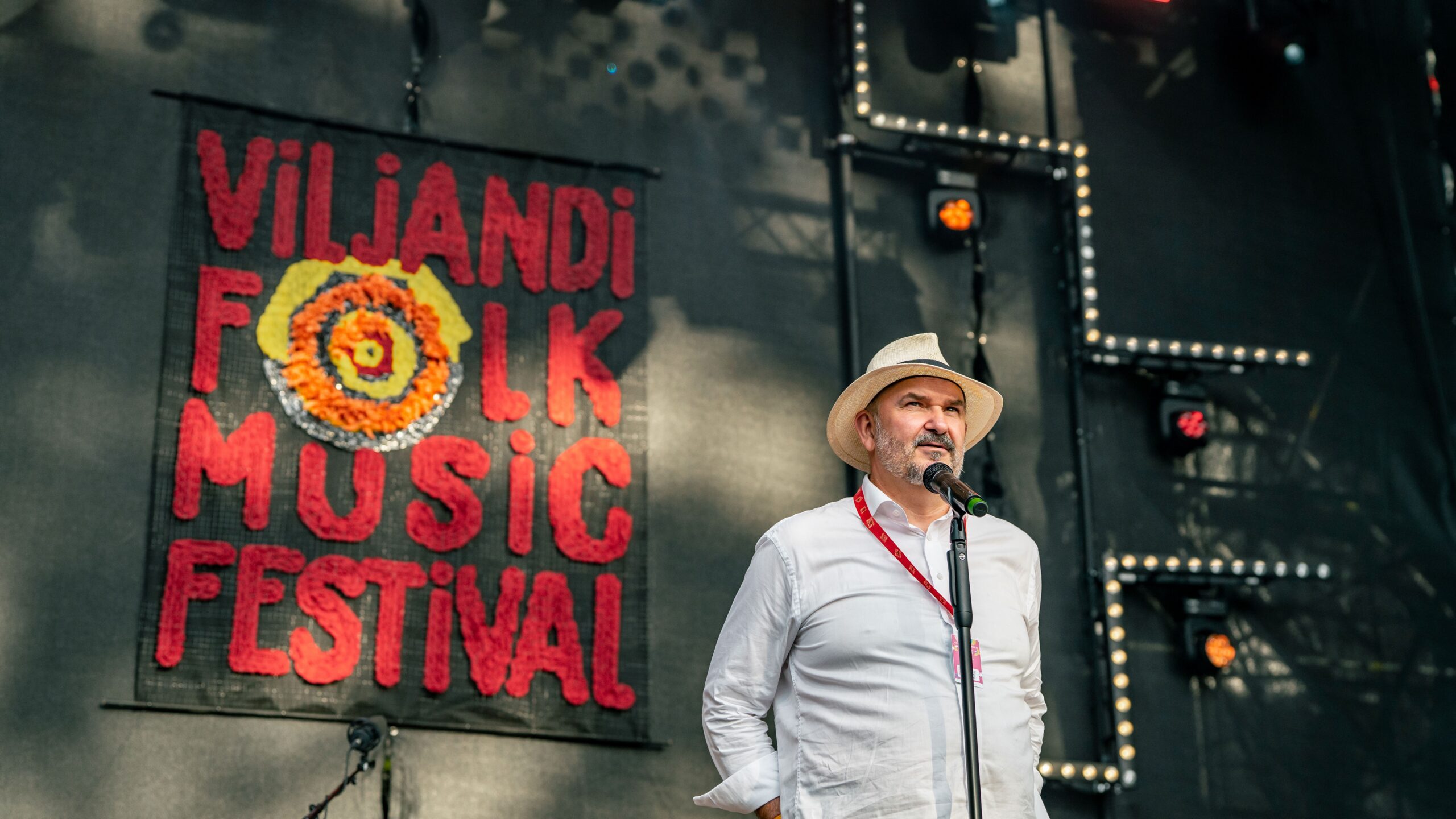
Musician, former mayor and self-styled “chief” Ando Kiviberg has spent three decades turning a fledgling folk gathering into one of Estonia’s defining cultural events.
Ando Kiviberg is, in his own words, a great supporter of democracy. As he should be. For four years, from 2013 to 2017, he served as the mayor of Viljandi, this picturesque and cozy town in the southern part of Estonia known for its stunning lake views and the festival he helped create. Although, truth be told, and also in his own words, he had absolutely no idea what he was doing.
At least at first.
“I was shocked when we won, because I wasn’t at all ready for it,” Kiviberg says of his mayoral success. “I had to learn on the job. At the beginning, I wasn’t prepared at all, I knew nothing, nada,” he goes on. “So there were a lot of long work days. I had to read a lot, talk to people.”
That learn-on-the-fly approach could be considered Kiviberg’s modus operandi. In the early 1990s, he helped set up the Viljandi Folk Music Festival to support and disseminate Estonian folk music to the masses. He had no experience running music festivals and was a recent convert to folk music. But he did it. The first Folk was held on one stage in one day in May 1993. There were a handful of local acts. Kiviberg drew the original posters for the festival by hand.
An early open-air folk gathering at Viljandi’s natural amphitheatre, 1993 or 1994. Photo: Taavi Siimson.
According to the Viljandi Folk Music Centre, last year’s festival, the 32nd edition, took place over four days at the end of July. It featured around 170 concerts across nine stages and involved about 50 artists, eleven of them foreign acts and three mixed ensembles. There were also 32 workshops. Estimated attendance over the four days was around 38,000. Given that Viljandi has about 17,000 year-round residents, the festival draws visitor numbers equivalent to more than twice the town’s population.
At the center of the festival is Kiviberg, who also performs, sometimes with his contrabass, other times with his beloved Estonian bagpipe. He is the Papa Smurf of Viljandi Folk, its benevolent leader in a white hat. For as much as he loves democracy, it is Kiviberg who has the final say on what acts play, what the theme will be, how things will come together. His official title is pealik.
“Chief.”
The chief is not alone, of course. Other organisers brainstorm. They make suggestions. Sometimes Kiviberg bats them down, sometimes he takes them and runs. “I help to craft a message around them,” Kiviberg says. “I don’t ever do it in a way that I force it on people but I always do it in a strategic way,” he adds. “I do like democracy, but I am still the festival chief.”
Viljandi Folk Festival in 2022. Photo by Janar Puuram.
From choirs to bagpipes
Kiviberg’s political activities date back to the mid-1990s, when he first stood for parliament. Yet when asked, he acknowledges that he is first and foremost a musician, rather than a politician or even a music festival director. After graduating from secondary school in Kärdla, on the island of Hiiumaa, he came to Viljandi in 1987, hoping to train as a choirmaster at what was then known as the Viljandi Cultural School.
“The idea was that I would get my basic music education at the university level and go to Tallinn to learn how to direct choirs at the Academy of Music,” he says.
Viljandi Culture Academy in Viljandi, Estonia. Photo: Ivar Leidus. Licensed under CC BY-SA 3.0 EE.
But then the Soviet Army called him up. Kiviberg was among the last cohorts of Estonian men to serve. He was initially stationed near Lake Ladoga, on the outskirts of what was then Leningrad, before being transferred to Kaliningrad, where he helped track NATO warplanes over the Baltic.
“While Estonia was having its Singing Revolution, I was sitting in Kalningrad in a Soviet uniform,” he recalls.
By the time he returned to Viljandi, the curriculum at the cultural school had changed, and it was in the process of becoming the Viljandi Culture Academy. He had to sit new entrance examinations to gain admission.
The school had also introduced a new specialism in folk music. Kiviberg soon changed courses and took up the bass and, eventually, the bagpipes. There were initially six people on the programme, and they were taken on a pilgrimage to Helsinki’s Sibelius Academy, where a folk music department had already existed for several years. There, Kiviberg saw that even in a country as close as Finland, things were being done very differently.
“In the Soviet era, folk music was used as a tool of state propaganda,” he says. Music was financed by the state. Songs were arranged by composers paid by the government, arrangements would be disseminated to approved folk music ensembles, who were expected to perform them flawlessly.
“In Estonia, everyone would play the same songs, in the same way, and the conductors would conduct,” Kiviberg recounts. “In a free country, folk music is expected to come from the bottom up. People perform music to express themselves emotionally, not for the sake of performing.”
Viljandi Folk Festival in 2022. Photo by Janar Puuram.
Other awakenings awaited Kiviberg and his fellow aspiring folkies. He and his new folk ensemble, Alle-aa, were invited to represent Estonia at the Falun Folk Music Festival in Sweden. This was their first exposure to an ethno camp, and to what was billed as the greatest folk music festival in Northern Europe. The Estonians naturally went there wearing their lovely folk costumes only to encounter other folk musicians dressed in t-shirts, jeans, and sandals.
“Everyone looked at us like, ‘who are these people?’” he says. “We understood that this was a different life, a different world.” Falun also gave them the idea to put on a festival in Estonia.
“It was immediate, the phenomenon”
Kiviberg and other musicians had already been exploring ways to promote folk music in Estonia, and the idea of a festival seemed a more effective means of doing so than simply performing in concerts and schools.
Establishing ethno camps for young people and adults could help sustain the musical ecosystem by producing new musicians who could perform at the festival. The camps also became social networks for Estonian youth; for example, the founders of Curly Strings met at one.
Viljandi Folk Festival in 2022. Photo by Janar Puuram.
Musicians were also working with archival material to help restore and develop folk music. Kiviberg saw these activities as part of the restoration of Estonian identity.
“The Hungarian composer, Zoltán Kodály, said folk music is the native language of the people,” remarks Kiviberg. “We decided to perpetuate Estonia’s music, to put our own mark on things.”
While the Soviet period is often portrayed as a kind of temporal abyss, creating a distinct before and after, when Estonia regained its independence in 1991, only 47 years had passed since Soviet tanks arrived in Tallinn in September 1944. Which meant that there were people who remembered Estonia’s folk music traditions.
But creating a new platform for traditional music also involved overcoming a certain reticence towards it. “One thing is forgetting; another is being ashamed,” says Kiviberg. “People used to be ashamed of being Setos” – a distinct Finnic people from south-eastern Estonia and neighbouring Russia – he says, when asked about Zetod, a musical act that performs regularly at Folk. “Thirty years ago, being called a Seto was an insult. But now everyone is proud of their roots.”
The festival format became a kind of focus point for all of these energies, and the selection of Viljandi, with its haunting castle ruins and lake backdrop, seemed to complement the effort.
“It was immediate, the phenomenon,” Kiviberg says.
Viljandi Folk Festival in 2022. Photo by Janar Puuram.
In addition to being a case of right idea, right place, festival organisers also stole ideas left and right. One early inspiration was Rock Summer, a music festival that had been held at the Tallinn Song Festival Grounds since 1988, and had hosted very un-folk acts like Public Image Limited. But there were several stages there, and by 1994 Viljandi Folk also had multiple stages.
“If you look back at the photographs from 1994, we were already holding concerts on Second Cherry Hill, one of the open-air plateaux within Viljandi’s medieval castle ruins,” says Kiviberg. “That’s an idea I got from Rock Summer, that when one concert ends, another one is getting started.”
Another early inspiration was Pärnu’s Fiesta Internationale. As he would later do as mayor, Kiviberg picked up and implemented new ideas along the way, learning on the go.
Musicians perform at the Viljandi Folk Music Festival in 1994, during the event’s formative years. Photo: Taavi Siimson.
They also encouraged young people to pick up the ball and run with it. “We knew this would only work if we approached it naturally and did not force it on anyone,” Kiviberg says. “That way, we could give others the freedom to create new songs based on our traditions.” This approach has also proved successful.
“We have been inspiring people for 30 years,” Kiviberg notes. “I was young too when I started, just 23,” he says. “Now young people are inspiring one another, because there are so many of them.”
Growing along with the public
But, as any long-time festival attendee will tell you, today’s Folk is not the Folk of yore. In the old days, perhaps a dozen years ago, Folk was a days-long cultural gathering and a peak-of-summer soirée where anything seemed possible.
At 56, Kiviberg admits that his partying days are somewhat behind him. But there was a time when he slept for, at most, two hours a day during the festival – if he slept at all. He has also said in private conversation that he spends 360 days of the year either recovering from the festival or preparing for it. The other five days are spent experiencing this big bang.
Viljandi Folk Festival in 2022. Photo by Janar Puuram.
In 2013, however, security fences were erected around the public area, although security guards had been present since the festival began. The festival’s riotous, convivial atmosphere was tempered by the need to ensure public safety.
“That was a tough decision to make,” Kiviberg admits. “But for years, we knew that things were not going smoothly at the festival,” he says. “People were afraid to go out with their children at night, and strange characters would turn up in the public area and start fights – that sort of thing.”
Viljandi Folk Festival in 2022. Photo by Janar Puuram.
Estonia, and Viljandi itself, have changed as well. In the early years, Kiviberg notes, many Viljandi residents grumbled about the festival. During the Soviet occupation, the town had been largely off-limits to tourists. Since 1993, however, it has hosted one of Europe’s largest folk music festivals, whether residents liked it or not.
“Viljandi residents were not used to such an influx of outsiders,” he says. “Over the years, people have grown accustomed to welcoming so many international visitors, which has been nice to see.”
Viljandi Folk Festival in 2022. Photo by Janar Puuram.
Attendees have also become more particular in their tastes. Having grown up with the festival, they now have certain expectations, whereas in the early years they may have been less discerning. “As your audience grows with you, its needs also grow,” Kiviberg says. “People do not forgive mistakes as easily. You have to be professional, think ahead and have everything ready on time.”
As for Kiviberg, although it takes time to recover from each festival, he shows no interest in stepping down from his role as the benevolent leader of the highly democratic folk music movement he helped foster. “I see it as being like a professional athlete,” Kiviberg says. “You train and train, and then you compete. You put everything into it, and afterwards you can rest for a little while.”
Ando ja Sõbrad (Ando & Friends) bring musicians, festival organisers and friends together onstage at the 2025 Viljandi Folk Music Festival. Photo: Taavi Bergmann.
The 33rd Viljandi Folk Music Festival takes place from 23 to 26 July 2026 in the Viljandi Castle Hills and surrounding area in Viljandi, Estonia.