
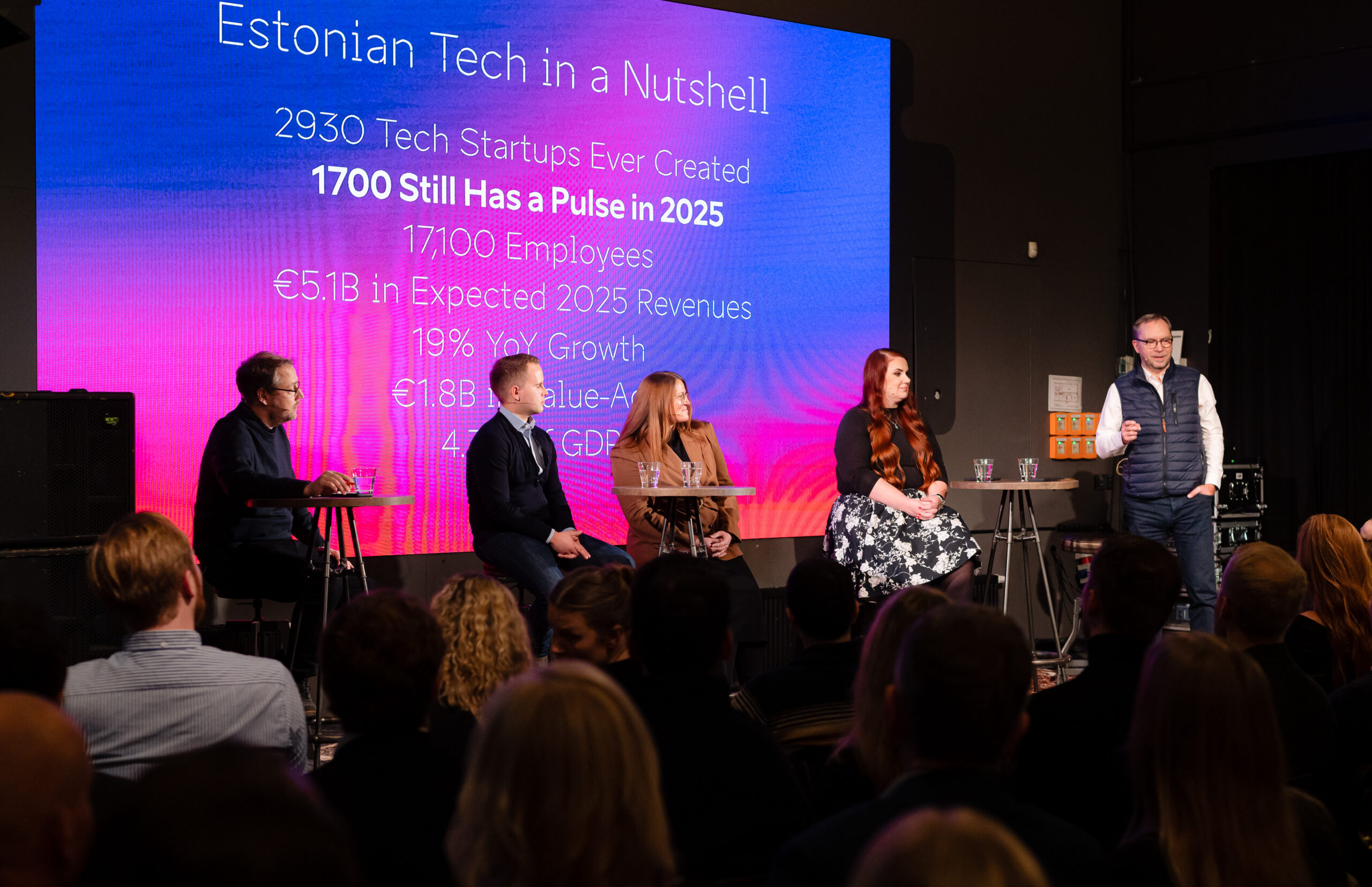
The Estonian startup ecosystem – founders, investors and ecosystem leaders – came together for its annual chat, concluding that the country’s startup sector remains resilient, highly efficient and globally competitive, and is evolving in ways that will shape its future for years to come.
Opening the discussion, Allan Martinson, the president of the Estonian Founders Society, framed the year with cautious optimism.
“It certainly wasn’t an easy year, but our founders have done excellent work.”
The numbers support this view. According to Martinson, Estonia’s startup sector generated €1.8 billion in added value, accounting for 4.3% of Estonia’s GDP – three times more than five years ago.
What makes this growth especially remarkable is its efficiency.
“The number of employees in the sector has not grown over the past four years, yet we now generate 2.5 times more added value per employee,” Martinson said. The sector’s turnover is forecast to exceed €5.1 billion, nearly 20% higher than last year, while the overall Estonian economy grew by only about 1%.
“Unlike the rest of the economy, the startup sector has not contracted even once.”
International investors are still watching Estonia closely
From an investment perspective, Estonia continues to attract strong international interest. Kärt Klein from Invest in Estonia highlighted growing attention, particularly in defence-related industries and deep tech.
“We work with international investors every day and see very strong interest. Currently, 40–50 foreign funds are actively looking for investment opportunities in Estonia, coming from an increasingly diverse range of countries. We are in a good place and moving in the right direction,” Klein said.
The angel investment landscape also offered reasons for optimism. Karin Künnapas, the CEO of the Estonian Business Angels Network, described a year of active investing and encouraging exits.
“Private investors are investing actively, both directly and through syndicates and funds. This year, we saw a record three angel syndicate exits, which brings optimism and fresh capital back into the market,” she said.
Karin Künnapas, the CEO of the Estonian Business Angels Network. Photo by Tiit Tamme.
At the same time, expectations for founders have risen.
“Angel investors have become more mature. In the past, a good idea and a strong team were enough, but today, even for early-stage funding, founders need to have something real to show.”
Where are the new founders?
One of the more serious topics discussed was the declining number of new startups being founded in Estonia. Several structural factors are behind this trend, including demographics.
“Today, we have far fewer people in their thirties than five years ago, even though this age group has historically been the most active among startup founders,” Martinson pointed out.
Allan Martinson, the president of the Estonian Founders Society, talking to Hendrik Reimand, the chairman of the board of the Estonian Private Equity and Venture Capital Association. Photo by Tiit Tamme, Startup Estonia.
Hendrik Reimand, the chairman of the board of the Estonian Private Equity and Venture Capital Association, agreed that the shortage of new founders requires focused action.
“We need to make Estonia even more attractive to foreign founders, encourage more experienced and somewhat older professionals to enter the startup sector and involve universities more strongly in commercialising scientific research,” he asserted.
The global context: entrepreneurship is not slowing down
While local challenges exist, Vaido Mikheim, the head of Startup Estonia, reminded the audience of the broader global picture.
“Every day, 137,000 new startups are founded worldwide. Entrepreneurship has not disappeared,” he said, highlighting the importance of positioning Estonia competitively in a global race for talent and capital.
The panel also addressed the broader European context. According to Kärt Klein, European venture capital funds raised €9 billion in 2025 – the lowest level in the past decade.
“This slowdown is not unique to Estonia,” she noted, adding that one of the key challenges ahead is attracting foreign fund-of-funds investors into Estonian venture capital.
Despite lower investment volumes, Estonia’s startups are proving that growth does not depend solely on large funding rounds.
“Estonia’s startup sector is profitable today, and increasing profits are replacing investor funding,” Martinson said. “This is a dramatic change that will strongly shape the sector’s development in the coming years. Estonia’s startup ecosystem is entering a new era.”


