On 26 July 1956, Egyptian president Gamal Abdel Nasser announced the nationalisation of the Suez Canal Company, the joint British-French enterprise which had owned and operated the canal since its construction in 1869. Both countries saw this as a threat to their interests and responded with a coordinated attack (with Israel) to take back the canal zone.
Israeli forces swept into the Sinai desert on 29 October and two days later there was an Anglo-French bombing campaign against Egyptian military targets. But on 6 November, under intense pressure from the international community and particularly the US, Britain and France accepted a UN-mandated ceasefire.
The Manchester Guardian was against the use of force from the beginning of the crisis. Under newly appointed editor Alastair Hetherington, the paper condemned an ultimatum given to the Egyptians to withdraw from the canal as “an act of folly without justification,” and on 5 November described the actions as “hideously miscalculated and utterly immoral”.
The Guardian’s critical coverage of the invasion proved so uncomfortable for the prime minister, Anthony Eden, that he tried to prevent the BBC from quoting from it and wanted the paper’s diplomatic correspondent, Richard Scott, banned from the airwaves. There was also strong public condemnation and as Guardian historian David Ayerst recorded, its reporters “often met with hostility as they went about their business.” In London, a plateglass window in the paper’s Fleet Street office was smashed.
Egypt nationalises Suez canal
27 July 1956
President Nasser announced last night that the Egyptian government had decided to nationalise the Suez Canal Company and to use the income from the canal of $100m a year to build the Aswan high dam. Last week the United States and Britain withdrew their offers of money for the dam. Britain is the largest single shareholder in the Suez Canal Company, owning seven-sixteenths of the total. The company’s 99-year concession was due to expire in 13 years, after which the canal would have reverted to Egypt.
Continue reading
Catalogue cover for a Guardian cartoon exhibition, 2006. Photograph: Guardian News & Media Archive
First blows by the navy and RAF
1 November 1956
Allied bombers made “concentrated attacks” last night on four Egyptian airfields, two near Cairo and two in the Suez canal zone. The RAF aircraft used were Vickers Valiants, the first of the V-class four-jet bombers, and English Electric Canberras. The targets of the attack were announced late last night. At the same time an Admiralty spokesman said that the cruiser Newfoundland, on shipping protection duties in the Gulf of Suez, had last night encountered an Egyptian frigate which failed to answer a challenge or to stop when called on to do so. She was therefore sunk and survivors taken on board the Newfoundland.
Continue reading.
Editorial: A disaster
1 November 1956
The world must be told clearly, as Mr Gaitskell said yesterday, that millions of British people are deeply shocked by the aggressive policy of the government. Its action in attacking Egypt is a disaster of the first magnitude. It is wrong on every count – moral, military, and political. It is a severe blow to Britain’s reputation, to the Atlantic alliance, to the United Nations, and, not least, to Britain’s prospect of material prosperity. To recover from the disaster will take years – if, indeed, it is ever possible. The government has ordered a military attack upon another country without just cause.
Continue reading
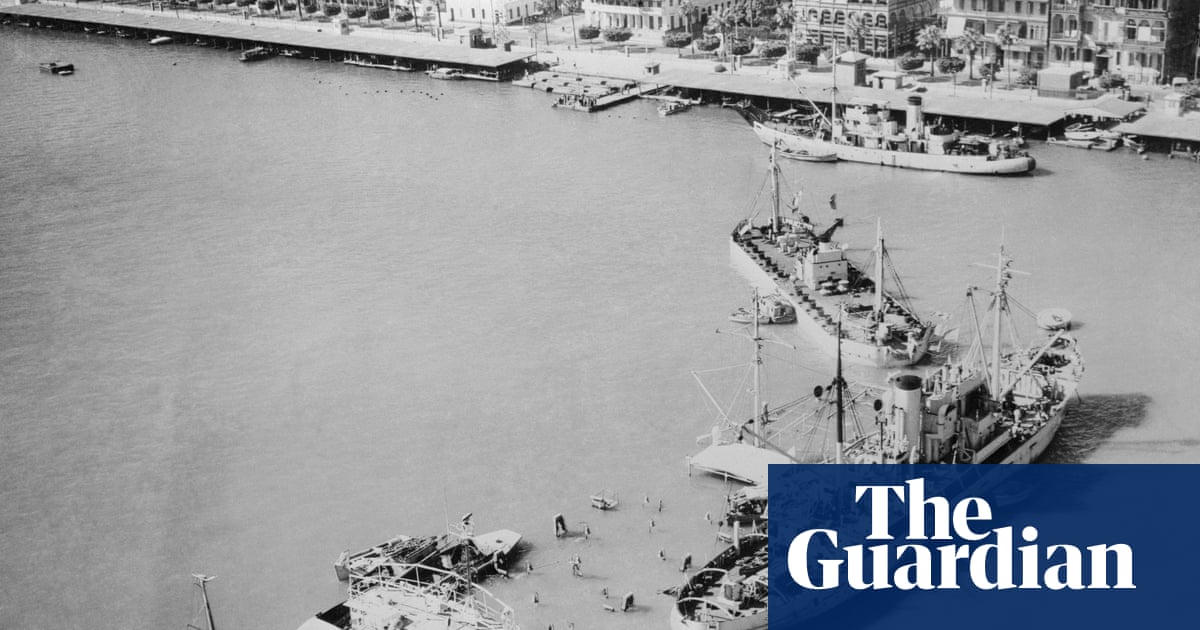
Anglo-French Troops occupy Port Said, 8 November 1956.
Fighting ends in Egypt: Allies halt 30 miles south of Port Said
7 November 1956
Fighting ended in Egypt at midnight, in accordance with the ceasefire announced by the prime minister in the Commons six hours before. Allied troops advanced all day yesterday from Port Said, and at midnight were reported beyond Kantara, 30 miles to the south.
The prime minister said the ceasefire was subject to confirmation of acceptance by Egypt and Israel, and to Allied forces not being attacked. In New York the Secretary-General of the United Nations said he could give the required confirmation.
Asked by Mr Gaitskell whether there would be no further landing of Allied troops, the prime minister said there would be “no movement forward” from existing positions, but he could not exclude what was necessary “in supplies and troops of that kind.”
Continue reading.
The Guardian, 7 November 1956. View the full page.
Premier’s position hazarded: head-shaking among the Tories
From our political correspondent
7 November 1956
Last night, the government’s decision was examined coldly both by those who wanted Sir Anthony to go the whole hog in Egypt, and by those who wished the government had never started its adventure at all. Nobody supposes that the circumstances which have now led the government to order a ceasefire were the objectives which the government originally had in mind when the adventure started.
Some Tories were shaking their heads gloomily because they believe the Arab states would argue that Israel had beaten Egypt and that Egypt had beaten Britain (it remains to be seen whether the successes that have so far attended Egypt’s arms will really impress Arab opinion).
Among the loyalists there is profound relief that the government has reversed the process of antagonising the United States. There is relief, too, that with Russia in a truculent mood Britain has taken a step to avoid the risk that her forces and equipment would be bogged down indefinitely in the Middle East. There is relief that Britain has ceased travelling away from the United Nations.
On 7 November 1956 the UN deployed an emergency force (UNEF) of peacekeepers into Egypt to halt the conflict. Egypt was granted ownership and sovereignty of the canal and in April 1957 it was re-opened to shipping.
Fears that Guardian’s editorial stance would lead to plummeting circulation were unfounded, with sales of the paper increasing, particularly in the south of the UK.
The Guardian, 31 October 1956, and a circulation graph from an internal 1957 working report. Composite: The Guardian