Your support helps us to tell the story
From reproductive rights to climate change to Big Tech, The Independent is on the ground when the story is developing. Whether it’s investigating the financials of Elon Musk’s pro-Trump PAC or producing our latest documentary, ‘The A Word’, which shines a light on the American women fighting for reproductive rights, we know how important it is to parse out the facts from the messaging.
At such a critical moment in US history, we need reporters on the ground. Your donation allows us to keep sending journalists to speak to both sides of the story.
The Independent is trusted by Americans across the entire political spectrum. And unlike many other quality news outlets, we choose not to lock Americans out of our reporting and analysis with paywalls. We believe quality journalism should be available to everyone, paid for by those who can afford it.
Your support makes all the difference.Read more
Archaeologists in Denmark have unearthed a vast Viking Age textile production site, dating back over a millennium, which offers compelling evidence of the sophisticated nature of Viking society.
Experts from the Moesgaard Museum announced this week that the sprawling 100,000-square-metre site, located in Søften, 10 kilometres north of Aarhus on the Jutland peninsula, features a dedicated area for processing flax. It also includes more than 80 pit houses – semi-submerged huts that served as workshops and dwellings during the Viking era.
The site’s origins trace back to the late Iron Age and early Viking Age, specifically between A.D. 600 and 950.
Liv Stidsing Reher-Langberg, the archaeologist who led the 10-month excavation, highlighted the site’s unique focus. “We have a clear focus on textile production, which makes this settlement different from other kinds of settlements of this period,” she stated.
An aerial shot shows an archaeological site in Soften near Aarhus, Denmark (AP)
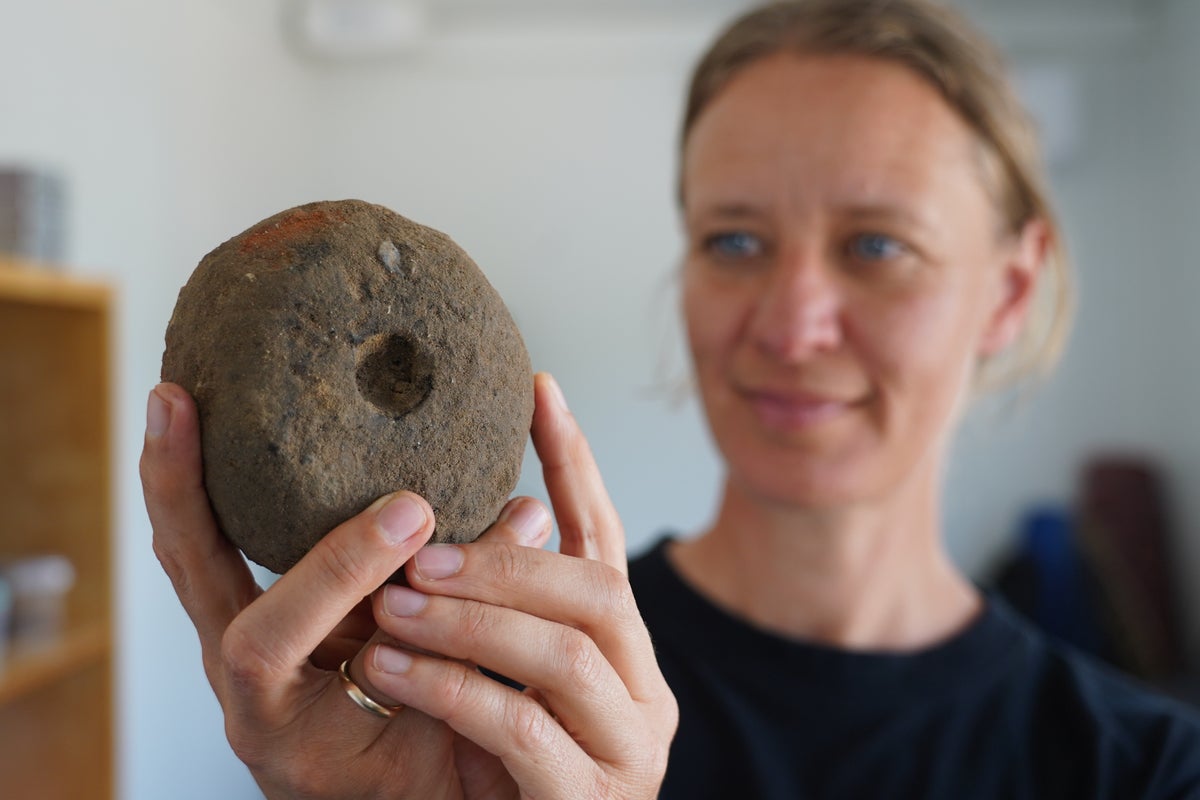
Evidence such as spindle whorls and weight looms found within the pit houses confirms the extensive textile work. Archaeologists also uncovered silver coins, glass beads, and pottery.
The discovery of distinct areas for production and crafts, alongside a single residential home, suggests a highly organised operation overseen by a powerful individual who controlled resources and output.
Reher-Langberg noted that metal detector enthusiasts had previously found several silver coins in the area over the past three decades, prompting a trial excavation 18 months ago that piqued archaeological interest before construction began on a new road and industrial area.
Kasper Andersen, a historian at Moesgaard Museum, described the Søften discovery as “another piece in the puzzle” for understanding the region’s economic, cultural, and political landscape of the period. During the Viking era, Aarhus – then known as Aros – was a hub for royalty and international trade.
A separate Viking site discovered last year in Lisbjerg, just 4 kilometres away, is believed to have housed members of the nobility.
Moesgaard Museum archaeologist Liv Stidsing Reher-Langberg holds a Viking Age glass bead unearthed in Aarhus, Denmark (AP)
Andersen explained that goods and resources were likely transported from rural settlements like Søften to Aarhus, before entering an extensive international trade network. “When you have a production site of this scale, it cannot be only because of the local area. It needs to be understood as part of a greater network, a much bigger international perspective,” he said.
The findings at Søften, Andersen noted, challenge the simplistic notion of Vikings as “not just simple, uncivilized, barbaric hordes, rambling about Europe.” He added: “To have a place like Søften, you need a very well-organized society with a production line, and you also need a market to have the production.”
Reher-Langberg hopes future carbon dating and pollen analysis will shed further light on the specific types of textiles produced at the site.