—
Many are wondering why so many buildings completely collapsed in the Venezuelan earthquake, leading to so many deaths and injuries.
By BBC Mundo (Efecto Cocuyo)
HAVANA TIMES – The devastation caused by the two earthquakes measuring 7.2 and 7.5 on the Richter scale that struck Venezuela on June 24th was so severe that many are wondering why so many buildings collapsed, leaving so many thousands dead and injured.
On that fatal Wednesday, the movement of the South American tectonic plate and the Caribbean plate generated a massive release of energy from the Earth’s depths. The tremors peaked off the northern coast of Venezuela, in what has been dubbed “ground zero” of the catastrophe: La Guaira state. The actual epicenter of the twin earthquakes was in Yaracuy state—the first near San Felipe, and the second near Yumare. However, the rupture in the Earth’s crust was so extensive that the seismic waves traveled all the way to the coast of La Guaira, where the San Sebastian Fault is located, the point of friction between the tectonic plates.
How many buildings collapsed in La Guaira, and why? The answer is still under study, but scientists have some clues.
“There can be more than 50 reasons why buildings collapse,” Feliciano de Santis, president of the Venezuelan Society of Geologists, told BBC Mundo.
Among these factors were the impact of the seismic waves from two earthquakes—a twin phenomenon last recorded in the country in 1812—and La Guaira’s proximity to the area where a massive amount of seismic energy was released. The type of soil and the resonance in the buildings also played a role, in addition to construction defects, De Santis noted.
Estimates suggest that thousands of people could be buried under the rubble.
The government—which declared La Guaira a disaster area—reported this week that more than 800 buildings were damaged nationwide, most of them in La Guaira. Independent reports, such as that from the Environmental Systems Research Institute (ESRI), estimate the number of damaged buildings at around 900.
NASA, for its part, made a preliminary estimate of the number of buildings that might have sustained damage throughout Venezuela, putting the figure at around 59,000, although that projection is for reference only and doesn’t include on-site verification.
What could have caused the collapse of buildings on Venezuela’s northern coast?
1) The direct impact of seismic waves in La Guaira
The coastline of La Guaira state was directly hit by seismic waves because it is located directly in front of the San Sebastian fault, where two tectonic plates meet and move very slowly in opposite directions.
This fault runs along the seafloor from west to east, almost parallel to the coast. It was precisely there, very close to the coastline, where the fault rupture triggered by the double earthquake had the greatest impact.
“The double event had all the characteristics of a disastrous earthquake anywhere in the world,” Rafael Abreu, a geophysicist with the U.S. Geological Survey (USGS), explained to BBC Mundo. It had a high magnitude, long duration, shallow depth, and a rupture—or horizontal slip—with characteristics that exacerbated the phenomenon, the expert stated.
Source: Global Earthquake Model Foundation. Part of the San Sebastian fault passes facing the La Guaira coastline.
José María de Viana, a civil engineer and professor at Andrés Bello Catholic University, added that the greatest impact of the second earthquake occurred off the coast of La Guaira, according to technical studies by Italy’s National Institute of Geophysics and Volcanology and the USGS.
“That helps us understand why the devastation was so exceptional there,” he explained. “The impact was at point-blank range.”
The last recorded seismic doublet in Venezuela dates back to 1812.
The Italian research, the expert said, revealed that the landslide reached a maximum depth of 3.6 meters on the seafloor just north of the city of Catia La Mar, in La Guaira, one of the areas hardest hit by the disaster.
In other areas, the fault rupture was only a few centimeters, Sergio Barrientos, director of the National Seismological Center at the University of Chile, pointed out. “The fault does not move the same way everywhere,” a phenomenon that explains why the effects vary.
In places where the rupture is larger, he said, “seismic waves are stronger and have greater amplitude, even if the epicenter was elsewhere.”
2. Soil Characteristics
Experts are wondering whether there was negligence or corruption in the construction of some buildings in La Guaira.
In addition to the destructive power of the seismic doublet, did the buildings collapse because the soil was soft or because they were poorly constructed? That’s the big question many experts are asking. As is often the case, there is no single answer.
“Not all soils are the same in La Guaira,” warned Michael Schmitz, a professor of geophysics at Simón Bolívar University and the Central University of Venezuela.
Within the state, he says, there are specific locations—such as the city of Caraballeda—where there is indeed a deep basin about 400 meters deep, and the softer soil type contributed to the collapses.
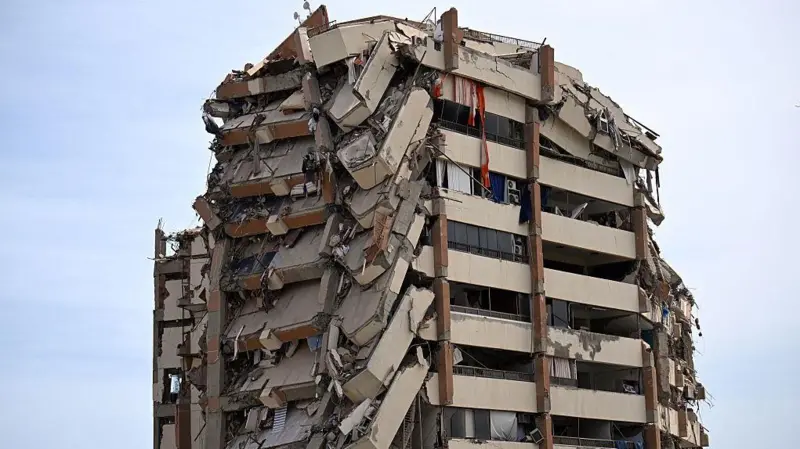
Hundreds of buildings suffered severe damage or collapsed completely, according to official reports. Photo: AFP via Getty Images
But in areas such as Catia La Mar—a tourist town that now resembles a war zone—the soils tend to consist of intermediate rock instead.
There are areas of La Guaira that are situated on alluvial cones that have accumulated soft sediment that isn’t very thick, detailed De Viana. These sedimentary soils “acted as a filter that drastically amplified the ground movement.”
Ruth Quereguán, a researcher at the School of Geology, Mining, and Geophysics at the Central University of Venezuela, toured Catia La Mar and the area surrounding Maiquetía International Airport in La Guaira. “I saw as much or more devastation than during the landslide,” she stated, referring to the tragedy caused by the landslides on El Ávila Hill in December 1999.
Those landslides directly affected La Guaira (at that time called Vargas State). Nearly three decades after that tragedy, the same area was the scene of the double earthquake. These two events, she argued, “are two overlapping phenomena.”
In La Guaira, there are many soils that are partially consolidated as a result of landslides—that is, they are soils formed by sediments with moderate strength. Therefore, she explained, these sedimentary soils may have contributed to the collapse of the buildings. “We’ll have many more answers once we have more data available.”
Explorations are even contemplating the possibility that the seismic double event was actually a triple event.
Entire families were left buried under the rubble. Photo: AFP via Getty Images.
3. The Quality of Construction
Regarding the quality of buildings, Ruth Quereguán noted that, following the 1999 landslides in El Ávila, some of the homes that were partially damaged were rebuilt. The problem, she said, is that experts don’t know whether the occupancy permits, building permits, or the types of materials used were verified. “There was certainly negligence” in some cases, she speculated.
Then there are the buildings that were constructed after the landslides. There is also no certainty that, for example, the appropriate soil studies were conducted for the new buildings, she stated.
“Were the standards established after the 1967 earthquake followed? We don’t know,” added Queraguán. The code governing earthquake-resistant construction, which has been updated on several occasions, went into effect in the early 1970s.
Nearly three decades ago, Venezuela suffered a landslide that also affected La Guaira with devastating consequences. Photo: AFP via Getty Images
It is likely that some of the buildings in La Guaira did not comply with the code, she affirmed. “That’s where negligence and corruption come into play.” And in that regard, “you can’t hide the sun behind your finger.” In any case, she added, we must wait for qualified professionals to provide answers.
So far, some members of emergency response teams who have traveled from other countries to assist with rescue and debris removal efforts have been surprised by the use of construction materials they describe as “substandard.”
One of them, who preferred to remain anonymous, reported that in a building in La Guaira he found beams made of a lightweight material that can be broken by hand (technically, expanded polystyrene) and that were covered with a layer of concrete just a few centimeters thick. He also found columns without rebar inside them.
The technical studies to be published in the wake of the tragedy in La Guaira will likely provide evidence that will help clarify more precisely what happened to the ground and the buildings.
Preliminary projections suggest that the rupture in the underground strata caused by the double earthquake extended up to 200 kilometers. Photo: AFP via Getty Images
Published in Spanish by Efecto Cocuyo and translated and posted in English by Havana Times
Read more feature articles here on Havana Times.