Who Is Emirlendris Benítez?
Emirlendris Benítez
She is one of the most emblematic faces of the suffering endured by political prisoners in Venezuela.
By Efecto Cocuyo
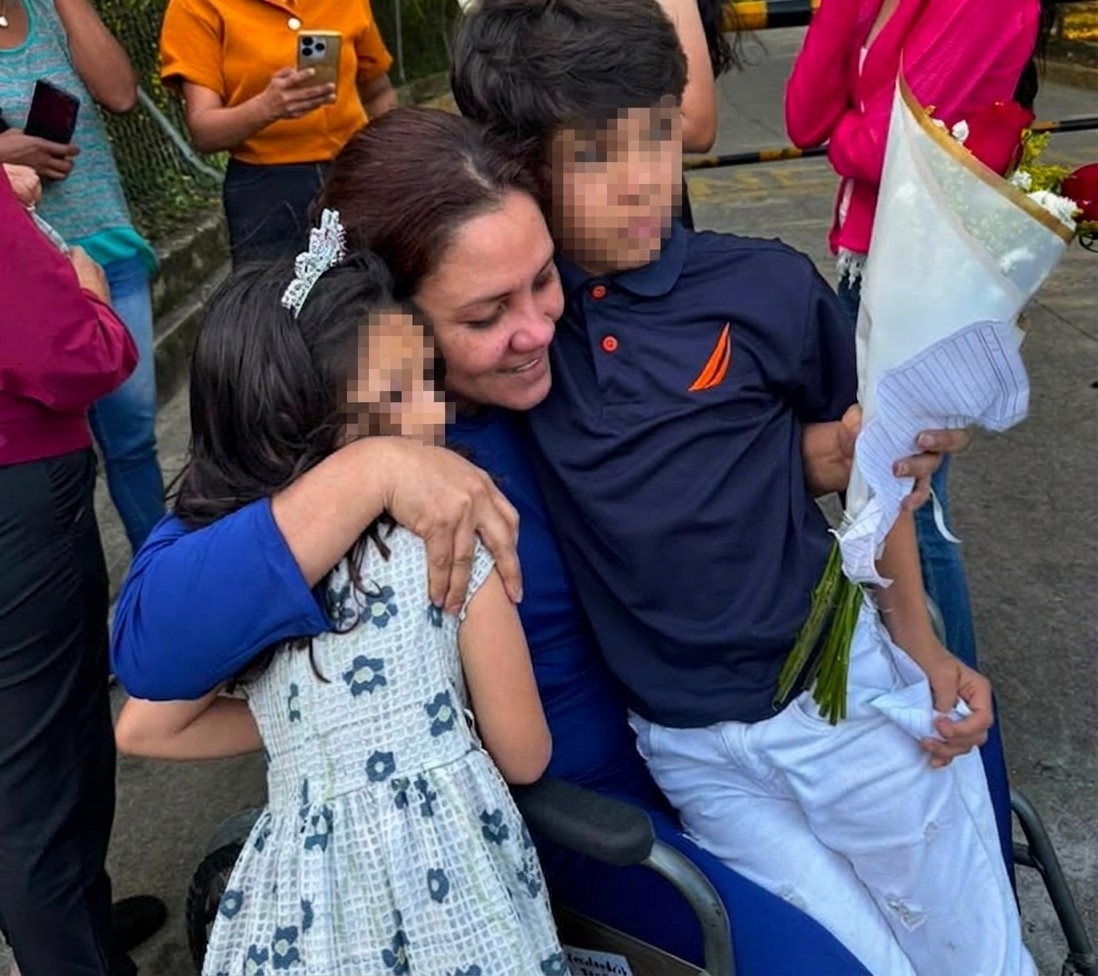
HAVANA TIMES – Few cases like that of Emirlendris Carolina Benítez Rosales have shaken the Venezuelan public in recent years. The history of her arrest and conditions of imprisonment is marked by irregularities, torture, injustice, and inhumane treatment. The merchant was imprisoned in 2018 and suffered multiple violations of her physical and psychological integrity so severe that the aftereffects will not easily disappear with time. On Friday afternoon, August 14, she was released after eight years in detention.
Her release from prison is a cause for celebration for thousands of people inside and outside the country, as she has become one of the most emblematic faces of the suffering endured by political prisoners in Venezuela, having resisted as best she could multiple humiliations under precarious conditions.
Before her life changed abruptly at kilometer 163 of the Jose Antonio Paez Highway in Portuguesa State, Emirlendris enjoyed a quiet daily life with her young son, kept in close touch with her older daughter, and went about her work without incident. She sold cosmetics and clothing, stayed out of trouble, and worried about the looming economic crisis like most people in the country.
Benítez was arrested on August 5, 2018, while accompanying her partner, Yolmer Escalona, a taxi driver, as he transported two passengers to Barinas. A police checkpoint stopped them along the way and, without presenting a court order or offering any explanation, took Emirlendris directly to Caracas. The two passengers riding in the back of the vehicle were allegedly involved in a purported drone assassination attempt against Nicolás Maduro that had taken place on August 4. At the time, Emirlendris was four months pregnant. “Despite telling them this, her tormentors ignored it,” a relative told Efecto Cocuyo in June 2022.
Without understanding why, she was taken to the headquarters of the General Directorate of Military Counterintelligence in Boleíta, Caracas, where she was held for a year. There she was subjected to systematic beatings and torture that caused her to miscarry, abuses that were documented by various organizations. Amnesty International reported that her pregnancy was terminated at a medical facility without her knowledge or consent.
She was subsequently transferred to the National Institute for Female Guidance in Los Teques, Miranda State. There she suffered complications from a previous injection of biopolymers into her buttocks. As a result, her spine was severely damaged, and Emirlendris had to begin using a wheelchair because chronic pain prevented her from standing for long periods.
Initially, her pretrial detention exceeded the three-year maximum established under Venezuelan law. On August 4, 2022, she was sentenced to 30 years in prison, the maximum penalty allowed under the country’s laws, after being charged with seven crimes she did not commit: criminal conspiracy, terrorism, attempted aggravated murder, aggravated murder with premeditation and for futile motives, treason, throwing explosive devices in public spaces, and property damage.
She was 38 when she was arrested and 42 when she heard the sentence.
A 30-Year Sentence
Emirlendris’s family always maintained that she was innocent of all the charges against her and repeatedly denounced her detention as arbitrary. Nongovernmental organizations described the case as an aberration and said her trial was riddled with serious irregularities. To begin with, there was no actual evidence that Benítez had participated in the drone incident.
In April 2024, Judge Katherine Harrington upheld Emirlendris’s 30-year prison sentence. Human rights defenders said the State was denying her urgently needed medical care. In October 2022, she had an encapsulated breast implant, suffered from fluid retention, and a spinal hernia. Two years later, she could barely endure the pain in her head and legs.
Benítez’s youngest son received psychological care after her conviction. At first, the family told the boy that his mother was working rather than in prison, which eventually led him to ask the guards at the prison to let her go so that she “wouldn’t have to work anymore,” according to testimony from Melania Leal, Emirlendris’s sister.
In 2024, the Venezuelan Prison Observatory described the jail as a “cemetery of living women.” At the time, 650 women were imprisoned there, although the facility had a capacity of only 350 people. This amounted to 185.71% occupancy, representing critical overcrowding. Emirlendris’s relatives also denounced the unsanitary conditions in which she was being held.
A Dozen Organizations Called for Her Release
Benítez’s case was closely followed by national and international organizations. Dozens of human rights defenders advocated on her behalf during the years she was imprisoned. The UN Committee Against Torture (CAT) and Amnesty International documented her case and demanded that the Venezuelan State investigate it. The UN Independent International Fact-Finding Mission on Venezuela included Emirlendris’s situation in its reports on crimes against humanity, while the Inter-American Commission on Human Rights granted precautionary measures on her behalf and demanded that the Maduro government guarantee her physical integrity.
Within Venezuela, organizations including Provea, Foro Penal, the Center for Justice and Peace, Justice, Encounter and Forgiveness, the Coalition for Human Rights and Democracy, and A World Without Censorship repeatedly denounced the mistreatment to which Emirlendris was subjected.
Today, Benítez is breathing the air of freedom again and, for the first time in eight years, will have dinner at home with her family. Her story will remain etched in the collective memory as one of the chapters in Venezuela’s history of repression and prison torture. Human rights defenders and activists are celebrating her release on social media:
“We welcome confirmation of the release of Emirlendris Benítez and other people who were arbitrarily detained. However, we reiterate: Freedom is not a concession, but rather the imperative restoration of a human right that should never have been violated. No person should be imprisoned for political reasons,” Cofavic stated on its X account on Friday.
First published in Spanish by Efecto Cocuyo and translated and posted in English by Havana Times.
Read more news here on Havana Times.