File photo / Confidencial
The report of the Group of Experts on Nicaragua was presented to the UN Human Rights Council and endorsed by nearly all countries.
Por Confidencial
HAVANA TIMES – More than a dozen countries expressed their “alarm at the findings” of the new report of the Group of Experts on Human Rights in Nicaragua (GHREN), presented to the UN Human Rights Council. The document exposes how the regime of Daniel Ortega and Rosario Murillo used State resources to sustain repression in Nicaragua and extend a surveillance and intelligence network aimed at persecuting Nicaraguans in exile.
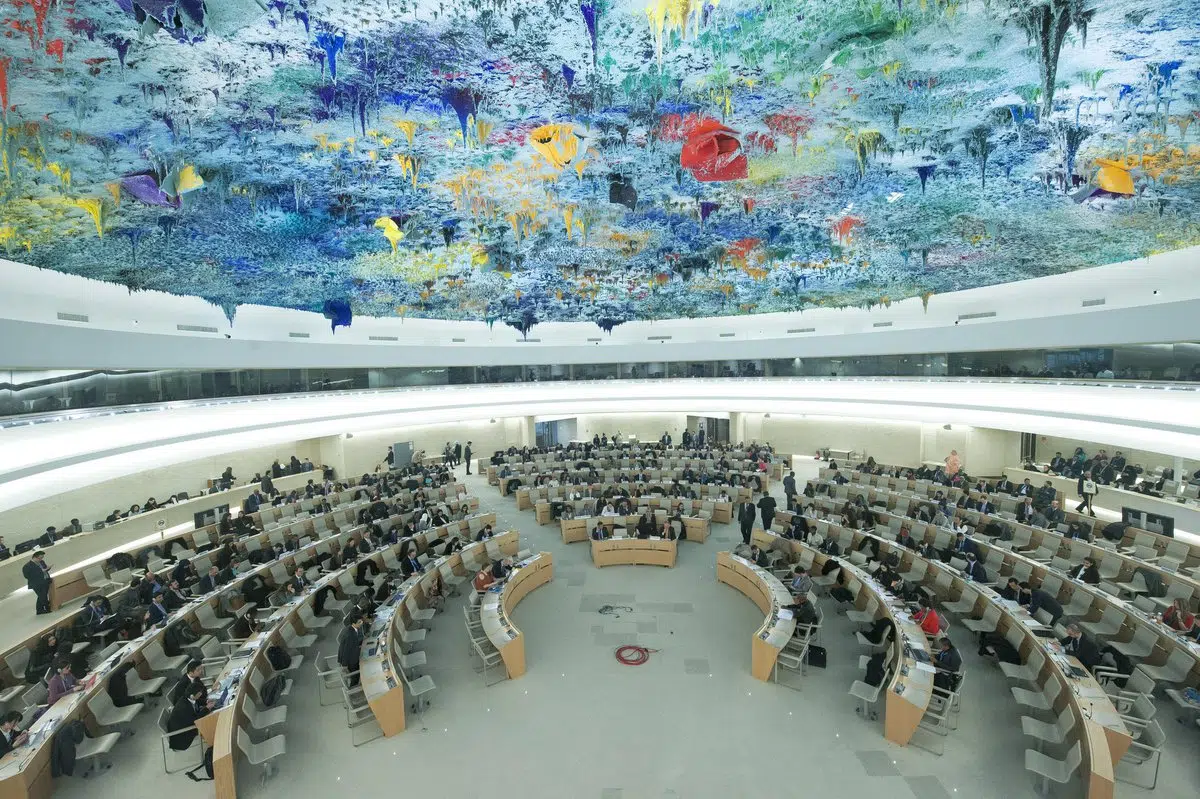
During an interactive dialogue held in Geneva on Monday, March 16, 2026, as part of the Council’s 61st session, GHREN urged the Nicaraguan regime to “dismantle the architecture of repression.”
“We have documented the functional connection between the Sandinista Party’s parallel structure within the State, the misuse of public funds, its accounting cover-up, and the serious human rights violations in Nicaragua,” said Jan-Michael Simon, chair of the Group of Experts, in his presentation before the UN Human Rights Council.
Representatives of Costa Rica, Canada, Chile, Brazil, Paraguay, and Spain condemned the human rights violations recorded in the country.
Spain denounced the “consolidation of a system of tight control” that eliminates human rights domestically and “extends its architecture of harassment and threats beyond its borders.”
“We are concerned about the Group’s findings on the harassment of Nicaraguans in exile, including incidents that have taken place on our territory,” said Spain’s representative, Clara Cabrera.
Costa Rica “appalled” by GHREN findings
GHREN determined that Rosario Murillo leads a “vertical chain of command” coordinating a broad surveillance and intelligence network designed to identify which exiled Nicaraguans should be targeted, by establishing “threat categories.”
Costa Rica—one of the main host countries for Nicaraguans fleeing repression—said it was “appalled by the transnational repression” documented in the report, particularly the “acts of surveillance, physical and digital harassment, and threats faced by Nicaraguans in exile, carried out by intelligence networks linked to the Nicaraguan State,” according to the report.
“The investigation into the murder of Roberto Samcam in San José in June 2025 points to political motives, as indicated in the GHREN report (…) authorities have activated certain institutional mechanisms to provide safeguards for exiled individuals,” said Costa Rican delegate Roberto Cespedes.
Viviane Ferreira, representing Brazil, said her government views with “concern the persistent deterioration of the rule of law and democratic guarantees” in Nicaragua.
“The report identifies ongoing patterns of serious human rights violations, including arbitrary detentions, enforced disappearances, and restrictions on due process,” Ferreira said, while calling on the Nicaraguan dictatorship to “put an end to human rights violations.”
Alexandra Salazar, representing the International Service for Human Rights, noted that the regime currently holds 46 people imprisoned for political reasons, who are subjected to a “torturous environment, prolonged isolation, physical violence, and the deliberate denial of medical care.”
Canada calls for an end to the persecution
Canada’s delegation, speaking on behalf of a group of countries, called on the UN Human Rights Council to “follow up and support accountability efforts.”
“Reports of killings and physical attacks against exiles are deeply concerning, and those incidents must be investigated thoroughly and swiftly in accordance with national legislation. We urge the Government of Nicaragua to immediately cease the persecution,” said Canadian delegate Patricia Lyn McCullagh.
Since the beginning of its mandate, the Group has sent 21 letters requesting information from the regime, but “they have received no response.”
“We view with concern the findings of the report, which once again document persistent patterns of human rights violations, including arbitrary detentions, enforced disappearances, restrictions on civic space, and the arbitrary deprivation of nationality,” said Maria Paz Florenzano of Chile.
Mario Raul Cano of Paraguay said that the “consolidation of constitutional reforms” has given the Ortega-Murillo regime “a total concentration of power, undermining democratic principles.”
“Repression, persecutions, and disappearances have become systematic practices,” denounced Cano.
The Deterioration of Human Rights is “ongoing”
Other countries that backed the GHREN report and condemned the regime’s authoritarianism include:
- Latvia: speaking on behalf of the Nordic and Baltic countries, said that “the situation in the country continues to deteriorate.”
- European Union: expressed concern over the “ongoing deterioration of democracy” in Nicaragua.
- Argentina: its delegate said the report “cries out to us with painful clarity” and that “prima facie crimes against humanity have been committed in Nicaragua.”
- Georgia: denounced the use of “gender-based and sexual violence to prevent women from protesting or participating in political activities.”
- Uruguay: rejected the “policy of arbitrary deprivation of nationality as a tool of repression.”
- Cyprus: said that “repression also has consequences for exiles.”
- Poland: said that in the country, “students are afraid to say what they think, journalists are forced into exile, and families no longer know whether they will ever see their loved ones again.”
- Dominican Republic: stressed the “importance of guaranteeing respect for the rule of law, the independence of institutions, and due process.”
- Peru: said that the repression has “implications for democratic stability and the rule of law in our hemisphere.”
- United Kingdom: warned that “scrutiny and international monitoring” are needed.
- Ukraine: called for “accountability for human rights violations.”
China was the only country to reject the report. The Chinese delegation defended the regime and said that it “welcomes the efforts of the Government of Nicaragua to promote and protect human rights.”
The report was presented in compliance with Council resolution 58/18, through which the mandate of the Group of Experts was renewed for two years and the Group was asked to submit its comprehensive report during this session.
Read more from Nicaragua here on Havana Times.