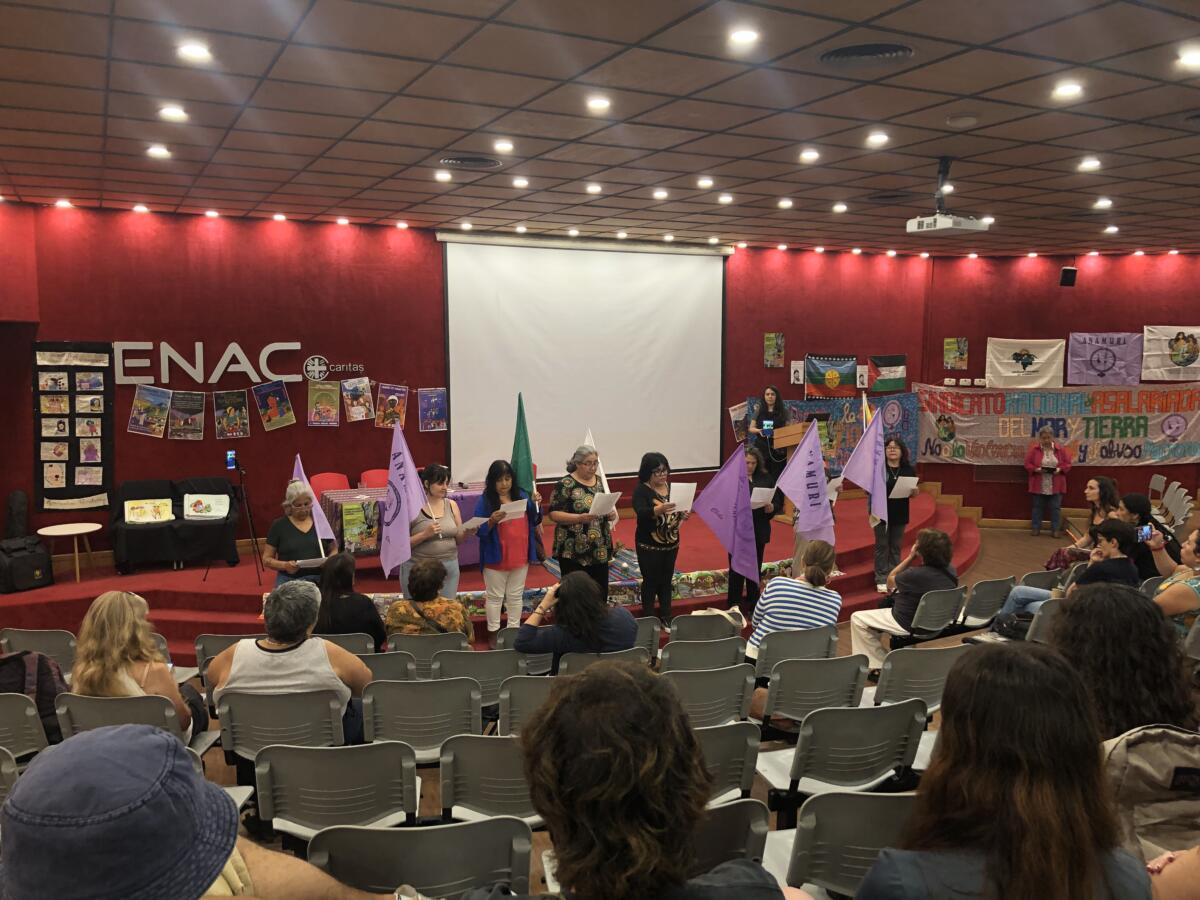
Women peasant leaders in Chile read a proclamation at the start of sessions analyzing the situation of seasonal workers due to the massive use of highly dangerous pesticides on large agricultural farms. Image: Orlando Milesi / IPS
By Orlando Milesi (IPS)
HAVANA TIMES – Rural women in Chile have denounced a strong uptick in the use of dangerous pesticides in the large agro-export businesses, along with the deterioration of their labor and environmental conditions.
They testified during an Ethical Tribunal set up during a meeting of the leaders of the National Association of Rural and Indigenous Women (Anamuri) with participants from all parts of the elongated South American country.
Over ninety leaders analyzed the increased use of pesticides in the agricultural tasks as one of the growing environmental problems impacting these labors. They declared the large agro-export companies guilty of using highly dangerous pesticides in their thousands of acres devoted to single crops.
In 1990, Chile imported 17,942 tons of pesticides, a quantity that increased in proportion to the rise in monocultures, until in 2024 such imports reached 53,140 tons. Many are unnecessary and only aimed at increasing productivity.
Berta Saavedra, 66 and a farmers’ daughter, worked as a day laborer for 35 years at the Hacienda El Sauce, on the outskirts of the city of Los Andes in Chile’s Valparaiso region, 80 kilometers northeast of the capital Santiago. The region produces grapes, avocados and peaches. The day laborers there are transitory workers, mostly women, who are contracted for short or successive periods.
She recounts that she was pruning vines right where a fumigation tractor passed by, and the fumes poisoned her. “I got nauseous and dizzy. My face turned all red, and my body was pocked with hives. I felt ill and my blood pressure shot up,” she recalled in conversation with IPS.
She received very inadequate attention at the health clinic she was taken to. “The doctor looked at me and said, ‘Go wash – wash yourself well, even your hair, with soap.’ And that was all. They didn’t give me anything, and there was no way to prove it was intoxication from the spray, because the farm covered everything up. I don’t remember the name of the poison,” she stated.
But the consequences remained. “You’re left sensitive – everything affects you. For example, if I go to San Esteban (neighboring town) where they often fumigate, just as soon as I smell it my head hurts and I feel discomfort,” she said, adding: “a lot of other women were working on the pruning like I was. Some of them also felt like throwing up, but they weren’t as affected as I was.”
A decade ago, Bertha sued the hacienda for damages and succeeded in obtaining a small compensation. She currently works as a security guard.
Female farmers from various regions of Chile participate in an assembly where they discussed, among other topics, the adverse effects of pesticides and the poor working conditions faced by seasonal female farmworkers. Image: Orlando Milesi / IPS
Wealth and poverty
During the Ethical Tribunal that Anamuri organized for Global No Pesticides Day on December 3, sociologist Maria Jose Azocar from the SOL Foundation, argued that the large agribusinesses translate into “wealth at the cost of poverty.”
Chilean agribusinesses are large-scale producers and marketers of agricultural products, mainly destined for export. The sector is showing a growing propensity for monoculture.
Maria Azocar detailed that the agricultural sector as a whole generates some 600,000 jobs directly with a downward trend. Many of these jobs are taken by migrants who come to Chile in search of better pay.
“However, half of these jobs generate an income under US $543 dollars – barely a subsistence wage. They’re unskilled labor, and 40.6% of the jobs are informal,” she asserted. She characterized agriculture as a dangerous occupation due to the health risks and its high mortality rate.
On the other end of the wealth-poverty scale are the companies, which reap significant profits from their exports. Maria Jose Azocar cited the example of Hortifrut, a producer and exporter of various berries, whose revenues between 2018 and 2024 reached $1.165 billion, including profits of $193 million.
According to the Research Department of the Undersecretariat for International Economic Relations (Subrei), between January and July 2025, Chile’s total exports reached US$60.961 billion, led by mining, followed by agriculture. Agricultural exports totaled $14.18 billion, an increase of 8.7% over the same period last year. Fresh fruit alone contributed $6.041 billion, an increase of 3.3%.
Berta Saavedra, a Chilean woman, was seriously poisoned at the El Sauce farm in the municipality of Los Andes, northeast of Santiago, while working in the vineyards as a tractor was spraying the vines. Image: Orlando Milesi / IPS
Hidden fallout from the export development
Alicia Muñoz, national director of Anamuri and its president until last September, denounced to IPS the precarious working conditions of agro-export workers. “The agribusiness system has disastrous practices and violates workers’ rights, causing severe damage and contamination of biodiversity. These violations continue ever more serious, despite the fact that we’ve been denouncing them for many years,” she stated.
More specifically, “the violation of labor rights manifests itself through incomplete or delayed wages, lack of social security coverage, excessive unpaid working hours, unjustified dismissals, and denial of vacations and written contracts,” she added.
According to Muñoz, “these abuses are exacerbated in the case of women, who are exposed to sexual harassment; and migrants, who are often deceived by contractors who are human traffickers.”
Highly hazardous pesticides have genotoxic, neurotoxic, and reproductive effects, and cause malformations in offspring. Their impact extends to those who live on the outskirts of large properties that are sprayed, at times by aircraft.
The situation is exacerbated in Chile, because the country permits the use of pesticides that are banned in the European Union (EU), such as Dormex, which is imported from Europe to this country due to more lax legislation.
Maria Elena Rozas of the Network for Pesticide Actions and the Alternatives for Latin America (Rap-Al) explained that in Chile they use pesticides with 400 active ingredients, 100 of them highly dangerous. Rap-Al is a network of organizations, institutions, associations, and individuals that challenge the massive and indiscriminate use of pesticides and propose formulas for reducing their use.
In 2024, there were 651 reported and confirmed cases of acute pesticide poisoning in Chile, with a total of 20 deaths, two of them work-related, she noted.
“In the Maule region, in 2024 there were 125 work-related cases of acute pesticide poisoning,” she continued, pointing to one of the most productive agricultural regions, located in the center of the country. She recalled that the toxic burden on the body in these cases is lifelong, and lamented: “it is very difficult to prove these cases legally, allowing, those responsible to go unpunished for these violations of the human right to health.”
Members of the Ethics Tribunal present their findings on the environmental and labor conditions faced by seasonal female workers in Chile’s large-scale agro-export monocultures. Image: Orlando Milesi / IPS
Liliana Zúñiga, a biologist at the Catholic University of Maule, told IPS that the effects of these pesticides have been studied mainly in women, but in fact entire families are affected.“ Some are agricultural workers, and others are these workers’ wives, since it’s the wives who help them wash their clothes and machines and thus are also exposed to the pesticide risks.”
According to Liliana Zúñiga, “the potential damage can be very profound, because these are families who are left to live the rest of their lives with the drama of often untreatable malformations.”
The biologist explained that the effects of pesticides depend on their toxicity, the duration of exposure, and the dose. She added that their effects have been linked to mental health as well, for example, depressive symptoms. The risk of exposure extend to the entire population, since food is the main source of exposure to pesticides.
Zuñiga warned that there is underreporting of such acute poisoning cases.
For her, the big question is how to reduce the amount of pesticides released into the environment. There’s both a conventional and an agroecological way of farming, she explained.
“They are two very different worlds. On the one hand, industrial agro-export, a model we know well after 30 or 40 years, employs pesticides full force before the pest appears. On the other hand, there’s agroecology, where the logic is that pesticides are a last resort,” Zúñiga explained.
She emphasized that agroecology aims to avoid monocultures that are endless acres of a single type, but rather to promote mixed crops, where the plants themselves help control pests.
“I have seen agroecological gardens where eggplants are planted alongside tomatoes because they attract the tomato flies. The plants help control pests,” she explained. There are also organic pesticides, although they’re more expensive and are not widely used.
“We know that traditional agriculture uses more toxic pesticides because they are considered more effective,” Zuñiga stated.
In her opinion, family farming, which feeds the majority of Chileans, is also part of the problem, “because it has the least control over pesticide use.”
The Rap-Al network called for an immediate ban on highly dangerous pesticides, and indicated that decisions on this issue are rooted in politics rather than technology.
According to Rap-Al, “political will is needed, not only to recognize the effect of these toxins but also to generate technological, food, credit, and land policies that enable producers to transition to sustainable, resilient, and viable agroecosystems.”
First published in Spanish by IPS and translated and posted in English por Havana Times.
Read more from Chile here on Havana Times.