The Death of Awdah Hathaleen in the West Bank
By Democracy Now
HAVANA TIMES – One year ago, an Israeli settler shot and killed the Palestinian activist Awdah Hathaleen in the occupied West Bank. Hathaleen, an English teacher and father of three young children, played a key role in the production of the Oscar-winning documentary No Other Land, which follows Palestinians in the community of Masafer Yatta as they struggle to stay on their land amid violent attacks by Israeli settlers.
A new report from the Palestinian human rights organization Al-Haq looks closely at the circumstances of his death and the culpability of his killer, Yinon Levi, who has yet to face any legal consequences for Hathaleen’s death.
Since October 7, 2023, about 1,100 Palestinians have been killed by Israelis in the West Bank, says Al-Haq’s Tahseen Elayyan. “None of these [deaths have] been held accountable by the Israeli legal system, which tells us a lot. It tells us that the Israeli occupying forces and the Israeli government are involved in these crimes, and this reflects a state policy … that aims at entrenching Israel’s settler-colonial project in the occupied Palestinian territory.”
Transcript
AMY GOODMAN: This is Democracy Now!, democracynow.org. I’m Amy Goodman.
“The Killing of Awdah Hathaleen: Beyond a Settler Crime.” That’s the title of a major new investigation by the Palestinian human rights group Al-Haq, released a year after the fatal shooting of Hathaleen, a Palestinian activist, English teacher, father of three young children. He was fatally shot by an Israeli settler in a village near Hebron in the occupied West Bank, July 28th, 2025. Hathaleen played a key role in the production of the Oscar-winning documentary No Other Land, which follows Palestinians in the community of Masafer Yatta as they struggle to stay on their land amidst violent attacks by Israeli settlers.
Residents identified Hathaleen’s killer as Yinon Levi, an Israeli settler who was put on a European Union sanctions list in 2024 for his violent attacks on Palestinians and their property. The Trump administration last year lifted the Biden-era U.S. sanctions on Levi. Al-Haq’s Forensic Architecture Investigation Unit used synchronized video footage, a three-dimensional digital reconstruction of the scene and expert analysis to recreate what happened the day Awdah Hathaleen was killed, concluding he was fatally shot by Levi as he stood unarmed in the public garden of Umm al-Khair’s community center filming settlers operating an excavator in the distance.
This is a clip from the Al-Haq investigation into Awdah’s killing.
Upon his arrival, Levi is observed with his firearm drawn prior to any physical confrontation with residents. As activists document the excavator operation, an altercation begins between Levi and the residents. At 5:29 p.m. and 13 seconds, Levi fires a single shot, which hits Awdah in the heart, causing his death. Five seconds later, he fires another round toward his left.
In the footage recorded by Awdah, Levi is seen moving laterally to his right immediately prior to firing, stepping aside from surrounding individuals while maintaining his orientation toward Awdah’s position. Awdah falls at the exact moment of the shooting.
We created a 3D model which shows when Awdah was killed. He was positioned in an open area behind the fence of the community center. He was physically separated from the altercation occurring near the excavator.
AMY GOODMAN: A clip from the new Al-Haq investigation, “The Killing of Awdah Hathaleen: Beyond a Settler Crime.”
Al-Haq argues that Awdah’s killing must be understood within a broader system of institutional support and state protection that enables Israeli settler violence, quote, “to serve as an instrument for consolidating control over Palestinian land.”
Well, for more, we go to Ramallah in the West Bank, where we’re joined by Tahseen Elayyan, deputy director of Al-Haq.
We welcome you to Democracy Now!, Tahseen. This is the year anniversary of Awdah’s killing. Tell us more as you — how you engaged in this investigation and exactly what you understand and what you’re accusing Levi of, and how he was or wasn’t held accountable.
TAHSEEN ELAYYAN: Thank you for having me.
Actually, based on our documentation of human rights violations in the occupied Palestinian territory, we have noticed a sharp increase in settler violence and settler crimes against Palestinians and their property. And we have also noticed that this guy, Levi, is involved directly in these crimes committed against Palestinians. So, this time we tried to find linkages — I mean, to establish his criminal responsibility for this crime and establish linkages, find out about linkages that connect him with other organizations, settler organizations, and Israeli official or government institutions. And this is what we have succeeded in doing.
We established that he is directly responsible for the killing of Awdah Hathaleen. In addition to that, we found out that there is a relationship between his — between him and other Israeli and occupation organizations, such as Amana, such as Hashomer Yosh, all of these organizations that support settlement activity and settlement crimes in the occupied Palestinian territory.
Because most of these crimes are not prosecuted, and those who commit them get away with them, we prepared this scientific evidence in order to send it to the ICC, the International Criminal Court, in the hope that these people are held accountable.
Just to give you an indicator or example of how settler violence and crimes have increased over the past years, I would tell you that since the 7th of October, 2023, about 1,100 Palestinians have been killed, and out of these, more than 35 Palestinians have been killed by settlers. None of these has been held accountable by the Israeli legal system, which tells us a lot. It tells us that the Israeli occupying forces and the Israeli government are involved in these crimes, and this reflects a state policy. These are not individual crimes. They are not isolated incidents. They are part of an Israeli policy that aims at entrenching Israel’s settler-colonial project in the occupied Palestinian territory, which is characterized by dispossession, fragmentation, colonization and all of these acts that we try to work against.
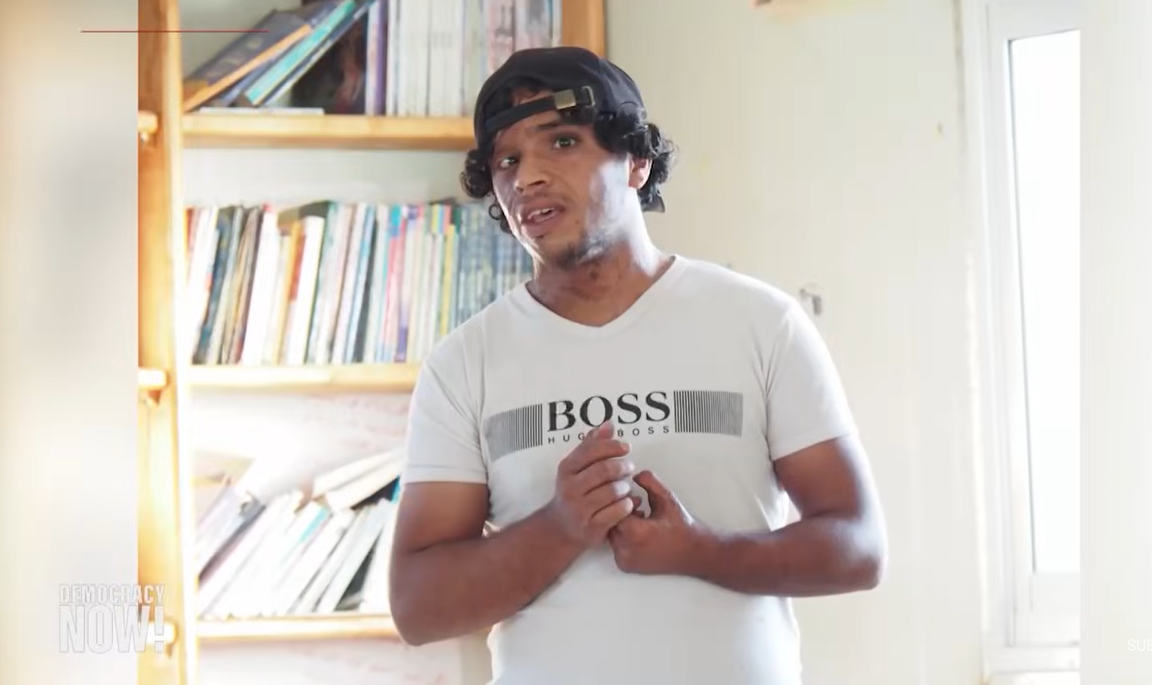
AMY GOODMAN: This is a clip of Awdah Hathaleen from the night before he was killed a year ago.
AWDAH HATHALEEN: Our future is really dark. It’s like — it’s like a black tunnel. There is no lights in it. We don’t know what to do. We don’t know what to say. We, the humans of Umm al-Khair, we, the real humans of Umm al-Khair, we are just asking about our justice. We want to be safe. We want to be — you know, I don’t want to be better than anyone else, but let us be equal. Let us be equal with others. Here in Umm al-Khair every day, every day, there is something going to happen. We don’t know when. We don’t know why. We don’t know what.
AMY GOODMAN: Last year, Democracy Now! spoke to Oren Ziv, a reporter and photographer with +972 Magazine and the independent Israeli news site Local Call. He co-wrote a piece with Basel Adra and Yuval Abraham headlined “’The most peaceful person’: Umm Al-Khair mourns activist slain by Israeli settler.” “Contrary to the settler’s account, eyewitness testimony and analysis of video footage shows that Awdah Hathaleen was gunned down in cold blood,” they wrote. This is Ziv speaking on Democracy Now! soon after Awdah’s killing.
OREN ZIV: His friends and colleague told me — and I also knew him personally — that he was the most peaceful man. Every time I came there, I would see him. He would always host and greet people and make tours there. He was in contact with the media. He was updated — updating me weekly on the harassment, on the campaign of the settlers and the army to force them to leave. And it’s a tragedy that it’s hard to imagine. You know, Umm al-Khair will not be the same without him.
AMY GOODMAN: So, if you can tell us more about who he was, where he was standing filming, and what happened right after his killing, the Israeli military moving in and arresting Palestinians?
TAHSEEN ELAYYAN: First of all, Awdah Hathaleen is a human rights defender. He is a resident of Umm al-Khair. It is a Palestinian community that is located in the south, southern Hebron Hill, in the south of the West Bank. And his family came originally from Bir al-Saba, meaning that he and his family are refugees the second time, meaning that the Israeli occupying authorities, through their colonial project that they are trying to entrench in Palestine, do not want any Palestinian to be here, so they kill them. They have been putting pressure on him and on his family and on his community to leave, in order to enhance the presence of Israeli settlements within the area.
Hathaleen not only was a human rights defender, he was one of the most peaceful protesters. He was one of the most peaceful and pacific human rights defenders. He did not use any other means other than peaceful means to stop in the face of settlement and settlers.
When he got killed, he was not allowed to be treated immediately. The settlers who were present in the area blocked the medical teams from providing medical health for him.
And later on, Israeli occupying forces came, accompanied by the killer, Levi, Yinon Levi, who gave them the names or directions to arrest those who were present in the area when the killing took place, and this is what they did. They arrested those who were defending their land and they were present in the area. So, instead of arresting Yinon Levi, who is the killer, they only took him for a few days, and they sentenced him only two, three or four days house arrest.
This is not a unique case, by the way. All of the settlers who kill Palestinians do not receive appropriate persecution. They are not — I mean, the sentence that they receive is not proportionate with the crime or with the offense they commit. The maximum is a social service or house arrest, and they are then released.
And he was only charged with manslaughter. How come that he had a gun and he pointed his gun at this guy, who was very far away from him, who did not pose any threat to his life or to the life of any other people? He was trying only to document what was happening, what was happening —
AMY GOODMAN: Tahseen?
TAHSEEN ELAYYAN: exactly like what he does usually.
AMY GOODMAN: Tahseen?
TAHSEEN ELAYYAN: Yeah.
AMY GOODMAN: Tahseen, we just have 30 seconds. What are you calling for now? What is Al-Haq calling for?
TAHSEEN ELAYYAN: We call for accountability. We want the third-state parties, including the United States and Europe, to hold perpetrators of the most serious crimes accountable. We do not want them to look at this crime as if it is a unique or as if it is an isolated individual crime. This crime is part and parcel of a system of colonialism and apartheid, and those who are responsible for it must be held accountable.
And the United States must stop attacking the ICC, the International Criminal Court, and stop attacking the organizations that are cooperating with the ICC, including my organization, that is sanctioned because of its cooperation with the ICC. So, cooperation with the ICC is not a crime, and criminals must be held accountable. And this is the responsibility of third-state parties, including the United States and European states.
AMY GOODMAN: Tahseen Elayyan, thank you so much for being with us, deputy director of Al-Haq, which has just published an investigation — we’ll link to it — “The Killing of Awdah Hathaleen: Beyond a Settler Crime.”
Read more interviews here on Havana Times.