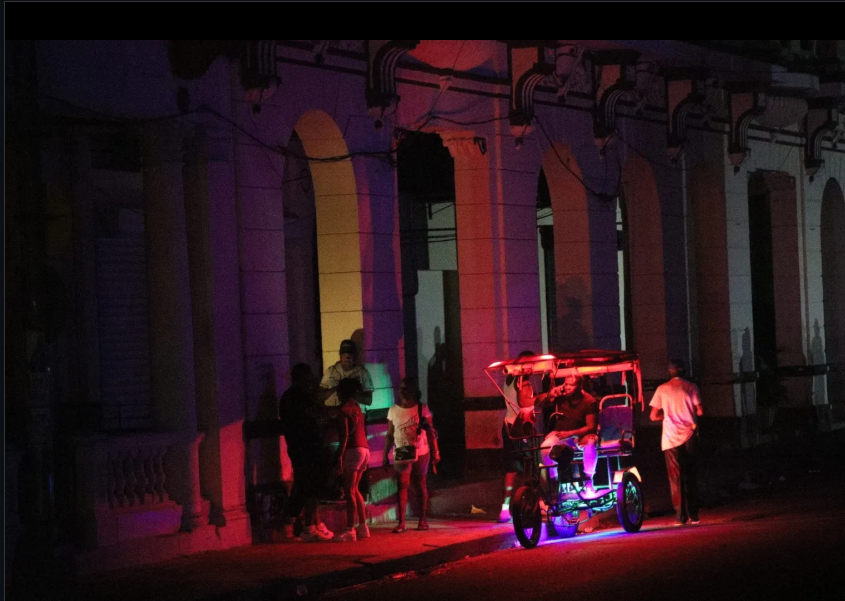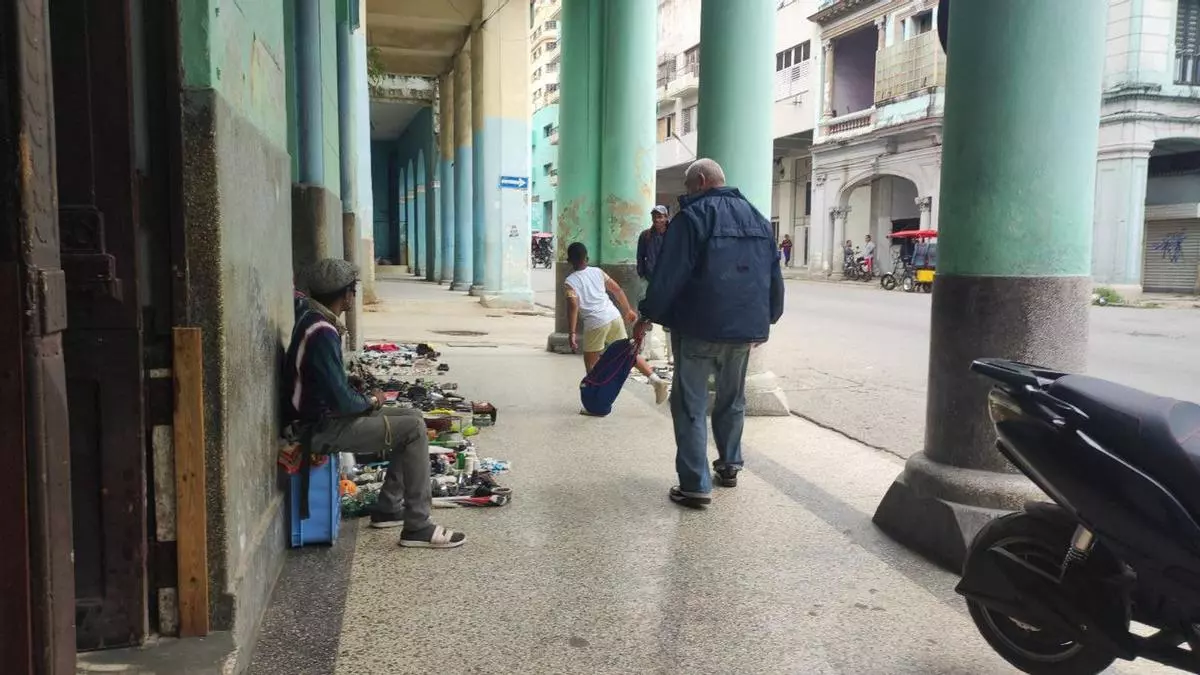
A single shoe is on display; it’s for the right foot, a woman’s shoe, and I estimate it’s a small size, perhaps for a teenager. / 14ymedio
The city’s arcades (covered walkways) display objects rescued from the garbage piles.
By Yoani Sanchez (14ymedio)
HAVANA TIMES — Caruso wakes me up. This rooster in my neighborhood has lost all sense of time and at three in the morning lets out a loud, clear crow that pulls me out of bed. For years he has been our wake-up calls and is probably the son or grandson of that first Caruso—what my husband and I named him when we noticed his power and richness of tone. We don’t know how he has managed to survive in a country where chicken soup is the dream of many, but there he is, beating the sun every day.
This Wednesday I have a complicated mission. I must go to a fair near the Capitol building in Havana to buy some welding rods and a few meters of royal cord cable. In Cuba, anyone who doesn’t know something about masonry, different repairs, and electricity is as good as dead. Most repairs depend on oneself, and buying supplies for any renovation is left to the interested party. So I’ve had to learn the grit number of sandpaper for wood or metal, the ABCs of fusing water pipes, and some rudiments of electricity so they don’t sell me 14-gauge wire as if it were 12.
I don’t even take a raincoat in my bag, even though rain is forecast. If yesterday’s downpour already hit me… today it won’t, I tell myself. I stop on Rancho Boyeros and stick out my arm. There are two possible signals: with the thumb pointing inward it means I’m heading to Centro Habana; the index finger pointing outward signals I’m going to El Vedado. But no one stops, even though I try both. So I start walking. I take Ayestaran for a stretch and turn onto 20 de Mayo. A friend’s daughter is having a birthday, and her mother wants to make her a cold salad with hot dogs. She’s entrusted me with the task of finding the blessed “perritos,” which are scarce these days.
There’s a state-run dollar store on Infanta and Santa Marta where I’ve been told they might have them. Ever since food and basic goods began being sold in foreign currency, these markets have been at the center of public discontent. Paying salaries in Cuban pesos while demanding US dollars to buy daily necessities doesn’t square with what we’re told from official podiums about an inclusive and deeply humane socialism. Outside the store, which miraculously has electricity, an elderly man stretches out his hand and asks me for something “to eat.”
I go in and leave my bag at the check in, because there’s no dollar store that doesn’t force you to leave your bag outside. The first blow hits the nose. It smells like spoiled meat. On the shelves there are cans of sliced mushrooms but no milk. They’ve put jars of asparagus in plain view, but there’s no butter. They don’t have eggs either, though one shelf displays black olives “Greek style,” dried out and salty. Who buys the products for these stores? How is it possible they don’t have canned sardines or cheese, but they do have a piece of cod—one kilogram of which costs the equivalent of three months’ pension? There’s frozen salmon, but no vegetable oil.
No “perritos” either. The most reliable staple on Cuban plates is now on the run. Hot dogs have staved off hunger for families on this island for decades. Easy to store, divisible ad infinitum—whole, in pieces, or even turned into ground meat—they’ve been snacks, romantic dinners, and have filled the bags families take to relatives in prison. Despite their low nutritional value, they are so essential to completing the daily ration that when they disappear, they create a domestic cataclysm in this country.
I leave the market empty-handed—the one that was supposedly going to have everything we needed and that we could pay for in “the enemy’s currency.” I hurry toward Carlos III and head determinedly down Reina St.. As soon as I begin walking under the arcades of Havana’s most stately street, I’m struck by the sight of sellers here and there. They’re not, as a few years ago, peddlers selling dish sponges and instant glue. They’re offering garbage.
There’s a man displaying worn, wrinkled shoes on the ground beneath the arcade, long exposed to sun and weather. He also has some old remote controls—no one knows if they’ll ever work again, but they still bear the trace of their last owner’s body grease. The man looks up and points out his best merchandise: some half-inch plumbing elbows that still have the mineral residue of the hard water pumped into our homes every day. No hydraulic system can withstand such neglect. I know because I’m constantly fixing leaks here and drips there. Each week I spend more time solving problems with drains and pipes than writing journalistic texts.
Farther along there’s another garbage vendor. All of them are selling objects taken from the many dumps scattered throughout the city. This one has been less careful and has barely cleaned the items before putting them on display, so they carry crusts here, sticky patches there, embedded with grime. He has a single shoe on display—it’s the right foot, for a woman, and I estimate it’s a small size, perhaps for a teenager. He also has a broken radio antenna and an Italian coffee maker missing its handle and funnel.
I move a few meters ahead and an elderly woman offers me a 2016 calendar and a blister pack of pills whose name can barely be read through the dirt. I almost run out of there, hold my breath as I pass under the arcade of the Ultra store, and when I emerge into Fraternity Park, a light goes on in my head. The state market La Isla de Cuba is just a few meters away. “Surely they’ll have hot dogs there,” I tell myself. I cross the street so eagerly I’m almost run over by the only motorized vehicle that has probably passed by in long minutes amid the energy crisis we’re living through.
Frustration again. There’s a heavy, sordid atmosphere in this store. Many employees watch every step customers take, as if we were all potential thieves. The butcher section is empty. There’s a jar of Spanish capers, but no frozen chicken. The hot dogs are nowhere to be found. The cold salad for my friend’s daughter’s birthday will have to be just with macaroni and homemade mayonnaise.
Finally, I arrive at the hardware market. It’s like a candonga—a cluster of private vendors—just a few meters from the seat of the Cuban Parliament. The legislators so formal over there, unanimously approving every law handed down from above, and these people over here, solving real problems. A hose for the sink? A switch to regulate the light we almost never have? A drainpipe for the toilet? “Ask for whatever you need—we’ve got it,” a young vendor assures me. I inquire about ten meters of royal cord. The transaction is quick. It doesn’t smell like rotten meat like the dollar store. No one asks me to leave my bag outside. No one distrustfully checks the bills I hand over. I leave with my cable draped over my shoulders to make it easier to carry.
I walk back home. There’s no other choice because there’s almost no transportation. As I pass along Reina, the old vendor once again shakes in front of my face the shoe for which he only has the right foot. Together we make a dreadful pair: him like a madman holding a teenager’s shoe in his hand, me like someone considering suicide with a cable around my neck.
First published in Spanish by 14ymedio and translated and posted in English by Havana Times.
Read more from Cuba here on Havana Times.