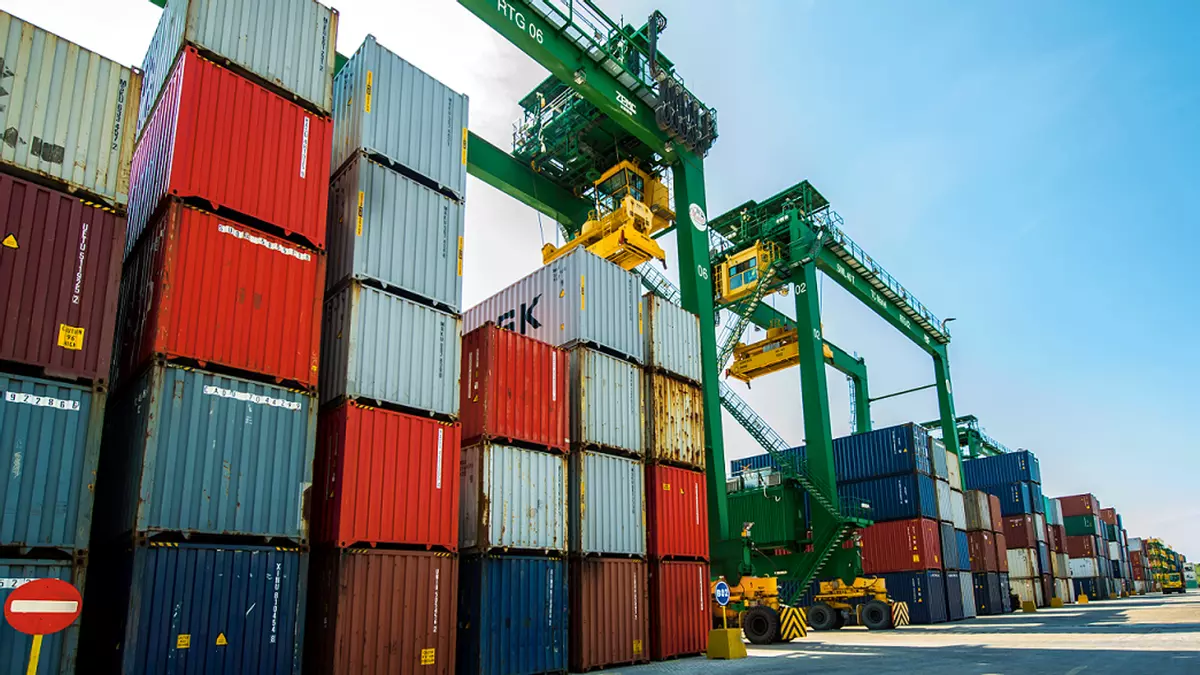
The decision will affect the country’s maritime trade with the entire world Photo: TC Mariel
The decision of the French and German based shipping companies is a consequence of new US sanctions. It will especially affect trade with China.
By 14ymedio
HAVANA TIMES – The international shipping companies CMA CGM and Hapag-Lloyd—based in France and Germany, respectively—officially confirmed on Sunday the suspension of their shipping services to and from Cuba. The information was unofficially leaked on May 15, when sources from both companies communicated it to the Spanish news agency EFE. The suspension could mean a 60% loss in maritime traffic for the island, according to estimates by two experts in a Reuters report.
“Following the US executive order issued on May 1, CMA CGM has decided to suspend bookings to or from Cuba until further notice,” the French company said in a statement released by email on Sunday. The shipping company indicated that it is closely monitoring the situation and will adapt its decisions to the current regulations.
The German company Hapag-Lloyd did the same, stating through a spokesperson that the suspension was due to “the risks of non-compliance associated with the US president’s May 1 executive order.”
Freight transport from China would be the hardest hit by the order, according to sources consulted by Reuters, who warned of a massive drop in transactions. In a context of widespread shortages such as those Cuba is experiencing, compounded by the oil embargo, the risk is enormous. Experts also point to Northern Europe and the Mediterranean as the areas most affected by the suspension of these shipments, although “all international maritime transport to Cuba will be affected.” According to data for the National Office of Statistics and Information, in 2024 – the last year where data was complete – the international shipping trade totaled 62.3 million tons.
The executive order signed by Trump on May 1 expanded US sanctions on trade with Cuba to include “any foreign person” operating in the sectors of “energy, defense and related material; metals and mining, financial services, or the security of the Cuban economy, or any other sector of the Cuban economy.”
Just one week later, the Canadian mining company Sherritt International withdrew from operations. The company had been active on the island for the past three decades—in nickel and copper mining operations as well as at the Energás wells in northern Cuba. The company made the decision—which led to the departure of three board members—out of fear of being added to the list of Specially Designated Nationals maintained by the Office of Foreign Assets Control (OFAC) of the US Department of the Treasury, a registry that includes sanctioned individuals, companies, or vessels, and entails a financial blockade and a prohibition on US citizens doing business with them.
The sanctions will take effect on June 5th, which means most companies with business in Cuba will be assessing the situation in the coming weeks. “No banking institution with a presence or interests in the United States will want to assume the risk of facilitating payments involving an entity designated as sanctioned by the US, regardless of its client’s nationality,” Ignacio Aparicio, executive partner at the Anderson law firm and head of Cuban affairs there, told the Spanish newspaper El Pais. His remarks were part of a special report, similar to one published by ABC days later, evaluating the impact of the measure on Spanish companies.
According to the report, all eyes are now on Melia, a large Spanish hotel chain which manages 34 hotel properties for the Cuban government. The company is currently remaining silent “due to the high level of uncertainty, although it believes that its business is not initially included among the five affected sectors.” However, although the US specifically targeted certain sectors, the measure makes reference to any part of the economy.
An anonymous businessman contacted for the report believes the sanctions are a clear warning to pull out of Cuba. “You can only do business with Gaesa [the military conglomerate that controls the country’s economy], which, moreover, hasn’t paid its bills in a long time. And now, if the United States finds out you’re doing business with a Gaesa company, it can fine you,” he argues.
The Madrid-based media outlet estimates that Spanish companies are involved in more than 60 operations, primarily in the tobacco industry, financial services, and wholesale trade, with a total value of 442 million euros. In addition, there are 70 hotel management contracts mostly between Gaesa and the companies Melia and Iberostar, with the presence as well of Roc, Barcelo, Valentín, NH, Blau, Axel, and Sirenis.
Ignacio Aparicio had a note of warning for these companies: “Cuba’s Foreign Investment Law, enacted in 2014, establishes a joint venture framework that prevents unilateral withdrawal. Any divestment would, in most cases, require the Cuban government’s approval, turning the process into a protracted and potentially costly negotiation.” In his view, the most likely outcome is “a slowdown in new investments, corporate restructuring aimed at reducing direct exposure, a search for currencies other than the dollar, and greater overall caution in the financial sector.”
First published in Spanish by 14ymedio and translated and posted in English by Havana Times.
Read more from Cuba here at Havana Times.
And, if you have a few minutes, we’d really appreciate it if you could take our reader survey as we strive to do a better job. Just click here.