“So we fix our eyes not on what is seen, but on what is unseen, since what is seen is temporary, but what is unseen is eternal.” — 2 Corinthians 4:18
By Lynn Cruz
HAVANA TIMES – Over time, Cuba could come to be seen as an island full of hostages. The story began with a revolution that promised to fulfill the ideals of the 1953 attack on the Moncada barracks. Fidel Castro had the exceptional ability to turn words into physical reality. A political animal and a lucky man, he awakened genuine hopes for social justice, sovereignty, and access to education and culture.
But when did the story begin to go wrong? Perhaps when one man’s power began to be confused with the destiny of a nation. Nationalizations, debts, and restrictions progressively narrowed the room for maneuver until the Revolution became a Leviathan. The consequences fell upon a people also trapped in a collective identity and a war against imperialism that outlived its central figure.
Fidel Castro lands in Washington, D.C.
From the Image to the Algorithm
In 1959, the Cuban Institute of Cinematographic Art and Industry (ICAIC) was established. Beginning in 1960, the ICAIC Latin American Newsreel, directed by Santiago Alvarez, produced 1,493 editions through 1990. Constructing political images required time, coordination, and control over the channels through which they circulated. That control also extended to the press. But editing is not correcting: it means making decisions about thought itself. Even documenting reality involves constructing a representation of it.
Fidel Castro died on November 25, 2016. He had been a speechmaking machine, a creator of political content whose voice occupied public and domestic spaces for decades. With the Internet and social media, the circulation of images changed. Post-truth found new means of expansion, and those in power learned to adapt. The Leviathan can mutate; its mechanisms of control do not disappear.
Since 2021, we have all become increasingly attached to the machine. What have algorithms changed? And what is changing now with artificial intelligence?
The Manufacturing of the Adversary
I want to focus on October 26, eight days before the US midterm elections. That day, Donald Trump and Truth Social seemed to speak with a single voice. Cubans, accustomed to seeing Granma present an official version of the truth, have historical reasons to distrust a platform that carries that word in its name.
Between 4:33 and 4:34 p.m., four Democratic figures appeared in succession: Adam Hamilton, Ilhan Omar, James Talarico, and Abdul El-Sayed. Four different contexts, reduced to controversies over identity, race, citizenship, gender, and religion. Six minutes later, the electoral endorsements began. At 4:52 p.m., Trump endorsed Sydney Gruters, a candidate in Florida’s 16th Congressional District, wife of then-state senator Joe Gruters, a Trump ally and the current chairman of the Republican National Committee. Her opponent, Kelly Kirschner, was portrayed as radical, reckless, and dangerous.
Attention shifted. What mattered was no longer what the candidates would do if elected, but which side they were on and what identity they represented.
Collage created in Photoshop using images of Kelly Kirscher, Sydney Gruters, Joe Gruters, Donald Trump, and Trump’s second inauguration ceremony.
Congressional District 16 is located on Florida’s west coast, in the Tampa Bay region along the Gulf of Mexico. Under the new 2026 electoral map, it includes portions of six counties: Manatee, Sarasota, DeSoto, Hardee, Polk, and Pinellas. It also includes part of St. Petersburg.
I met Kirschner personally. That is why I was not looking at an abstract confrontation between political parties: I was following people, their stories, and the communities they claimed to represent. His repeated invitations to his opponent to participate in a debate caught my attention. Accustomed to the absence of dialogue between those in power and the opposition in Cuba, I recognized a fundamental question: What happens when disagreement ceases to be an opportunity for conversation and becomes a spectacle?
Kirschner had built his career through community work. He participated in neighborhood mobilization efforts for Payne Park, a public park near Sarasota. As mayor, he promoted campaign finance reforms and, through UnidosNow, an organization he co-founded, helped first-generation students gain access to college. Gruters, by contrast, developed her career within political and administrative institutions. Her campaign defended familiar conservative priorities: taxes, border security, education, and family values.
Kelly Kirschner and his team connect with the community. Screeshot
Florida: The Stage for Magic
In 2022, after Disney criticized the Parental Rights in Education law, known by its critics as “Don’t Say Gay,” Governor Ron DeSantis pushed to eliminate the special administrative autonomy of Reedy Creek, a special improvement district created in 1967 by the Florida legislature to manage and provide municipal services (water, electricity, roads, fire protection) to the lands of the Walt Disney World Resort. The dispute became a political and legal battle.
Disney is a factory of stories. Florida became the stage for another kind of factory: one that manufactures adversarial characters. And onto that stage stepped Sydney Gruters. Sydney, Disney: two names that, when brought together, seem to suggest something more than a coincidence of sound. Magic ceased to be merely entertainment and became a metaphor for the power to manufacture realities.
There, politics, entertainment, and business shared the same landscape of representation. Disney, culturally associated with a liberal worldview, and DeSantis, a representative of Republican conservatism, appeared to occupy opposite extremes. Yet their interests revealed that party colors do not always define the principal boundaries of power.
AI-generated image: Kelly Kirschner transformed into a knight. On the right, Countess Sydney de Gruters, Joe Gruters, Donald Trump, and his technological court.
The Child as Political Territory
While major technology companies promote artificial intelligence literacy, pro-Gruters propaganda constructed another image of childhood: that of a child threatened by a cultural transformation from which someone had to protect them. A flyer from the super PAC Conservatives for American Excellence used AI-generated images to portray that threat.
I ask: “Mr. Trump, did you write the script for Sydney Gruters’ campaign?”
All we know is that there were flyers, a post on Truth Social, and a video that translated those words into images. The written word begins to abandon its role, and in its place—much like a memory—there emerges this fictional image.
AI-generated image.
When the defense of transgender rights became part of Democratic discourse, an aspiration toward inclusion emerged. But what happens when a cause ceases to be discussed and becomes an identity marker, a boundary separating one group from another? Childhood became the center of a dispute among adults. Children appeared less as individuals with rights than as figures in a political representation.
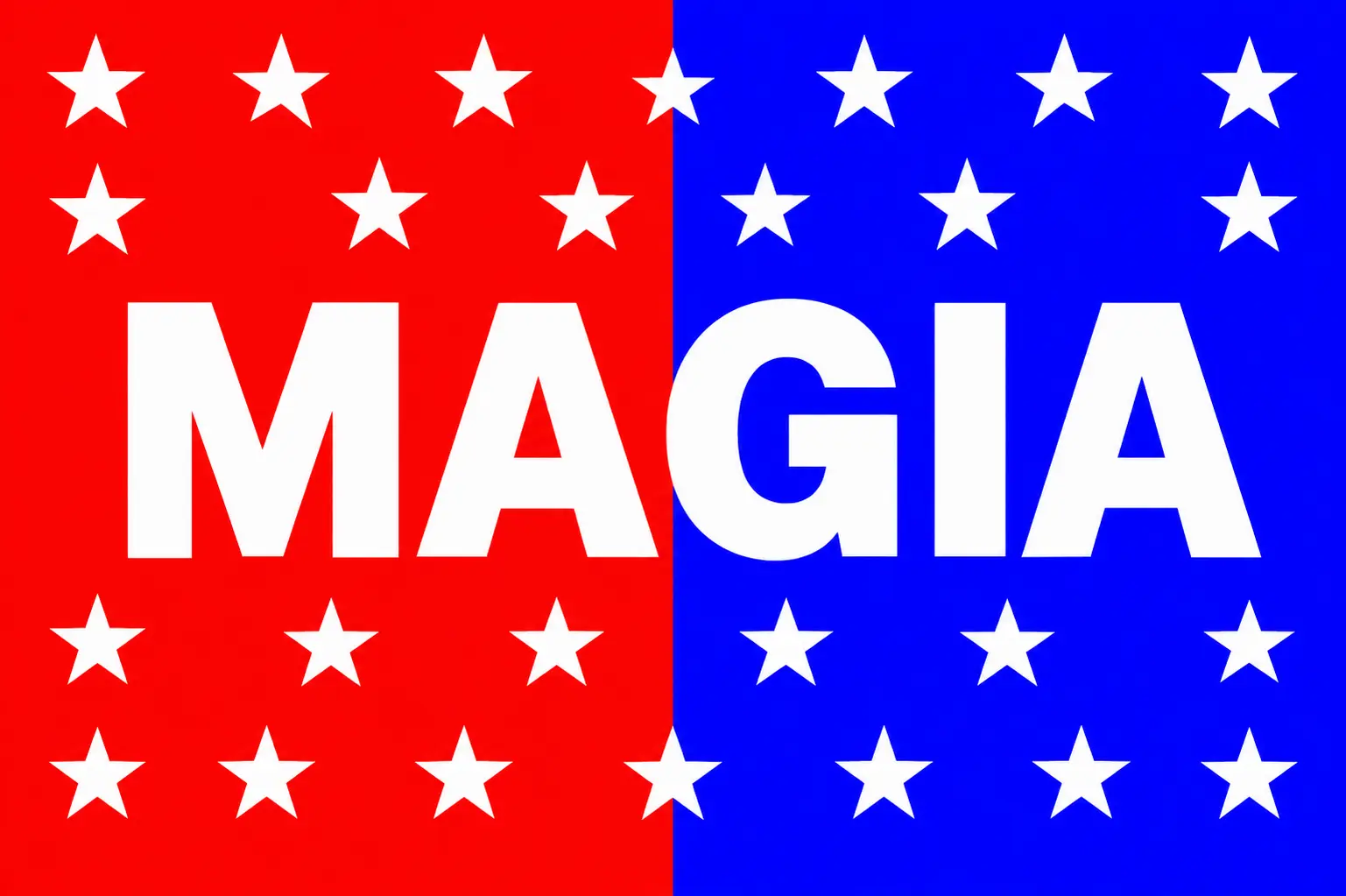
MAGIC
On October 28, six days before the elections, an artificial intelligence-generated video appeared on television showing Kelly Kirschner being arrested. The words Trump had posted two days earlier were now being transformed into images.
The image evoked the assassination of Lee Harvey Oswald during his transfer in police custody in Dallas in 1963. But the difference was fundamental: Oswald had actually been arrested; Kirschner appeared in a fictional situation, digitally fabricated. The image no longer needed to document an event. It could produce one.
It is easier to dismantle a lie than a fiction. A lie can be checked against the facts; fiction constructs a scene, creates associations, and leaves images in the memory. It does not need to prove what it tells: it needs the viewer to remember it.
Florida, After Texas
The Republican defeat in Texas has a central figure who was not on the ballot but had invested hundreds of millions of dollars to influence the outcome: Elon Musk. The businessman hoped to maintain Republican control of the state, but found himself facing a Democratic victory that threatens to change the conditions under which his technological projects can expand. The newly elected governor, Gina Hinojosa, has promised to halt permits for new data centers until safeguards are established for communities, water supplies, and the electrical grid.
Musk responded with a statement worth noting: Data centers in space were beginning to look like an attractive alternative.
But while Texas prepares to review the conditions governing that expansion, Florida offers another setting. There, tax incentives and legislation favorable to certain technological investments coexist with growing community resistance to the consumption of water, electricity, and land required by these facilities.
Could Florida become a new frontier for Musk’s technological interests?
District 16 was one battle over control of political representation. What is at stake in the rest of the country is much greater: who controls technology, who pays the price of its expansion, and who has the power to manufacture the images through which citizens interpret reality.
Propaganda can win an election. The infrastructure that makes it possible can determine who will have the power to construct the next reality.
And Cuba? Where will Cuba fit into all this? This increasingly abstract island.
Read more from Lynn Cruz’s diary here on Havana Times.