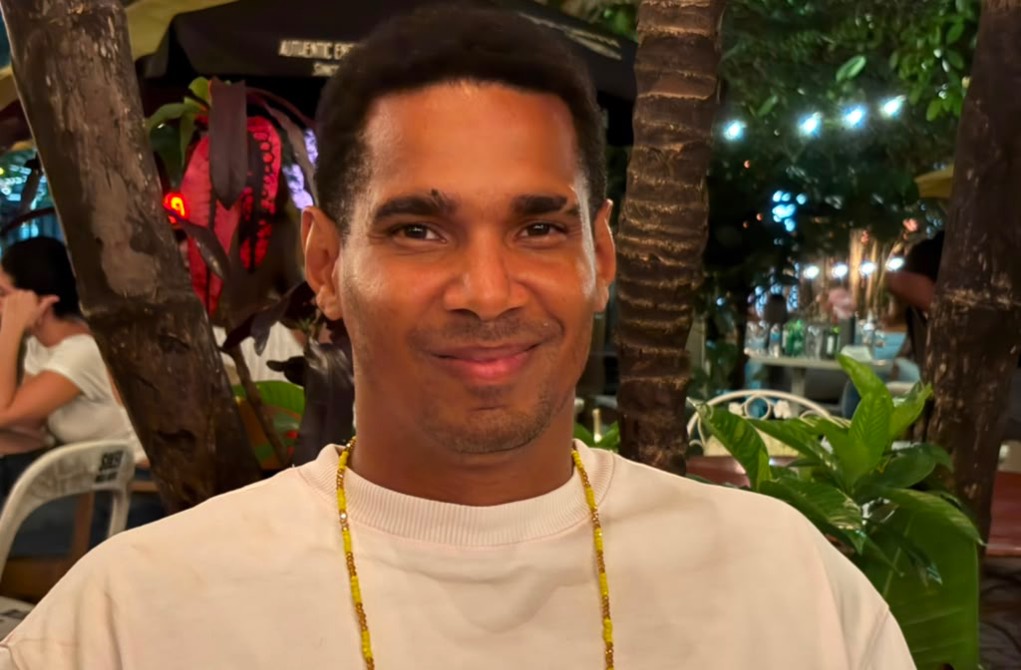
Luis Manuel Otero Alcantara, artist and activist for a free Cuba. Photo: El Estornudo
By Francisco Acevedo
HAVANA TIMES – He fought for several years to avoid being broken, but in the end Luis Manuel Otero Alcántara, the most prominent political prisoner still behind bars in Cuba, had to choose the path of exile, where he promises to continue his struggle for the freedom of his homeland.
He arrived in Miami on the afternoon of Saturday, July 18, after the US government granted him humanitarian parole and after serving a five-year prison sentence for participating in the mass protests of July 11, 2021, although he was arrested before he could join the demonstrations.
Throughout all those years in the maximum-security prison in Guanajay (about 50 kilometers southwest of Havana), he was a symbol of resistance and, whenever he could, continued to use his art, his voice, and his courage to challenge a rigid and authoritarian political system.
He was actually released on July 7, but Cuban authorities kept him detained at an undisclosed location, and family members and activists reported him missing, until it emerged that he would be leaving the country in exile.
Upon arriving in Miami, he said that he had been held in a house near Guanabo, under the custody of State Security.
According to activist Anamely Ramos, also a member of the San Isidro Movement, since 2023 the authorities had left exile as his only alternative for regaining his freedom and continuing his work as an artist and activist. About 20 days before completing his sentence, they warned him that this was the only path he could take, or he would be sent back to a prison cell on any pretext.
His departure prompted US Secretary of State Marco Rubio to reiterate his call for the release of the more than 700 political prisoners who remain on the island. His message was directed not only at the repressive apparatus, but above all at the international community, which, in his own words, must stop turning a blind eye to this phenomenon.
A new front has now opened, but as I also said when Jose Daniel Ferrer took a similar step, there is nothing to reproach this young man for, because through his defiant actions he defended the dignity of the entire Cuban people, the same people who are terrified of taking to the streets to demonstrate.
This is not a geographical surrender, but rather a strategic reconfiguration of activism in a globalized context, where voices and actions can transcend physical borders.
From his earliest days as a visual and performance artist, Otero Alcántara used his work to denounce political repression, censorship, and the lack of fundamental freedoms in Cuba.
His resistance was not merely symbolic; it became direct action against the machinery of the state.
Constant surveillance, arbitrary detentions, and judicial persecution were predictable responses to someone who dared not only to challenge the imposed order, but also to lead an entire movement, the San Isidro Movement, which put the dictatorship on the defensive.
For years, he carried out hunger strikes, street protests, and acts of peaceful civil disobedience, turning him into a leading figure for the artistic and political community both on and off the island.
Nevertheless, this prolonged struggle came at a considerable personal and physical cost: prison conditions, isolation, and the constant threat to his physical safety exposed the harshness of a regime that tolerates no dissent.
The decision to leave his homeland and continue his struggle from abroad is therefore not an act of defeat, but a forced move that in no way means silencing his protest. Instead, it offers new spaces and platforms to amplify his message and generate international solidarity.
His presence outside Cuba should become a bridge between internal resistance and global mobilization, facilitating alliances with human rights organizations, cultural institutions, and international media.
By using technology and social media, he can once again reach mass audiences, generate diplomatic pressure, and raise global public awareness about the reality in Cuba—something that was completely impossible while he was locked away in a dungeon.
He will now have to be alert to another kind of enemy: those who quietly infiltrate his surroundings to sow division and destroy the political opposition, an arena in which he is still inexperienced.
So far, his mind has demonstrated an ability to reinvent protest, and once he adapts to his new circumstances and takes advantage of the opportunities offered by technological tools and international alliances, he will be able to reconnect with the people from whom they have tried to erase him in recent years.
His story is a call to understand the struggle for human rights as a constant, dynamic, and expanding commitment, capable of overcoming geographical and political barriers to build a future in which dignity and freedom are truly universal.
According to independent organizations, 286 people remain imprisoned for participating in the July 11, 2021, protests, enduring terrible conditions in their places of confinement.
For Otero, this is exile in every sense of the word, but at 38 years old, with his whole life still ahead of him, it can be very productive. It is practically the only possible option, because it forms part of a pattern in which high-profile political prisoners are being released only if they agree to leave the country.
The fundamental challenge is to keep up the demand for freedom from a broader arena, adding more voices and building global solidarity.
Read more from Cuba here on Havana Times.