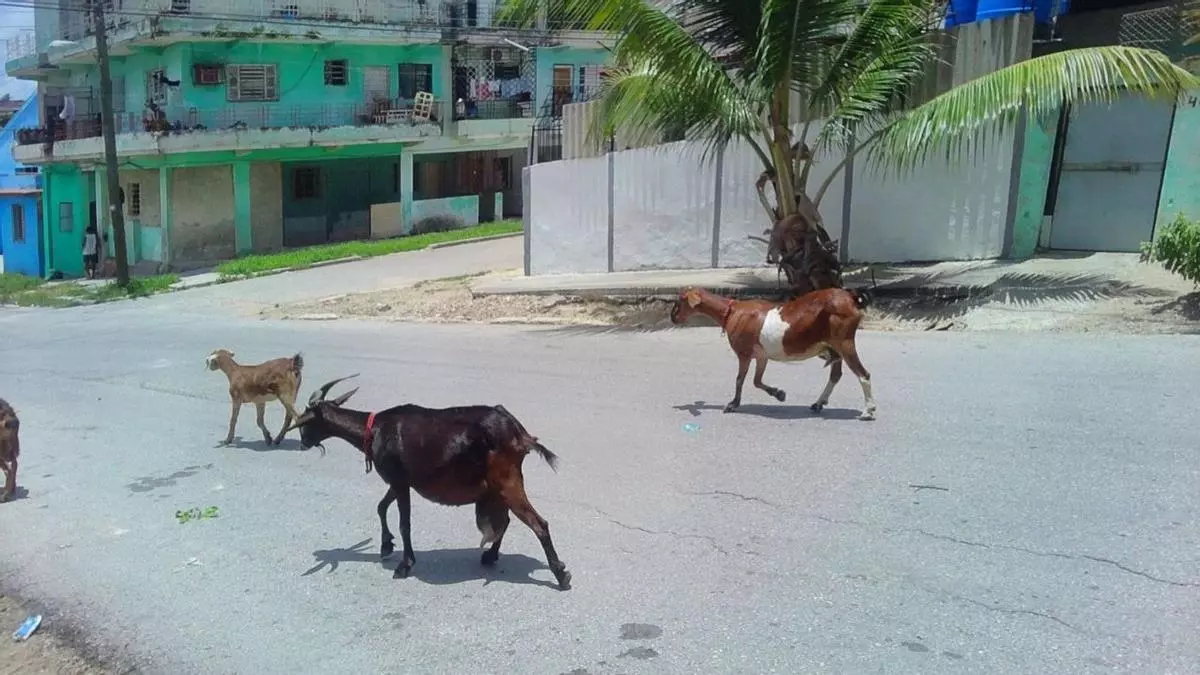
A young man has taken a small herd of goats out to graze among the grass that has sprouted over the ruins of a collapsed building. / 14ymedio
In a country where the State no longer provides electricity, water, medicine, or bread, every family is trying to save itself however it can.
By Yoani Sanchez (14ymedio)
HAVANA TIMES – Today I couldn’t carry the trash downstairs. It didn’t weigh any more than usual, but my body sent me a brief and forceful telegram: “Don’t even try. Every cell is carrying too many days of accumulated exhaustion.”
So, I left the bag by the door and went out carrying only my purse, umbrella, water bottle, mosquito repellent, and shopping bags. I also slipped my cellphone into my bag, increasingly useless in a country where connecting to the internet or making a phone call can take longer than delivering the message in person.
As I make my way down the building’s more than 120 steps, the greetings become shorter and shorter, almost whispered. Few people even dare say “good morning” or “good afternoon” anymore, because there’s very little left that’s good. Conversations revolve around the accumulated hours without electricity, the unbearable heat that barely allowed anyone to sleep the night before, or the problems with the water supply.
One neighbor sums up the collective mood with a phrase that has become the standard greeting: “Here, just surviving.” He says it as though we were all contestants on one of those reality TV shows where you have to cross raging rivers, hunt for food, and find a cave to spend the night.
I walk along Tulipan Street toward Ayestaran. The ration-market bakeries that I pass every morning are closed. One woman warns another not to waste her time returning to the darkened counter because today, she says, “they’re not even going to have enough to tie up a goat.” Ironically, just a few yards farther on, a young man has taken a small herd of goats to graze on the grass growing over the ruins of a collapsed building. In this Cuban version of televised survival, that urban shepherd would have an excellent chance of making it to the finals.
While some wage the daily battle on the streets and sidewalks, others have decided to barricade themselves indoors. Since almost no one places much hope anymore in the thermoelectric plants or the national power grid, everyone is trying to build their own island of stability. Those who can afford it buy rechargeable batteries; those with greater means install generators or solar panels.
One friend, worn out from paying as much as 640 pesos for a bag of bread in some private businesses, finally bought herself a bread maker. To the initial investment she has had to add the cost of flour, yeast, and the uncertainty of the blackouts. “I’ve used it three times,” she tells me. “Only once did it complete the full cycle.” The other two times, the electricity went out before the baking stage, leaving the machine guarding a lump of sour, inedible dough.
A friend, exhausted from paying as much as 640 pesos for a bag of bread in some private businesses, finally bought herself a bread maker. / 14ymedio
Another acquaintance has covered his rooftop with solar panels and designed an electrical system that allows him to power his entire home with the flip of a switch. “Now I get my electricity from the one whose boiler never breaks down or trips because of a malfunction,” he jokes, mocking the endless string of explanations the Cuban Electric Union offers to justify every system collapse. “I really did carry out an energy revolution,” he boasts as he shows off the inverters and batteries that have restored something resembling normal life.
Even leisure has become a do-it-yourself endeavor. With television signals constantly interrupted, several young people in the neighborhood have improvised a small viewing room on the ground floor of their apartment building to watch the World Cup. An EcoFlow battery pack, a television, and a few planks turned into benches are enough to gather the fans. A cable runs down from one of the upper-floor apartments, connected to one of those satellite dishes that remain illegal, even though they have become almost as common in Cuba as the daily insults aimed at Miguel Diaz-Canel.
After breaking her collarbone, a former university classmate decided to prepare herself for the possibility of another hospital stay. What she keeps in several boxes is not exactly a first-aid kit. There are urinary catheters, intravenous catheters, IV fluids, suture thread, syringes, disposable gloves, and other supplies that any hospital should provide. “If I’m hospitalized again, I’d rather arrive with everything I need,” she explains. She too is trying to shield herself from scarcity.
Each story seems different, but they all follow the same logic: creating, within the confines of one’s home, a tiny functioning country. A household bakery. A private electric company. An improvised movie theater. A personal medical supply warehouse. As if every family were building a miniature republic where it is still possible to solve the problems the State has stopped guaranteeing.
But no home can become a country. No bread machine can replace a network of bakeries baking fresh bread every dawn; no amount of solar panels can substitute for a national electrical grid; no private stockpile of medical supplies can sustain a healthcare system in ruins. Hospitals, transportation, communications, and least of all the fragments of the nation that we gather from outside every day, cannot fit within four walls.
When I returned home, the trash bag was still sitting by the door. Tomorrow, if my body grants me a reprieve, I’ll try to carry it downstairs. In this competition, no one wins a prize. The only goal is simply to stay alive until the next episode.
First published in Spanish by 14ymedio and translated and posted in English by Havana Times.
Read more from Cuba here on Havana Times.