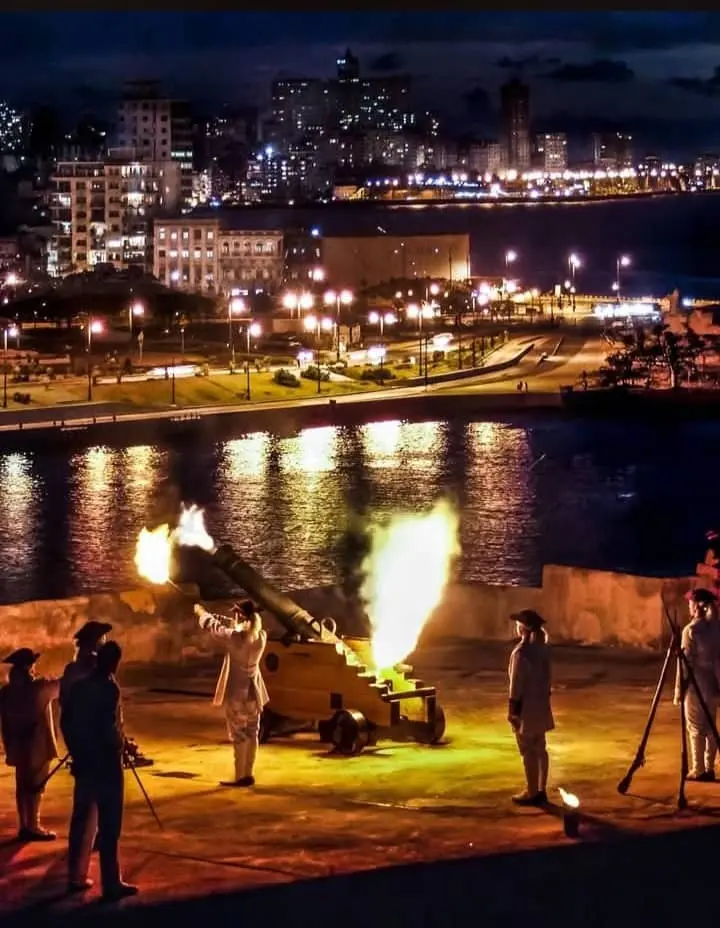
File photo of the cannon shot fired every night in Havana at 9 p.m.
By Kamil Kenders
HAVANA TIMES – Some sounds are part of a city’s identity. They need no introduction or explanation. Just hearing them is enough to know where we are, even when we cannot see what produces them. In Havana, one of those sounds comes every night at nine. It is a brief, sharp, unmistakable boom. The cannon shot from La Cabaña Fortress.
For centuries, that cannon shot has been tied to the city’s history. Originally, when Havana was still protected by walls, the cannon announced the closing of the city gates and the entrance to the harbor. It was a signal to residents, a warning that the day was coming to an end and the city had to retreat behind its defenses.
With the construction of the San Carlos de La Cabaña Fortress, completed in 1774, the cannon began to be fired from there. The city walls disappeared over time, but the tradition survived.
In 1986, the ceremony began to be reenacted as we know it today: soldiers dressed in period uniforms, torches, drums, shouted commands, and a small artillery crew recreating that 18th-century military ritual every night.
The spectacle has something theatrical and solemn about it. It is also quintessentially Havana. For decades, attending the Nine O’Clock Cannon Ceremony was one of those experiences you could treat yourself to from time to time. Crossing the bay, arriving at the fortress, exploring its grounds, waiting for the ceremony, and gazing from its walls at the city stretching out across the water.
There was something special about that experience. It wasn’t just the cannon shot. It was the outing, the night, the view of Havana, the atmosphere that developed among those waiting for the moment. It was also the opportunity to share with family or friends a tradition that seemed to belong to everyone.
But cities don’t always lose their traditions all at once. Sometimes they preserve them while gradually losing the conditions that make it possible to enjoy them. And that seems to be what is happening with the cannon ceremony.
The ceremony continues. At least, the most recent available information indicates that it is still held daily. However, getting to La Cabaña and returning home has become increasingly difficult.
Transportation is one of the first obstacles. Getting around Havana, especially at night, can become a real odyssey. Options dwindle, routes become complicated, and finding a way home after nine is not always easy. Added to this is another problem that has ended up changing our relationship with the city: darkness.
Some streets remain without lighting for hours. There are areas where walking at night means practically feeling your way through the darkness. The lack of electricity not only disrupts domestic life; it also transforms public spaces, restricts movement, and ultimately confines us to our own homes.
Who would venture across the city to enjoy an evening spectacle when they cannot even be sure how they will get home?
Perhaps those who live near the fortress can do so more easily. But for many other Havana residents, what was once a pleasant outing now requires calculating expenses, transportation, schedules, and risks.
And so, little by little, we give up things that were once part of our lives. It’s not that we’ve lost interest in our history. Nor has the cannon ceremony ceased to be important. It’s that everyday life has become so complicated that even enjoying a centuries-old tradition requires conditions we don’t always have.
There is something particularly sad about this contradiction. While the soldiers continue to wear their period uniforms and the cannon still fires at nine, part of the city remains in darkness. The boom carries across the bay, but not everyone can make it there to watch the ceremony.
Havana preserves the sound but is losing the setting that makes it possible to enjoy it. And I’m not talking only about La Cabaña. I think of the parks that cease to be gathering places when night falls, the evening strolls we no longer take because getting home has become too complicated, and the streets we once walked without a second thought but now avoid when the electricity goes out.
A city is not alive simply because its buildings remain standing or its traditions continue to be celebrated. It also needs its residents to be able to move through it, meet one another, enjoy it, and recognize themselves in it.
The nine o’clock cannon shot still rings out. It is good news that such an old tradition remains alive. But I wonder how much longer we can continue to consider it part of our everyday lives if it becomes increasingly difficult to get there.
Perhaps someday we will once again cross the bay without having to worry so much about getting home. Perhaps we can recover those little evening outings that once required so little planning. In the meantime, at nine every night, the cannon will continue to fire from La Cabaña. And on the other side of the bay, Havana will continue to go dark.
I don’t know which is more painful: hearing the boom of a tradition that has survived for centuries, or realizing that, little by little, even the things we have always felt were ours are slipping beyond our reach.
Read more from the diary of Kamil Kenders here on Havana Times.