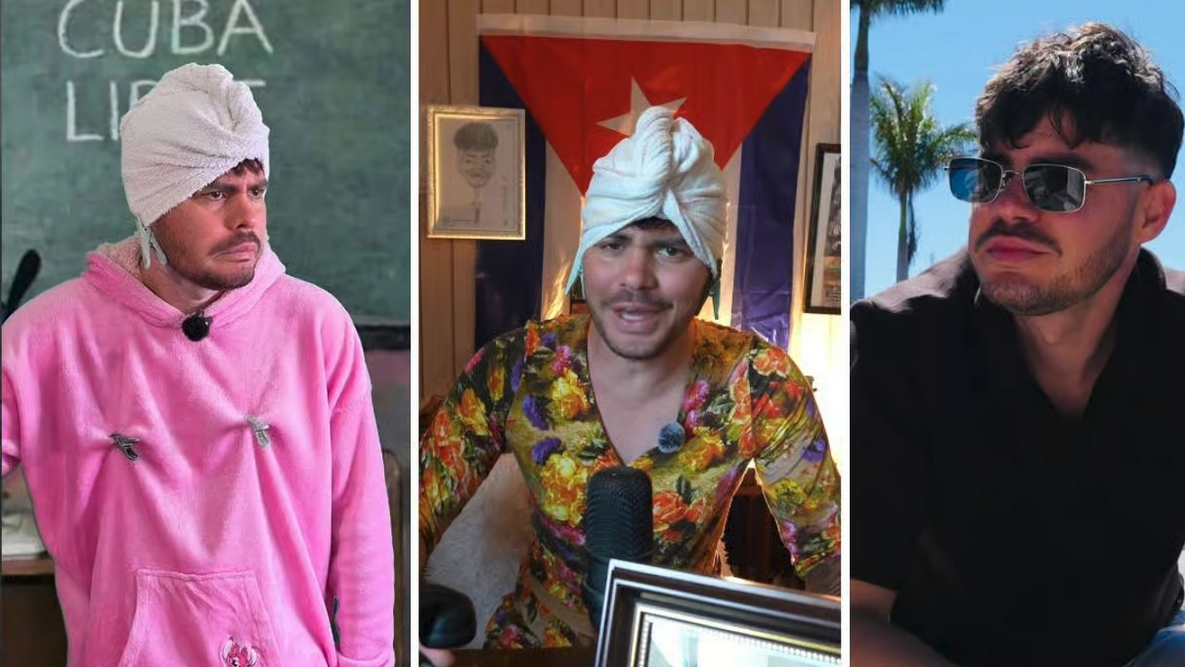
Cuban comedian Aldring Mirabal Mora. Collage: elTOQUE.
By Marleidy Muñoz (El Toque)
HAVANA TIMES – There are creators who invent characters. And there are others who, almost without intending to end up capturing an entire nation in a single voice.
Aldring Mirabal Mora, from Ciego de Ávila, actor, theater instructor, and Cuban comedian living in Tenerife (Canary Islands, Spain), belongs to the second group. On social media, his bio already hints at the tone of his universe: “A Cuban comedian who even does humor. POLITICALLY INCORRECT.” But it only takes a glance at his profile to understand that it’s not just comedy. In the pinned image at the top, he appears sitting on the sand facing the sea beside a phrase written like a declaration: “Long live a free Cuba.”
That is where his scene begins.
There is always a Cuban flag somewhere in the frame. And always that mother who shouts, complains, sighs, survives. That woman with talcum powder on her neck, frayed nerves, and phrases that have become part of the intimate language of his followers: “My God in heaven,” “tiqui tiqui tiqui,” or his now famous calls to the bolliflexibles*.
The central figure in his videos—that Cuban woman interacting with her daughter, the neighbor, the boyfriend, the girlfriends—was born, he explains, out of theatrical play and careful observation of everyday life.
“The character of Yurisleidy’s mother has a lot of my own mother in her, and also my paternal grandmother. And Yurisleidy has a lot of me as a son, and of my sister. It’s like a mix. Then there are all those who’ve written to me and told me stories. That’s how I’ve built this caricature,” he says in an interview with El Toque.
What Aldring has achieved is not just a character. It is a social portrait.
Because that mother is not simply a comic device; she is the voice of a generation shaped by scarcity, stress, and daily survival. A woman who embodies the accumulated tension of life in Cuba.
“There’s no one in Cuba right now with more anger than mothers,” he says. That statement contains the key to his success.
The connection with audiences comes not only from the joke, but from immediate recognition. Everyone, inside or outside Cuba, has seen that mother: their own, an aunt, the neighbor in the building, the woman sweeping the hallway while commenting on everyone else’s life.
“We all come from a mother,” says Aldring. “And then there are these cultural patterns that, even though every family is different, repeat themselves. That’s where the formula lies.”
The formula, in reality, is more complex: humor as an emotional archive.
“It’s a wonderful mix of being able to tell truths through humor,” he explains. “People connect with the joke, but also with the truth behind it.”
That is why, in his scenes, caricature never separates from the social portrait.
His secondary characters complete the symbolic building that is Cuba: the gossip, the CDR president, the drunk, the hardliner, the boyfriend, the absent one, the neighbor with family abroad who used to be viewed suspiciously. “We have that whole rainbow of characters in Cuba.”
His work functions like an apartment building where every door contains a version of the country he comes from.
From that seemingly small domestic space, he has managed to engage with politics. His videos include direct appeals to figures such as Donald Trump, Marco Rubio, and Miguel Diaz-Canel, as well as artists and celebrities.
For Aldring, humor not only allows that dialogue, it makes it possible.
“I wouldn’t dare write to or speak to Donald Trump as Aldring,” he admits. “But through humor, through the tool of caricature, you can.”
The mother he portrays has permission to burst into any conversation because she embodies emotional overflow itself.
“She’s a Cuban mother living outside the country, but she still has that nervous tic from the chaos of life back home, from having to go out and struggle every single day.”
Far from being exaggerated, that nervousness functions as the physical memory of crisis. That is why his humor also carries a political responsibility he embraces openly.
“Those of us living abroad have the responsibility to speak out from whatever platform we have.”
His stage is the mobile phone screen; his weapon, satire.
“My trench has always been humor, since I was a child, and the best truths I’ve told have been through humor.”
He speaks from Tenerife, but the center of his work remains in Cuba: in the family left behind, in the people resisting, in the mother surviving through ingenuity.
Perhaps that is why, when he imagines what this character he created would say to him today, the answer carries a sense of intimate approval. “I hope she tells me she understands what I’m doing, that I should keep at it, that I shouldn’t stop.”
And if the country’s present had to be condensed into a single phrase, the answer comes in pure Cuban slang, just as one of his characters would say it:
“This is one giant damn mess piled on top of another.”
It is not just an expression. It is a distinctly Cuban X-ray of reality.
*bolliflexibles: The term became popularized in the Cuban diaspora and on social media through comedy skits and creators who use it as a hilarious euphemism for extreme resourcefulness.
First published in Spanish by El Toque and translated and posted in English by Havana Times.
Read more from Cuba here on Havana Times.