Amid unmet needs at home
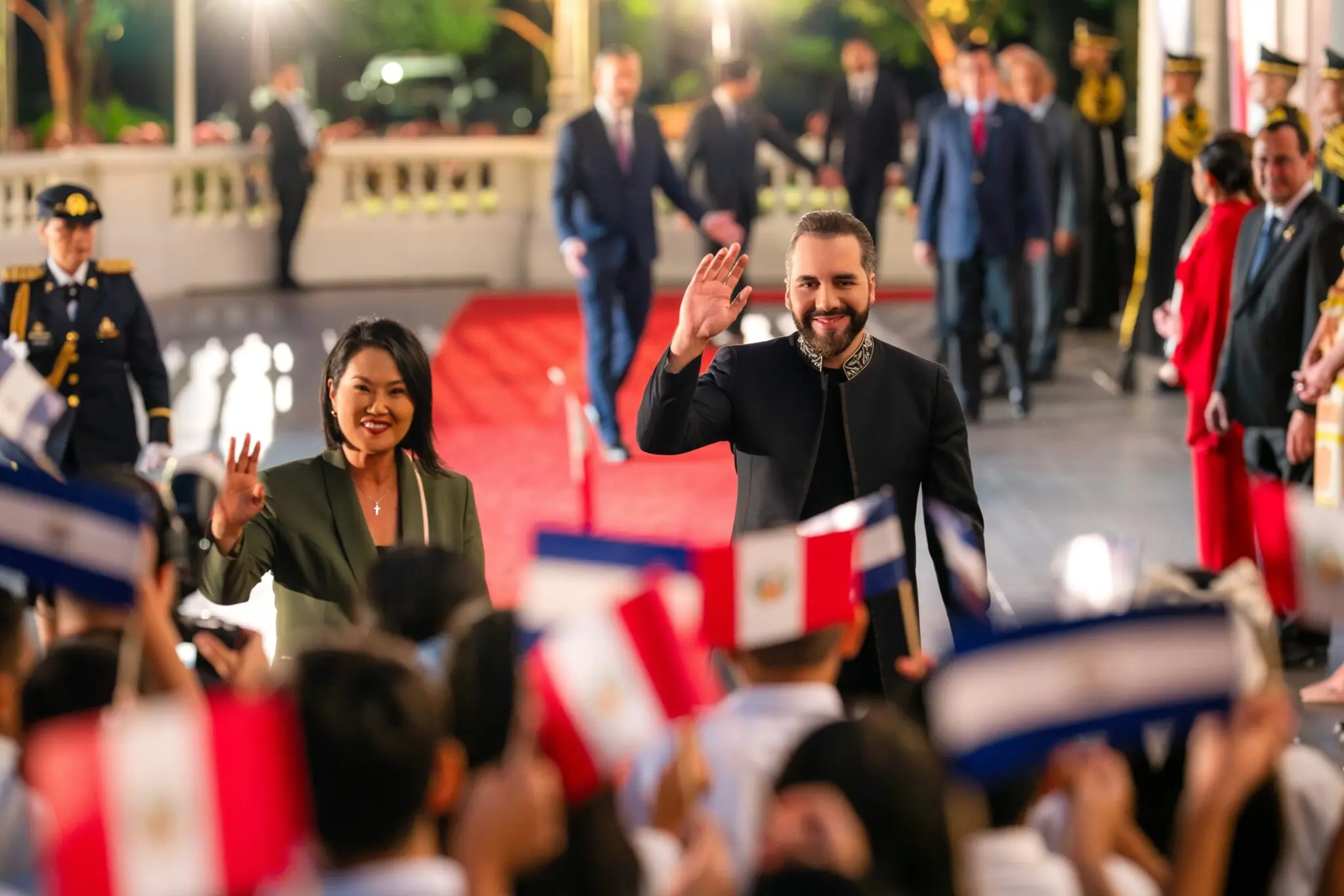
Salvadoran President Nayib Bukele, alongside his Peruvian counterpart Keiko Fujimori, during her visit to El Salvador on October 29, 2026. That day, the president declined to specify the cost of the military operation in Haiti—an operation his government claims to be 90% funding. Image: Presidency of El Salvador
By Edgardo Ayala (IPS)
HAVANA TIMES – As if El Salvador were a global economic powerhouse with resources to spare, President Nayib Bukele is pressing ahead with his risky military gamble in Haiti, where some 2,000 Salvadoran troops have been searching since late October for four of their missing comrades following an ambush by gangs.
That a poor country like El Salvador, with serious social needs, would embark on such an operation continues to surprise analysts both locally and across the region, considering the economic cost of maintaining a military contingent in the Caribbean nation.
Although overall poverty affected 22.5% of Salvadoran households in 2025, slightly below the 22.8% recorded in 2019, the year Bukele took office in El Salvador, extreme poverty rose from 4.5% to 7.67% during that period, according to household surveys from those years.
According to Bukele, El Salvador is covering 90% of the financial cost of the deployment in Haiti. However, the president did not disclose the estimated total, despite being asked directly by a journalist at a press conference in San Salvador on October 29.
“Obviously, I don’t think the cost is low. I suspect that when he says 90% is covered by El Salvador’s budget, he means that those troops are not receiving any additional salary beyond what they already earn as members of the Salvadoran Armed Forces,” economist Carlos Acevedo told IPS.
The new deployment followed the disappearance of four Salvadoran aviation technicians on October 18, 2026, after an ambush in Croix-des-Bouquets, on the outskirts of Port-au-Prince, the country’s capital.
They were part of the contingent supporting the UN-backed Gang Suppression Force (GSF).
Bukele, a leader who has drifted toward authoritarianism and aligned himself with the far right, announced the rescue operation on October 21. By October 28, the press was reporting that approximately 2,000 Salvadoran soldiers were in Haiti.
UN spokespersons have been careful to clarify that Bukele’s forces are not part of the GSF and that only 200 Salvadoran personnel had been operating under its mandate before the four aviation technicians were abducted.
Emboldened by his success in subduing El Salvador’s violent gangs through a hardline crackdown launched in March 2022, the Salvadoran president has claimed that he can also eliminate Haiti’s criminal groups.
To carry out his plan in El Salvador, he resorted to a state of emergency that continues to suspend several constitutional guarantees. To date, more than 90,000 people have been arrested, most of them gang members who had previously been identified and located.
Haiti’s longstanding crisis worsened, descending into collapse and a breakdown of governance following the assassination of President Jovenel Moïse in July 2021. Gangs took advantage of the power vacuum to expand their control over Port-au-Prince and other areas through killings, kidnappings, and control of transportation routes and services.
Haitian Prime Minister Alix Didier Fils-Aimé will visit El Salvador on November 16 and 17 to participate in an international conference on democracy and discuss the future of Salvadoran troops in Haiti, according to an announcement made by Vice President Félix Ulloa on November 6.
However, in a country where secrecy surrounding the president’s activities is common, it remains unclear whether Fils-Aimé will meet with Bukele.
Salvadoran soldiers in formation in San Salvador. The deployment of approximately 2,000 military personnel to Haiti—an operation of uncertain nature—raises questions regarding El Salvador’s public spending priorities, at a time when deep-seated social deficiencies persist. Image: Office of the President of El Salvador
Poor Country, Grandiose Ambitions
To cover the transportation of troops and military equipment to Haiti, probably the most expensive component of the operation, El Salvador has received support primarily from the United States, whose president, Donald Trump, has backed the operation in Haiti.
The United States contributed at least one C-130 military transport aircraft to move personnel and military equipment, according to confirmation provided to the Miami Herald by a spokesperson for US Southern Command. It is unknown whether Washington has provided other forms of military assistance.
“I don’t know how much the day-to-day logistics cost over there. I imagine it depends on the activity, whether ammunition is being used, how intensive the patrols are, and now with diesel prices through the roof, those kinds of expenses,” said Acevedo, a former president of El Salvador’s Central Reserve Bank.
He added: “But I suspect that the United States must be providing substantial support for those kinds of costs.”
As the Salvadoran operation continues, the financial resources being invested in the military campaign in Haiti, whatever the amount, could instead be used to strengthen social services in El Salvador, such as healthcare and education.
That was the view expressed by a 55-year-old Salvadoran barber as he rested in a plaza in downtown San Salvador, the country’s capital.
“We approve of what the president has done here, putting an end to the gangs. We all support him, and it’s good to go rescue our fellow countrymen, but I think it’s very risky,” said the barber, who asked that his name not be disclosed “to avoid problems.”
Moreover, he continued, that money “could be used to keep building better hospitals,” referring to the Rosales National Hospital in San Salvador, which was renovated by the government. The project included construction of a modern tower for specialized consultations and outpatient treatment, inaugurated in June.
Economist Acevedo acknowledged that those resources could be used to address social needs, although he noted that the impact of the operation in Haiti on public finances could be relatively small compared with the country’s fiscal obligations and longstanding social deficiencies accumulated over decades.
The World Bank and the International Monetary Fund (IMF) project that El Salvador’s economy will grow by 4.5% in 2026, compared with 3.9% in 2025. The World Bank attributes this momentum to consumption and investment, particularly in construction, amid increased business confidence resulting from reduced crime.
However, the IMF recommends protecting priority social spending to continue reducing poverty.
In this regard, Acevedo called on the Salvadoran government to adopt a more active policy against extreme poverty, with targeted programs that complement economic growth and job creation.
The government should adopt a policy of “zero tolerance for extreme poverty,” he argued.
Acevedo viewed favorably the earlier participation of Salvadoran aviation technicians in the United Nations-backed mission and initially supported the recent troop deployment. However, he fears that the intervention could drag on and lead to more deaths.
“I’m very skeptical of military adventures,” he said. In Haiti’s case, he acknowledged, “I’m really afraid this could turn into a quagmire, that we’ll end up bringing home four, five, twenty, or fifty bodies, and that the situation will escalate.”
A police officer keeps watch over inmates packed into a cell in El Salvador. President Nayib Bukele maintains that he can subdue Haitian gangs just as he did in his own country, while analysts question the risks and the economic cost of this military-led approach. Edgardo Ayala / IPS
A Different Kind of Combat
The Salvadoran military deployment in Haiti requires “a ton of money,” former guerrilla commander Pablo Parada told IPS. Known as Goyo during El Salvador’s civil war, Parada fought in the conflict between the Farabundo Martí National Liberation Front (FMLN) and the army under right-wing governments from 1980 to 1992.
Following the Peace Accords signed in 1992, the FMLN became a political party and went on to win two consecutive presidential terms, from 2009 to 2019.
According to Parada, if the objective is to recover the missing soldiers, whether alive or dead, the government should first have relied on intelligence operations and explored the possibility of negotiating with their captors.
That would mean coordinating with more experienced agencies if El Salvador’s own capabilities proved insufficient, and establishing possible channels for negotiation, he explained.
The former commander, now a lawyer, warned that an armed confrontation could result in the deaths of people who possess information about the missing soldiers’ whereabouts, making it harder to locate them.
In his view, an impulsive reaction accompanied by threats of retaliation, such as those made by the Salvadoran president, could jeopardize both the safety of the deployed troops and the objective of recovering their comrades.
“When you react that way, it’s very dangerous because you put many things at risk, including the lives of the newly arrived troops,” he said.
Parada also questioned the Salvadoran army’s readiness to confront Haiti’s armed groups, despite Bukele’s assertion that his hardline methods could also crush them.
It is known that, under the state of emergency, Salvadoran gangs simply fled en masse without putting up resistance against the army. There were no major battles as such.
“I can state categorically that our army is not prepared for the urban combat it would face in Haiti,” Parada emphasized.
So far, the Haitian press has reported clashes in Santo and Croix-des-Missions, with several gang members reportedly killed.
Knowledge of the terrain, the experience of commanding officers, and soldiers’ ability to advance, protect themselves, and assist their comrades are all factors that, according to Parada, determine the chances of success in an urban combat operation.
Other important factors include available weapons and support, as well as an understanding of the historical and cultural conditions of the place where the intervention takes place, he added.
“Whoever knows the terrain will always have the advantage,” he said.
Parada recalled that before the November 1989 guerrilla offensive in the urban areas of San Salvador, in which he participated, the rebel forces, composed mainly of peasants, spent three months scouting the locations where they would operate.
They also had local guides and had identified routes for moving around and evacuating in an emergency, he said.
The former commander believes the deployment in Haiti has a strong propaganda component, “in the style of what we’ve had in this country for about seven years,” referring to Bukele’s rise to power in June 2019.
Similarly, economist Acevedo argued that the Salvadoran president is also seeking to demonstrate to the world that his hardline model can bring Haiti’s gangs under control.
“I think he wants to teach the world a lesson, showing that even Haiti’s powerful gangs can indeed be subdued by the power of the state,” he stressed.
Acevedo described Bukele as a president “obsessed with his image” and argued that his taste for media spectacles entails expenditures that could otherwise be directed toward social needs.
“I think the president is quite narcissistic,” the economist concluded.
First published in Spanish by IPS and translated and posted in English by Havana Times.
Read more feature articles here on Havana Times.