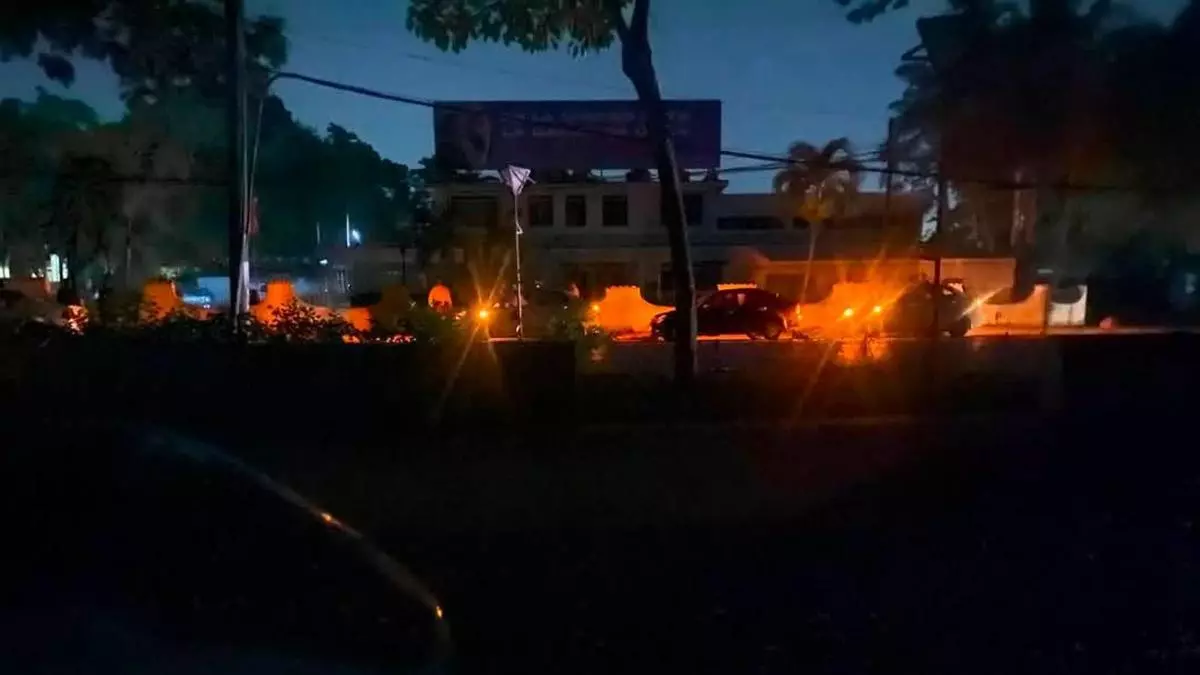
Police patrols outside the Communist Party headquarters in La Lisa, Havana, on Saturday night, July 4, 2026. / Social media
Diaz-Canel responds to the protests with a message aimed at the US: “Bang your pots at the neighbors to the north.”
By 14ymedio
HAVANA TIMES – Shortages, deteriorating living conditions, and power outages that in some areas have now exceeded 30 consecutive hours, combined with hot humid temperatures, are forcing many families to sleep on their porches in an attempt to escape the heat. Against this backdrop, protests over the prolonged blackouts continue to spread across Cuban cities.
The growing discontent was reflected in figures released by the Cuban Conflict Observatory, which recorded 107 protests during June. Havana and Santiago de Cuba topped the list of provinces with the highest number of demonstrations. According to the report, many of them took on an openly political character, featuring actions, slogans, and demands directed against the government.
On Saturday night, residents of the La Lisa municipality in Havana once again gathered outside the local headquarters of the Communist Party to demand the restoration of electricity after enduring about 30 hours without power. Testimonies shared on social media reported the presence of police patrols and State Security agents surrounding the area.
This was the second protest outside that government office in less than a week. Last Tuesday, after nearly 50 consecutive hours without electricity, residents of the same municipality assembled there to demand the return of power. According to witnesses, demonstrators chanted, “The people, united, will never be defeated,” ironically repurposing one of the slogans historically associated with the Cuban government.
Irony also played a role in Saturday’s protests in Santiago de Cuba. At the city’s Medical School, students staged a cacerolazo (pot-banging protest) after enduring about 24 hours without electricity. According to accounts shared on social media, some of the protesters were foreign students attending the school. Among the chants was “Down with Batista,” a reference to former dictator Fulgencio Batista. The slogan’s double meaning appears to reflect the atmosphere of repression and surveillance surrounding areas where protests have been reported. Electricity was restored shortly afterward.
Pot-banging protests were also reported Saturday night in Alamar, where several participants shouted, “Freedom!” Similar demonstrations were reported in Havana’s Plaza de la Revolucion and San Miguel del Padrón municipalities, a level of simultaneous protest that is becoming increasingly common despite ongoing repression.
On July 3, President Miguel Díaz-Canel referred to the protests during an interview with the Puerto Rican news outlet Claridad.
“People bang pots, some more angrily than others. I say, well, go bang your pots at the neighbors to the north, because they’re the ones responsible for these blackouts,” he said.
During the same interview, the president acknowledged the severity of the country’s current situation.
“There are shortages of transportation, food, and medicines here. We have blackouts lasting more than twenty hours. That creates dissatisfaction. No one can be happy. The people are suffering,” he said, while attributing the crisis exclusively to the US embargo.
The interview focused primarily on the government’s recently announced package of reforms, which has been met with skepticism by many Cubans. Speaking about the measures, Diaz-Canel acknowledged that there were “divided opinions” within the ruling leadership, but insisted: “We are not going to make changes to the political system. We will continue defending our socialism.”
Meanwhile, the condition of Cuba’s National Electric System continues to deteriorate. The Cuban Electric Union has described the situation as “extremely complex” and continues to report daily power generation deficits exceeding 65% of national demand, translating into massive prolonged blackouts.
Of the country’s 20 thermoelectric generating units, 11 remain out of service—six due to breakdowns and five undergoing maintenance. Among them is the Antonio Guiteras power plant in Matanzas, the largest in the country, which has suffered 17 breakdowns so far this year and remains one of the principal symbols of the deterioration of Cuba’s electrical infrastructure.
First published in Spanish by 14ymedio and translated and posted in English by Havana Times.
Read more from Cuba here on Havana Times.