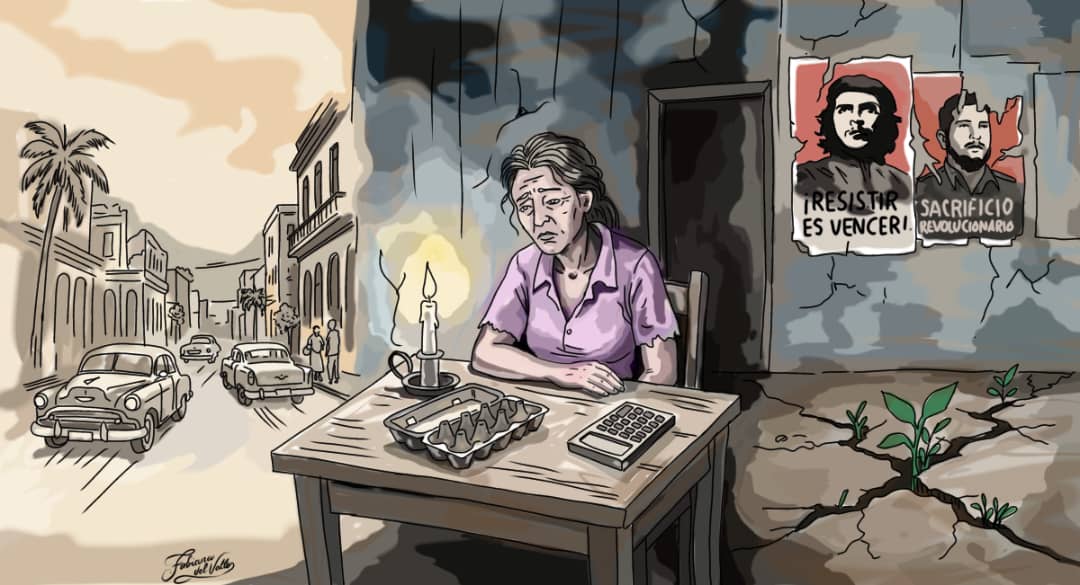
Illustration by Fabiana del Valle
By Fabiana del Valle
HAVANA TIMES — A few days ago, my best friend told me that her greatest concern is not that everything may finally go dark, but that we might get used to that as well. The idea has haunted me ever since. While my husband and I were cleaning the fish tanks in our shop and taking care of household chores, I kept thinking about her words. Unfortunately, she is right: there is a very thin line between resistance and conformity.
People talk in the streets and on social media about the “zero option,” a kind of new “Special Period” like the one in the post-Soviet 1990s, only harsher. I have fragmented memories of that time because I was a child, but there are memories the body preserves faithfully.
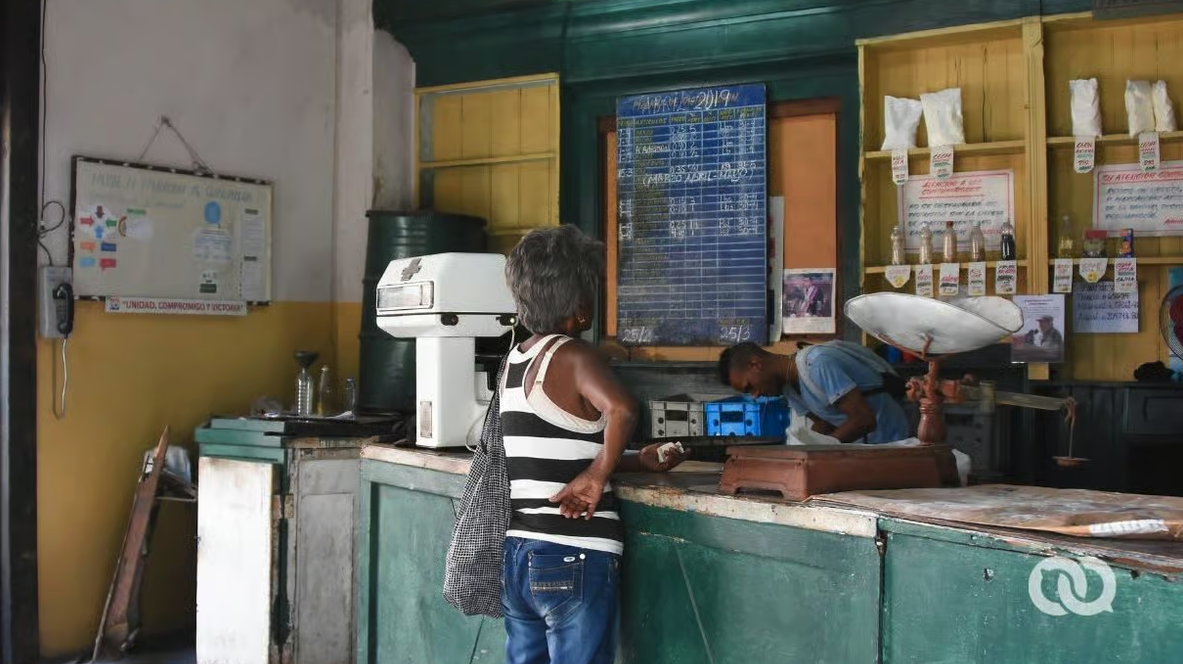
At home, we ate whatever was available, and my parents performed miracles to keep my brother and me from feeling the full weight of scarcity. Mealtime became a solemn ritual. When we sat down at the table, there was only one rule: we could not get up until our plates were empty. It did not matter if the rice was overcooked or accompanied by something with no name. It was what there was, and that was that.
Today, my only problem with food is its absence. We learned from childhood to eat whatever was put before us; for Cubans, rejecting a meal is an unacceptable luxury. Yet in those years, some structures were still standing. The pharmacy, for example, still had medicines.
From an early age, my brother underwent a long treatment for an allergy that later developed into bronchial asthma. He received injections every other day for two years, but he never suffered another asthma attack. I also underwent numerous tests because doctors suspected rheumatic fever—blood tests, specialists, injections. Cuban biotechnology, despite other shortages, held up. I remember the vaccinations at school and the fluoride rinse we were given every month to prevent cavities.
Education was much the same. Our notebooks were made from dark paper produced from sugarcane bagasse, and our pencils slid across the page as though we were writing on wet cardboard. An eraser might be nothing more than the cap from a penicillin bottle. But we went to school every day because, in my home, studying was sacred, and teachers still believed that educating someone was an act of faith in the future.
The biggest difference between that period and today is spiritual. In the 1990s people were exhausted, yes, but they believed the hardship was temporary. There was still a memory of better times, and that memory served as a kind of compass. Today, the maps have been lost and the compass is broken. Even those who defend the system often do so from a place closer to fear or habit than conviction.
The island has been losing its young people, and with them, its hope. Official statistics speak of the millions who remain rooted here, but anyone who walks through a Cuban neighborhood can see that the human landscape has changed. More gray hair, more shuttered houses, more empty chairs at family tables.
What we are experiencing now is a combination of the political repression of the 1970s and the hardship of the 1990s, but without the social lifelines that still survived back then. The result is a sense of fragility in which daily life is held together by invisible threads that can snap without warning.
At this point, violence is not only physical; it is also the violence of abandonment. The shortage of medical supplies, psychological deterioration, the anguish of being unable to plan even for the next day, and the certainty that those who hold power make decisions far removed from the reality of ordinary people while appearing immune to the disaster they create.
The hardest thing is breathing in this collective fear, the kind that is not always spoken aloud but can be felt in conversations, in glances, in the things left unsaid in order to survive one more day. Fear of the present, fear of the future, and even fear of what each of us might do when pushed by desperation.
If we look back at the so-called zero option of the 1990s, we realize it was never truly zero. There was always something, however fragile, to sustain the country. Today it is different. We have learned that it is always possible to fall lower, and that in those depths there are no euphemisms or speeches capable of disguising reality.
Even so, we get up every morning. We open businesses, raise children, take them to school even when the teacher never shows up, rescue animals, share a cup of coffee, tell jokes to chase away sadness.
I feel that getting used to a total blackout would be the greatest defeat of all, and refusing to disappear is the last form of resistance we have left.
Read more from Fabiana del Valle’s diary here at Havana Times.