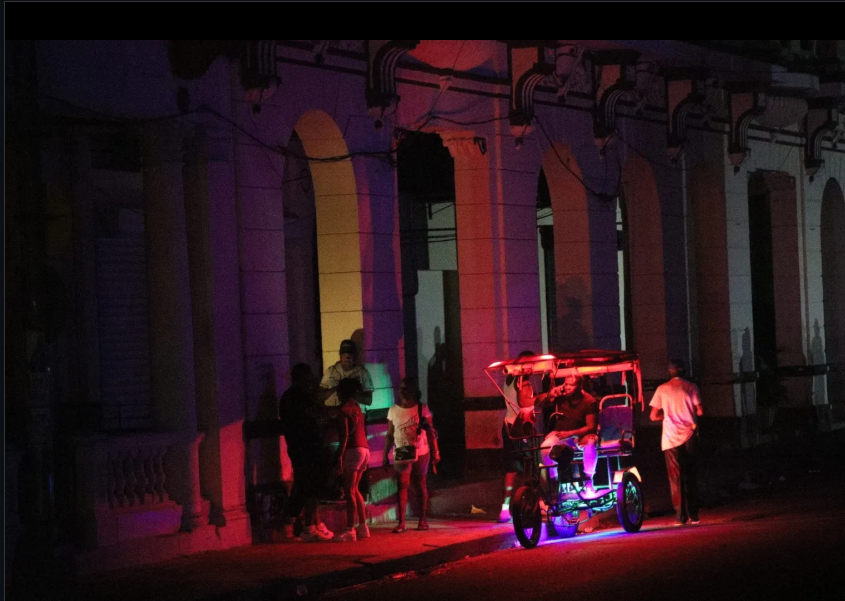
Havana in the dark photo by Juan Suarez
By Khanh Vu Duc*
HAVANA TIMES – For many Cubans today, the question of whether Miguel Díaz-Canel should step down is less about political speculation and more about daily reality. Across the island, repeated blackouts, fuel shortages, and disruptions to basic services have become part of everyday life. In this context, leadership is no longer judged primarily by ideology or continuity, but by the capacity to respond to an increasingly constrained environment.
Energy Shock and the Closing of Cuba’s Lifeline
Recent developments highlight how fragile Cuba’s energy situation has become. A tanker carrying Russian diesel, the Sea Horse, initially bound for the island, diverted mid-voyage after lingering offshore—an episode widely interpreted as reflecting rising financial and sanctions-related risks. Around the same time, Cuba experienced multiple nationwide grid collapses in March 2026, leaving large parts of the population without electricity for extended periods.
These disruptions are not isolated technical failures. They have cascading effects on daily life: hospitals operate on limited backup power, water systems become unreliable, and food storage is increasingly difficult in a tropical climate. In many parts of the island, daily routines are being reorganized around unpredictable power cuts and resource scarcity.
Such conditions point to a deeper structural issue. Cuba’s heavy dependence on imported fuel, combined with limited access to stable supply channels, has turned energy into a central constraint on state capacity. As external pressures tighten and supply chains become more uncertain, the system’s ability to manage even routine functions is increasingly tested.
Leadership Change: Symbol, Strategy, or Both?
Against this backdrop, the question of leadership has taken on renewed urgency. External pressure—particularly from Washington—has sharpened the debate, with suggestions that political change could facilitate negotiations and potentially ease economic constraints.
However, the implications of leadership change remain uncertain. A transition limited to replacing Díaz-Canel with another figure from within the same institutional framework may have only marginal impact. The underlying constraints—energy dependence, economic rigidity, and restricted external access—would likely persist.
At the same time, maintaining the status quo carries growing risks. Recent protests linked to blackouts and shortages, along with continued migration, suggest that social pressures are building. The system remains intact, but its margin for adjustment is narrowing.
The critical question, therefore, is not simply whether leadership will change, but what such a change would represent. Would it signal a broader strategic adaptation, or merely a symbolic adjustment within existing limits?
A Narrowing Space for Adaptation—and the Question of Agency
Cuba today appears to be entering a phase where options are becoming more constrained. In earlier periods of crisis, external support—from the Soviet Union and later Venezuela—provided a buffer that allowed for gradual adjustment. That buffer is now far less reliable.
The result is a form of cumulative strain. Energy shortages affect transportation, food distribution, and public services, while also contributing to rising migration. The system has not collapsed, but it is operating under increasing pressure, with fewer mechanisms available to absorb shocks.
In this context, a deeper question begins to emerge. The issue is not only whether external pressure will force change, but whether Cuban society itself will play a more decisive role in shaping that change.
For decades, Cuba’s trajectory has been defined largely by state structures and external actors. Yet the current crisis—experienced most directly in everyday life—may be shifting that dynamic. As constraints become more visible and more immediate, the limits of the existing model are no longer abstract; they are lived.
This suggests that any meaningful transition is unlikely to be imposed from outside or engineered solely within elite circles. Its direction will depend, to a significant extent, on how Cuban society responds to the narrowing space of daily life—economically, socially, and, potentially, politically.
For now, many Cubans appear less concerned with political scenarios than with immediate concerns—electricity, food, and the ability to plan daily life. Yet it is precisely these pressures that may, over time, redefine the terms of the debate.
Cuba is not facing a single decisive moment, but a gradual tightening of constraints. Outside pressure may accelerate events, but it cannot determine their direction. Initiatives—whether driven by geopolitical interests or humanitarian solidarity—may shape conditions, but they cannot substitute for the agency of Cuban society itself. In the end, the decisive factor will not be pressure from abroad, but whether Cubans themselves are able to shape the terms of their own future.
*Guest author Khanh Vu Duc, Part-time Professor, University of Ottawa, Canada, Faculty of Law
Read more from Cuba here on Havana Times.