While blaming the USA for the island’s crisis
The Government portrayed itself in the speech as a passive victim, incapable of making decisions about the country it governs. / Cubadebate
The Cuban leader turned the July 26 commemoration into a lengthy harangue devoid of self-criticism, solutions, and still clinging to the rhetoric of the external enemy.
By 14ymedio
HAVANA TIMES – Miguel Díaz-Canel devoted nearly half an hour this Sunday to describing a country without electricity, without medicines, with hospitals unable to perform surgeries, paralyzed industries, and rising infant mortality. Yet at the main July 26 ceremony, held in Pinar del Río before sunrise, the Cuban leader absolved his government of any responsibility and once again portrayed the national disaster as an epic struggle and the government’s incompetence as a form of heroism.
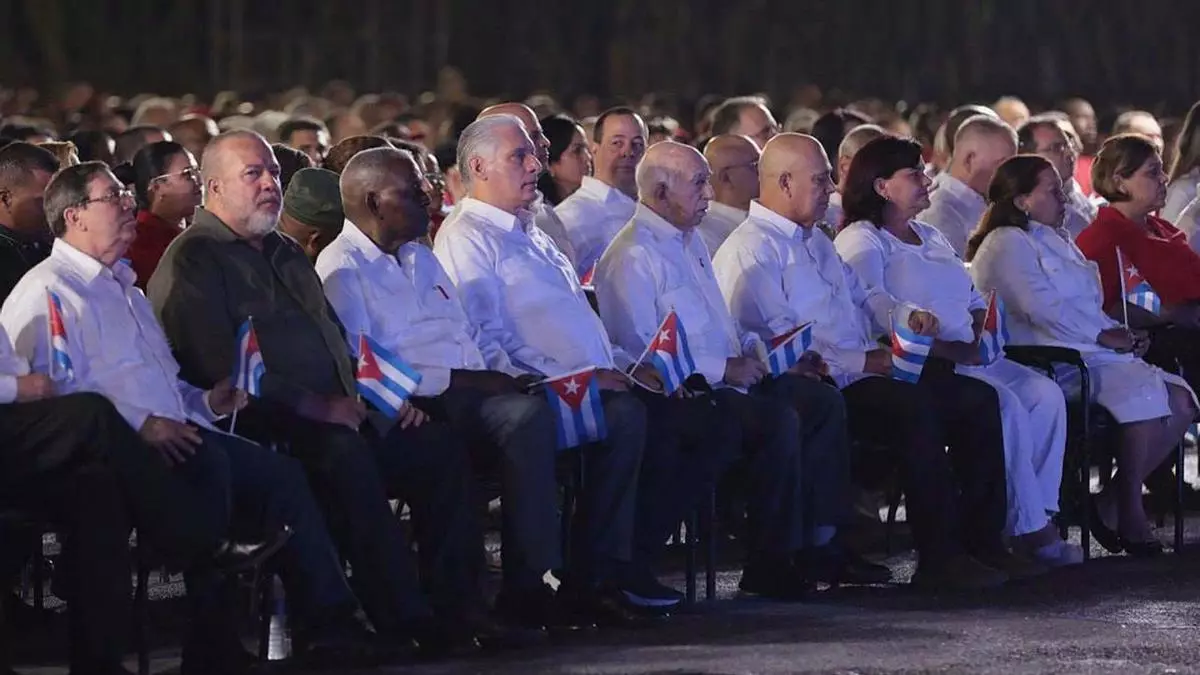
The tone was set from the outset. Before delivering his own speech, Díaz-Canel read a message from Raul Castro, once again introducing him as “the leader of our revolution.” The scene underscored the symbolic weakness of a president who, even at the most important political ceremony on the official calendar, still needs the legitimacy of the retired—and absent—general, serving merely as the messenger of his words. Before him, the audience appeared listless, showing little enthusiasm and paying attention more out of ritual obligation than political conviction.
From there, the ruler resorted to the most worn-out repertoire of propaganda. He claimed that Cuba is fighting “a new Moncada” against a US policy designed to suffocate the country, comparing today’s hardships with the 1953 assault. The difference is that, despite its military failure, that action had a concrete objective, whereas Díaz-Canel’s “Moncada” lacks strategy, deadlines, or any possible conclusion. It is an endless battle, useful for justifying every deprivation and indefinitely postponing accountability.
The continuation of his belligerent rhetoric against the United States occupied much of the speech. Diaz-Canel accused Washington of waging “a world war against the left,” compared State Department officials to medieval authorities and Nazi occupiers, and portrayed the sanctions as part of a genocidal plan.
The verbal inflation reached the point where every concept was stripped of meaning. Fascism, colonialism, Nazism, genocide, supremacism, and world war were all used interchangeably as elements of the same political tirade.
The most pathetic part of the speech was precisely the section in which Díaz-Canel attempted to demonstrate the effects of the embargo. The Cuban leader acknowledged blackouts lasting more than a day, the shutdown of industries, the disruption affecting tens of thousands of workers, deaths caused by the lack of medicines, more than 100,000 surgeries left unperformed, and 118,000 cancer patients forced to receive second- or third-line treatments. He also admitted that infant mortality had risen to 9.3 per 1,000 live births.
Never before had an official speech summarized the failure of the model so starkly. Yet this litany was not accompanied by a single explanation of the internal decisions that had led to this point. There was no mention of the billions invested in hotels while the electrical system deteriorated, agricultural inefficiency, the monopoly held by military conglomerates, the mass emigration of professionals, inflation, dollarization, or the collapse of public services. In the speech, the government appeared as a passive victim, incapable of making decisions about the country it governs.
Nor did the Cuban leader present any vision for the future. When the time came to explain what the government intends to do, he retreated into bureaucratic phrases about “macroeconomic stabilization,” “deep transformations,” incentives for workers and farmers, new forms of management, and opportunities for “responsible” investment. Rather than an economic program, he offered a catalogue of aspirations.
The government’s desperation became even more evident when the speech turned into a plea for help from the regime’s international allies. Diaz-Canel thanked social movements, parliamentary groups, European organizations, governments of the Global South, and US activists who continue to support Havana. He also praised those who travel to the Island with humanitarian aid, presenting their solidarity as an act of courage in the face of Washington’s pressure.
The gratitude sounded less like a celebration than a plea. The regime needs its defenders abroad to intensify their campaigns, contribute resources, pressure their governments, and keep alive an international narrative that grows weaker as Cuba’s crisis becomes increasingly difficult to attribute solely to the US embargo.
Diaz-Canel even equated Cuba’s situation with the wars in Gaza, Lebanon, and Iran, warning that today it is Cuba’s turn and tomorrow it could be any other nation. The speech also devoted time to the “joy of the Cuban people,” which the president presented as another response to economic suffocation. After acknowledging preventable deaths, untreated patients, and entire days without electricity, his appeal to joy sounded less like a description than an order. Citizens must suffer, endure, and still appear optimistic so as not to give satisfaction to the enemy.
The speech ended with the same calls for unity, production, import substitution, and confidence in the country’s own strength that the Castro regime has repeated for decades. To young people—many of whom have already left the country or are planning to do so—Diaz-Canel could offer only the role of “heirs” to the centennial of Fidel Castro’s birth.
After several chants in support of Raul Castro, Diaz-Canel, and the Communist Party, one resident of Pinar del Río seemed to grow tired of the ritual and shouted, departing from the script: “Long live the people of Pinar del Río!” The spontaneous outburst provoked laughter from the audience and, in an instant, punctured the pomposity and hypocrisy of all the slogans that had come before.
First published in Spanish by 14ymedio and translated and posted in English by Havana Times.
Read more from Cuba here on Havana Times.