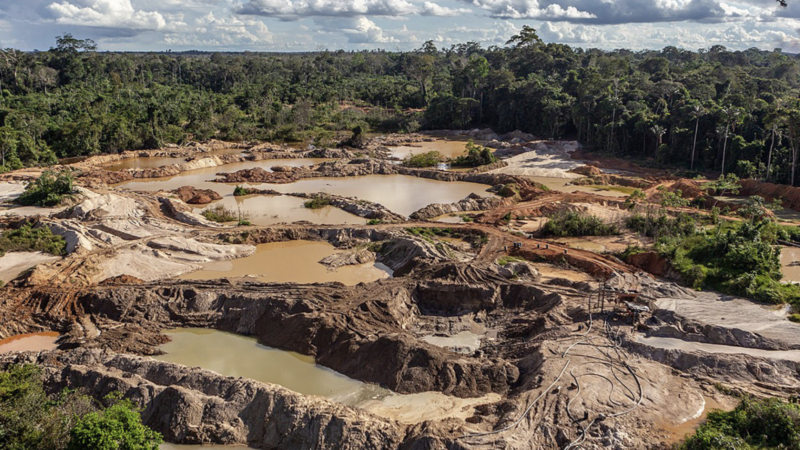
Illegal exploitation of cassiterite in the Tenharim do Igarapé Preto indigenous territory, in the state of Amazonas, in northwest Brazil. Image: Vinícius Mendonça / Ibama
By Emilio Godoy (IPS)
HAVANA TIMES – After 16 years of operations, communities near the San Jose del Progreso silver and gold mine in the southern Mexican state of Oaxaca can now clearly document its environmental impacts, including the appropriation of local water resources.
“About 30 years ago, the water table was still at ground level. There were wells where you could draw water with a bucket, and the deepest ones were only about 10 meters down. When the mining company arrived, there was a significant decline. Then the wells dried up, especially around San Jose del Progreso,” Nestor, a member of the NGO Articulación por la Vida, told IPS from the municipality of San Juan Chilateca, 311 miles south of Mexico City.
The underground mining operation, part of a 247 square mile mining concession held by the Peruvian company JRC Ingeniería y Construcción in the municipality of San José del Progreso, consumes over 8 million liters of water per day and has extracted roughly 800 tons of gold and silver.
While residents of San Juan Chilateca obtain water from three wells, neighboring San José del Progreso relies on three to four reservoirs after the mining company built a dam for its own water supply.
“It’s a model that cannot be sustained because it is far too destructive and deeply invasive for local communities. It destroys the environment and community life itself, tearing apart the social fabric. There are pollution problems,” said Nestor, whose full name IPS is withholding for security reasons.
The small-scale farmer and artisan recalled the 2018 spill of 1.5 million liters of mining tailings into a stream, contaminating local wells with heavy metals.
The mining company holds three wastewater discharge permits totaling 52.5 cubic meters per day, issued by government authorities.
The loss of water has affected agriculture, once the region’s main economic driver. Today, farming shares that role with the service and commercial sectors.
The water problems in San Jose del Progreso illustrate a largely overlooked aspect of the energy transition toward cleaner alternatives designed to gradually replace fossil fuels and reduce emissions through widespread electrification.
Because that goal of “electrifying everything” requires minerals such as copper, silver, graphite, and the so-called rare earth elements, which are used in electric batteries, solar cells, magnets, and other technologies. For example, without lithium there are no efficient, long-lasting batteries. But extracting these minerals requires enormous quantities of water, creating conflicts with Indigenous and local communities.
A critical mineral is any mineral, element, substance, or material considered essential to a country’s economic and national security, whose supply chain is vulnerable and which plays a key role in manufacturing.
The raw materials—minerals and metals—needed to generate renewable energy, produce clean technologies, and facilitate the transition to less-polluting forms of energy are at the center of this dilemma. Humanity is trapped in this inevitable paradox, despite voluntary international frameworks promoting a just energy transition.
The scale of the pressure on Latin America—a region rich in mineral resources—is illustrated by recent reports from the International Energy Agency (IEA): demand for lithium could increase fortyfold by 2040, while demand for graphite and cobalt could rise twentyfold.
Satellite image of the San Jose del Progreso mine in the southern Mexican state of Oaxaca, where mining has generated regional conflicts. Photo: Google Earth
Risks
Mining companies may ultimately lose access to the water they have diverted from local communities, which already face the double burden of dispossession and drought caused by climate change.
A new analysis by the London-based International Council on Mining and Metals (ICMM), which represents the world’s largest mining companies, shows that water shortages and drought threaten mining projects around the globe that produce critical minerals such as silver, copper, and lithium.
An IPS analysis of ICMM data found that of 692 mining and metallurgical facilities in Latin America, 453 (65%) face medium or high risk of water shortages – with 149 facing medium risk and 304 at high risk. Chile, Mexico, and Cuba have the highest proportions, while Brazil has the largest absolute number of high-risk facilities (112).
These mines produce materials such as copper, iron, lithium, gold, silver, and zinc, all essential for manufacturing the devices used in the energy transition, including batteries, sensors, rotors, and cathodes.
Leandro Gómez, coordinator of the Investment and Rights Program at Argentina’s NGO Foundation for Environment and Natural Resources (FARN), told IPS that there is growing demand and competition for an increasingly scarce resource.
“The export-oriented large-scale mining model requires enormous amounts of water and energy. It is important to remember that these activities usually take place in regions where water is already scarce. They impact local communities and biodiversity. They tend to limit nearby communities’ access to water and, in some cases, have affected agricultural activities,” he explained from Buenos Aires.
One example in Argentina is the Muerto Norte project, located near Salar del Hombre Muerto [“Dead Man’s Salt Bed”] in the northwestern province of Salta. The area contains 1.58 million tons of lithium carbonate equivalent and the mining project is owned by South Korean steelmaker Posco.
Communities and environmental organizations have challenged the project because of its impact on the salt flat—a highly sensitive ecosystem—and its heavy demand for water in an already arid region.
Residents of Mazapil in the northern Mexican state of Zacatecas protesting operations at the Peñasquito mine. Mining is at the center of environmental conflicts in Latin America. Photo: Alfredo Valadez / “Así se ve la minería”
Argentina produces about 50 tons of gold annually and, during the first five months of 2026, produced 55,682 tons of lithium carbonate and other lithium minerals.
Last April, the government of far-right President Javier Milei enacted reforms to the 2010 Glacier Law, which had protected glaciers as strategic water reserves, allowing copper and lithium mining in those ecosystems.
In Brazil, the Catalao niobium mine in the central state of Goiás, owned by China’s private CMOC Group Limited, also faces water-related risks.
In 2025, Latin America’s largest economy extracted 293.18 million tons of iron, 73.63 million tons of gold, 56.86 million tons of aluminum, 7.06 million tons of niobium, 3.56 million tons of silver, 2.96 million tons of manganese, and 2.31 million tons of graphite.
Chile faces a similar situation at the Chuquicamata copper complex, the world’s largest open-pit copper mine, located in the northern Andes, where water shortages are also severe. During the first five months of 2026, Chile—the world’s largest copper producer—mined 2.04 million tons of copper.
In Mexico, the El Boleo copper mine in the northwestern state of Baja California Sur, owned by a consortium of five South Korean companies, faces similar challenges. The mine holds a water concession for 489,830 cubic meters annually and a permit to discharge 812 cubic meters of liquid waste per day.
During the first five months of the year, Mexico extracted 43,943 tons of copper, 362 tons of silver, and five tons of gold. During the same period, Peru produced 1,417 tons of silver and 54 tons of gold, while Colombia produced 56 tons of gold in 2024.
Full Speed Ahead
Latin America wants to accelerate mining development to expand production of critical minerals and become part of the value chain for cleaner technologies.
Bolivia, Argentina, and Chile stand out as the countries with the most significant lithium reserves, ranking first, second, and fourth globally, respectively, according to some estimates. Chile and Peru rank first and third in copper reserves. Brazil ranks third in nickel and rare earth deposits, while Mexico ranks second in fluorite, behind China.
Argentina has had a Strategic Mining Development Plan since 2020. Brazil established a legal framework for mining as part of its 2011–2030 National Strategy, and is moving towards a proposed Strategic and Critical Minerals Policy introduced in 2024. In 2021, Brazil also adopted a Pro-Mineral Strategic Policy, covering 27 raw materials, including aluminum, copper, lithium, nickel, and tungsten.
In October 2025, Colombia’s government introduced the “Mining Law for a Just Energy Transition, National Reindustrialization, and Mining for Life,” strengthening state oversight while guaranteeing ecosystem protection and a greater role for Indigenous communities and artisanal miners. Since 2023, Colombia has maintained a list of 17 critical minerals, including copper, lithium, cobalt, nickel, and gold.
Last January, Chile published its National Critical Minerals Strategy, listing copper, lithium, molybdenum, gold, and silver.
Mexico is currently preparing its own national strategy.
Meanwhile, in February, the US State Department organized a ministerial meeting on critical minerals attended by representatives from eight Latin American countries, positioning the region as central to the US energy strategy as Washington seeks to narrow China’s lead in mineral and technology supply chains.
The US government has signed bilateral agreements with Argentina, Ecuador, Paraguay, and Peru, and reached an agreement with Mexico to develop a Critical Minerals Action Plan.
At the same time, multilateral initiatives have emerged to establish a governance framework for critical minerals that incorporates environmental protection and respect for the rights of Indigenous peoples and local communities.
In 2024, the UN Secretary-General’s Panel on Critical Energy Transition Minerals issued seven voluntary principles, including placing human rights at the center of all mineral value chains and protecting the integrity of the planet, its environment, and biodiversity.
In addition, the United Arab Emirates Just Transition Work Program, launched at the 2023 UN climate summit in Dubai and adopted at the November 2025 summit in Belem, Brazil, emphasizes “the importance of just transition pathways” that uphold the rights of Indigenous peoples, local communities, and Afro-descendant populations.
But international rhetoric collides with realities on the ground, centered on one fundamental question: where will the water come from to support this urgent energy transition?
In Mexico, mining consumed 2.43 billion cubic meters of water annually in 2023. In Brazil, it used 33 cubic meters per second in the same year. In Colombia, mining consumed 660 million cubic meters annually in 2022, while Peru used about 270 million cubic meters in 2024. In Chile, copper production required about 18 cubic meters of water per second in 2024.
In places like San Juan Chilateca, Mexico, the vision is not centered on electric cars and buses, even though the minerals extracted from these communities help fuel the green dreams of the cities.
“We have a system that has sustained us for thousands of years. We have sustainable ways of life. What the world is debating is how to preserve a model that is not sustainable. We are victims of that model. What is needed is to work with affected communities and respect the autonomy and self-determination of the local people. That would be enough for us—to be the ones who decide whether these projects are necessary,” Nestor said.
For Gomez, what is needed is a global political commitment to apply these principles in the face of a geopolitical race that continues to increase pressure on governments and communities while leading to violations of rights.
“The priority is on speed, without paying attention to human rights or planetary limits. Projects continue to be approved without considering their full impacts. Most countries are in a similar situation, despite political differences. There is a clear trend toward weakening environmental regulations and standards,” he concluded.
First published in Spanish by IPS and translated and posted in English by Havana Times.
Read more feature articles here on Havana Times.