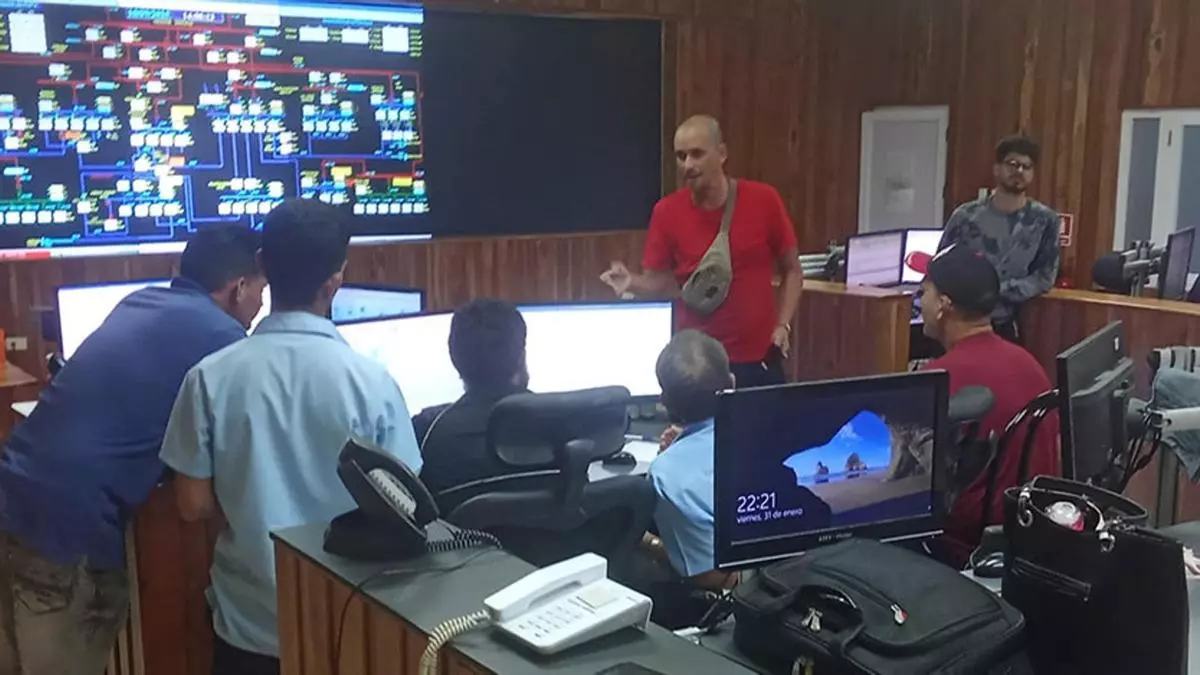
Load Dispatch Office of Ciego de Ávila’s Electric Company / Invasor
Priority circuits, such as the hospital and the Dairy Combine processing plant, are also affected.
By14ymedio
HAVANA TIMES – The electrical situation is critical, and only the solar parks provide a “daytime breather.” With these blunt words, and right from the headline, Invasor online describes this Friday the situation in Ciego de Ávila. According to Lester Arencibia Bacallao, director of the Provincial Load Dispatch Office of the Electric Company, the province is experiencing the “maximum blackout,” meaning power cuts that last up to 24 hours a day.
For this reason, they are prioritizing circuits that supply “essential centers,” such as the Provincial Hospital or the dairy factory. Even these, however, are not spared from outages: three and a half hours without power for every three and a half hours with electricity.
Arencibia responded to a “frequent concern among the population”—“Why are these circuits so large and why aren’t they segmented to provide energy to more areas?”—without offering much clarification. “These circuits have been physically configured this way for many years. That’s the setup they’ve always had,” he explained to the provincial newspaper (which notes at the end that the text was generated with artificial intelligence based on information provided by the official).
He further explained that making changes “requires very costly investments, such as laying 33 kilovolt (kV) lines and installing substations, resources not available in the current economic situation.”
Regarding “non-priority” circuits, the intention is for outages not to exceed 12 consecutive hours, but the official acknowledged that with the current deficit “this is impossible.” He detailed: “Sometimes circuits go from 12 to 14 hours. They have even reached 19 and 20 consecutive hours without power.”
Arencibia also addressed the extent to which solar parks alleviate the situation. While he said that photovoltaic generation is “the main relief”—Ciego de Ávila has three solar parks totaling 21.4 MW and four smaller ones bringing total capacity to more than 76 MW—he reminded readers that this type of energy “is intermittent.”
Their greatest contribution, between 10:30 a.m. and 2:30 p.m., is fragile—even a single cloud can interrupt it. “This volatile nature, combined with the lack of storage systems, makes it impossible to rely on this energy consistently or during the critical nighttime peak hours,” notes Invasor. Arencibia adds: “During the day, the solar parks save tons of fuel… and if we do the math, without any of these parks the situation would be much worse.”
Although the interview focused on the province of Ciego de Ávila, the official did not refrain from drawing conclusions about the rest of the country: as long as the “structural problems of national thermal generation” remain unresolved, the situation “will continue to be complex.”
Regarding energy issues, the official press only reports news related to the effects of Hurricane Melissa, which almost a month later are still felt in eastern Cuba. One of the damaged facilities was the Hermanos Díaz Oil Refining Company in Santiago de Cuba, which supplies fuel from Las Tunas to Guantánamo. “Diesel, fuel oil for electricity generation, kerosene for mountainous areas, lubricants, and other derivatives depend on its stable operation,” Juan Jesús Alfonso López, CUPET’s director of refining, told Sierra Maestra newspaper of Santiago de Cuba.
At the refinery, the newspaper reports, “uninterrupted workdays are underway to restore the plant’s vitality.” Hurricane-force winds—up to 200 kilometers per hour—caused “severe damage to internal electrical networks, thermal insulation, maritime containment barriers, and other systems essential to the refining process.”
Just this Thursday, President Miguel Díaz-Canel—again dressed in olive green—visited areas in the provinces of Santiago de Cuba and Granma, the latter being the most affected by the hurricane. In Granma, he noted, 96.43% of electrical service has been restored (when there is electricity). “There are 9,000 customers in remote areas who are still being worked on,” he assured.
Meanwhile, the daily power deficit is returning to its pre-hurricane levels, once again nearing 2,000 MW. On Wednesday, the Cuban Electrical Company registered a deficit of 1,964 MW during peak demand hours in the late afternoon and evening. For the following day, available capacity was expected to be 1,494 MW for a demand of 3,200 MW, leaving a deficit of 1,706 MW—though the real deficit was estimated at 1,776 MW.
Six units at thermoelectric plants are out of service due to breakdowns or maintenance: one at Felton, three at CTE Renté, one in Santa Cruz, and another in Cienfuegos, as well as the gas plant in Puerto Escondido, Varadero.
First published in Spanish by 14ymedio and translated and posted in English by Havana Times.
Read more from Cuba here on Havana Times.