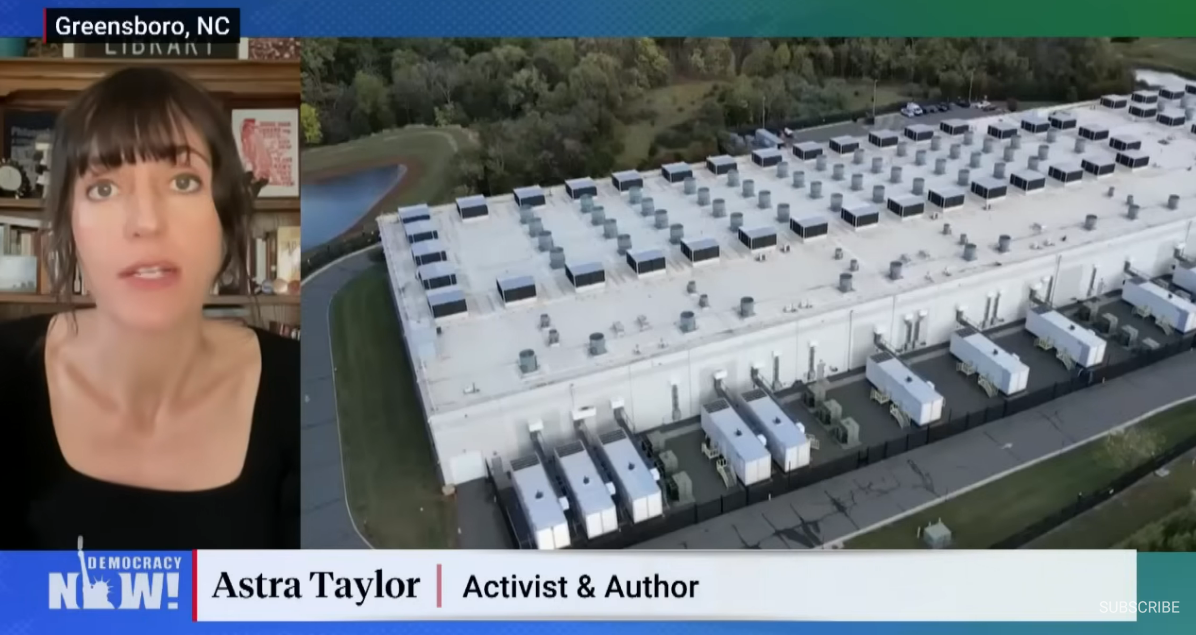
Democracy Now Interviews Astra Taylor
By Democracy Now
HAVANA TIMES – As the “supercharged” construction of new data centers to power artificial intelligence blankets the country, a growing resistance movement to these massive corporate projects amid a lack of public oversight is not far behind.
As organizer Astra Taylor explains, local fights across the country are leveraging this “industry chokepoint” to force important questions, from the distribution of land, water and energy resources to democratic governance over an industry currently driven by a “billionaire Big Tech agenda.”
While AI boosters frame the technology as inevitable, Taylor says, “I think that many people are more skeptical than that. … That’s part of what it means to have democratic governance over AI, to say, ‘No, we don’t need this technology to take over every facet of our existence.’”
Transcript
AMY GOODMAN: This is Democracy Now!, democracynow.org. I’m Amy Goodman.
Calls are growing across the United States for moratoriums on new AI data centers over their impact on energy costs, water and land use, the U.S. economy, greenhouse gas emissions and democracy. In Maine, state lawmakers recently approved the first statewide moratorium, but the governor, Janet Mills, vetoed the legislation. A new Gallup poll released today shows seven out of 10 Americans oppose data centers being built near them, and the opposition spans the political spectrum.
In Utah, residents are fighting plans to build what would be the largest data center in the world in Box Elder County. If built, the facility would generate and consume more energy than the entire state of Utah. The proposed complex would cover an area more than two-and-a-half times the size of Manhattan. Estimates show the project could increase Utah’s greenhouse gas emissions by 50%.
On Capitol Hill, Vermont’s independent Senator Bernie Sanders and Democratic Congressmember Alexandria Ocasio-Cortez have introduced legislation to impose a temporary national moratorium on new artificial intelligence data center construction.
REP. ALEXANDRIA OCASIO-CORTEZ: More than 100 local communities across 12 states have already enacted local moratoriums on data centers, and Congress itself has a moral obligation to stand with them and stop Big Tech from ruining their communities. Our legislation in the House and the Senate would hit the brakes on construction of new data centers until we address several of the key areas of harm AI poses.
AMY GOODMAN: We go now to North Carolina, where we’re joined by Astra Taylor, writer, organizer, co-founder of the Debt Collective. She co-wrote a new piece for The Guardian headlined “The fight against AI data centers isn’t just about tech — it’s about democracy.” Astra Taylor and Naomi Klein’s forthcoming book, out this September, is titled End Times Fascism and the Fight for the Living World.
Astra, welcome back to Democracy Now! Why don’t you start off just by talking about what these AI data centers are, this largest one in Utah? I was just in Middleburg, Virginia, last night. Every other person was raising this issue with me, very critical issue in Virginia right now. Explain what they are.
ASTRA TAYLOR: Thanks for having me.
Yeah, data centers are essentially the backbone of the AI revolution. Data centers aren’t new. Every time you use the internet, you’re using data centers, so they’ve been around for a while. But they have been supercharged by the push towards artificial intelligence.
Virginia is indeed the data center hub in this country, but they’re spreading rapidly across the United States. Sam Altman, the head of OpenAI, has said that, you know, perhaps we’ll have to cover the entire world in data centers. And it’s about the drive for computing power.
And they are often on an absolutely enormous scale, like you described the data center being proposed in Utah, which would actually use twice as much energy as the entire state. There’s one being proposed in Michigan that is going to be as big as 32 NFL football fields.
And they use incredible amounts of energy, often gas, fossil fuel. They are being used as an excuse to put even old coal factories and coal production back online. And there are many negative consequences for communities from emissions. Often they are powered by temporary gas turbines that are being used almost on a permanent basis. So there’s air pollution, carcinogens.
There’s light and noise pollution. You know, people are absolutely tormented by the sounds of these huge warehouses of whirring computers. There is water use issues, depending on where it’s located.
And then there’s just the question of: What are people getting in return? Because these are massive, quote-unquote, “factories,” but there are no jobs and a lot of harms for the people who live near them, and larger harms for our society.
AMY GOODMAN: Explain why it requires so much energy. What does it have to do with AI? Why does artificial intelligence require this, Astra?
ASTRA TAYLOR: Just the nature of, you know, what they call compute, right? The computers themselves require an incredible amount of energy to run and then to be cooled, so they have to be kept in a stable temperature setting. So, there’s just energy to cool these machines, because they produce an enormous amount of heat. And so that’s another problem with them.
And this is blowing — this is helping to blow through whatever, you know, now-long-gone climate commitments we had. But this drive to AI has been — you know, when you look at Silicon Valley, they say the direct AI is why we can no longer meet our climate commitments, right? All of these companies, Google, Meta, presented themselves as climate champions, and AI has caused them to throw those ideals out the window.
AMY GOODMAN: One of the primary investors of the proposed mega data center in Utah is Kevin O’Leary, better known as “Mr. Wonderful” on the reality TV show Shark Tank. This is O’Leary defending the project and dismissing the protesters.
KEVIN O’LEARY: Well, I’m actually the only developer of data centers on Earth that graduated from environmental studies, so I’m pretty aware of what these concerns are. They are around air, water use, heat, noise pollution. So, sustainability is at the heart of what we do in terms of all these proposals, not just Utah. We have 10,000 acres in Alberta, Canada, with the same concerns. And so, we search for the best technology. There’s many air-cooled turbines now, so you’re blending in air-cooled versus water. And there’s so many different ways to generate power. We can also put a percentage of the power generation to solar, wind and batteries, because the battery technology is 10x more efficient than it was just five years ago. So, that’s very helpful, because it makes the cost of energy lower. So, no one — you know, if you’re an environmentalist and you don’t care about that stuff, of course, you protest. And that’s what happens. I noted, you know, what’s happening in Utah right now is we think over 90% of the protesters are actually not people that live in Utah or Box Elder County. They’re being bussed in.
AMY GOODMAN: That’s Kevin O’Leary, better known as “Mr. Wonderful” on the reality TV show Shark Tank. Your response, Astra Taylor?
ASTRA TAYLOR: Well, he should be called “Mr. Full-of-It.” I mean that his claims are absolutely absurd. You know, you could build data centers that were connected to sustainable renewable energy sources. That is not what these tech companies are doing, because they are rushing to compete to be the company that controls this industry. So, you know, take somebody like Elon Musk, who has built three data centers, supercomputers, around Memphis, Tennessee. One of them, for example, the first one, uses enough energy to power almost 300,000 homes. He’s using these very high-polluting gas turbines. Colossus 2, as the second supercomputer is called, uses enough energy for 2 million homes. You know, this is a guy who presented himself as a green champion for many years, but he has not built these computers, these supercomputers, these data centers, in a way that reflects those values at all.
You know, and absolutely, the point about this protest movement against data centers being, you know, not grassroots, being paid, is absolutely absurd. What’s incredible about this movement is the grassroots nature of it and how it’s bringing together people from across the political spectrum. It’s bringing together folks who live in Memphis, Tennessee, rural farmers, just concerned citizens, who are saying, “What are we getting out of these?” You know, there used to be a bargain when a factory came to town. You would get jobs, even if maybe it emitted some pollution, or had tax breaks. These massive — you know, these massive warehouses maybe produce 30, 50, a hundred jobs at best, often low-wage jobs doing things like security or sanitation. And now there’s even companies who are saying that they are going to actually provide security services with robot dogs — right? — with robots. So it will be robots guarding the computers. And so, people are rightly saying, “What? Why should we support this?” And that is what is causing this amazing movement to rise up and to block these developments across the country.
AMY GOODMAN: Astra, the University of Buffalo professor in environment and sustainability, Holly Buck, recently wrote an article in Jacobin headlined “Democratic Governance of AI Is the Real Solution,” in which she argues against the idea of a moratorium on data centers. She writes, “A moratorium on AI data centers is a terrible idea — one that poses serious equity concerns. A moratorium springs from the desire to stop the concentration of wealth, but ironically, it is likely to exacerbate it. It’s a massive strategic blunder for the Left, and we should think through the global justice implications and follow-on effects. … We should be wary of proposals that would send burdens elsewhere. Under neoliberal capitalism, industries offshore environmental harms to places with weaker governance, cheaper labor costs, and fewer environmental safeguards,” unquote. Buck says AI should be regulated as a public utility. What’s your response to her argument on a moratorium?
ASTRA TAYLOR: Yeah, The Guardian piece I wrote with Saul Levin was a response to her criticism of this movement, which she said was a dead end, and her criticism of the idea of a data center moratorium.
First, I want to say that I like the idea of democratic governance of AI, but you need to have leverage to have any kind of democratic control. We think it’s important to pause and just note how undemocratic the rollout of AI has been so far. Nobody has asked for this. You cited polling. This is incredibly unpopular technology. Even 80% of Republicans and independents, of people who voted for Donald Trump, say they want more regulations on AI, even if it slows things down. Last year, there was a poll that said only 10% of people are excited about where this technology is going. And that’s because the people who control it, who own it, have been very clear that they don’t have democracy in mind. They define AGI, artificial general intelligence — this is OpenAI’s definition — as autonomous systems that can do — essentially, do human work. And so, this is a human job elimination machine, and maybe a human elimination machine, in the sense that AI is not just automating workplace labor, but also, you know, impersonating human beings and trying to be your best friend and your companion and sort of take over human life. So, this is not — and this, again, is not something that people have wanted.
You know, Silicon Valley has gotten very aggressively behind Donald Trump, who has said, you know, he’s going to block all attempts to regulate or control this technology, that we’re in an accelerationist mindset. So, you only can wield democratic power in opposition to that, if you are, you know, an ordinary citizen who doesn’t have a direct line to Donald Trump or millions of dollars to buy him off, by engaging in protest, by engaging in disruptive action. And data centers provide local focal points, local chokepoints, where people can come together and push back on the billionaire Big Tech agenda and say no. And it has absolutely changed the terrain, I think, of the political conversation. That’s critical. I think there are some people — a good-faith critique is, “Well, is this the most tactical thing that people can do?” And I would say it is tactical, because it provides, again, people a place to meet locally and a way to make their discontent known.
But I would — I think where I have another disagreement with Buck is, you know, I think there’s a question about how much we want AI in our lives, right? You know, I think part of her argument is that it’s a bit Luddite to resist this technology. It’s inevitable. It’s the future. Everyone should have access to it in every facet of their existence. And I think that many people are more skeptical than that, who are saying, “Do we really want AI in our schools teaching our children? Do we really want AI talking to our children? And do we want AI to be our boss at work?” You know, and so, there is a — there is a deeper debate there about where we want to allow this technology to be. And to me, that’s part of what it means to have democratic governance over AI, is to say, “No, we don’t need this technology to take over every facet of our existence, from the industrial to the intimate.”
AMY GOODMAN: And finally, very briefly, can you explain the tech sector fighting back against the anti-data center movement — you write, quote, about “concerted PR efforts, flooding elections with dark money, or even shadier tactics” — In this last minute?
ASTRA TAYLOR: Yes. You know, Bernie Sanders recently said that, by his estimate, the AI sector has put $400 million into elections already in 2026. They are also trying to use other tactics, PR tactics, to smear protesters. For example, that idea that this is actually a paid movement and it’s not a grassroots movement is part of their campaign against the data center uprising.
And, you know, it seems to not be working at this point, because there is such grassroots momentum. People are coming together from all walks of life and realizing they have more in common around this issue. They might have voted for Donald Trump. They might have — they might be a Democrat. But they’re saying, “This is not the future that we want. We want a future where we can breathe the air, we can drink the water, where we have jobs, where our kids have jobs, where we have a livable future.” Naomi Klein and I, in our forthcoming book, call this a new pro-life movement. We don’t want to be subjected to robot overlords.
So, there’s going to be pushback, undoubtedly, more pushback to come from the tech sector. And I hope that people who are sympathetic to the idea of regulating this technology can appreciate what a strategic movement this is. The data center fight is giving us leverage to create the conditions where, hopefully, the Democratic Party can come in and seize the moment and propose not just smart regulations, but things like a jobs guarantee, insisting that this technology is tied to green energy and the like. This is creating conditions for the changes that we need to push back on Silicon Valley and its authoritarian agenda.
AMY GOODMAN: Astra Taylor, writer, organizer, co-founder of the Debt Collective. We’ll link to your new piece in The Guardian titled “The fight against AI data centers isn’t just about tech — it’s about democracy.” Astra and Naomi Klein’s forthcoming book, out in September, is titled End Times Fascism and the Fight for the Living World.
Read more interviews here on Havana Times.