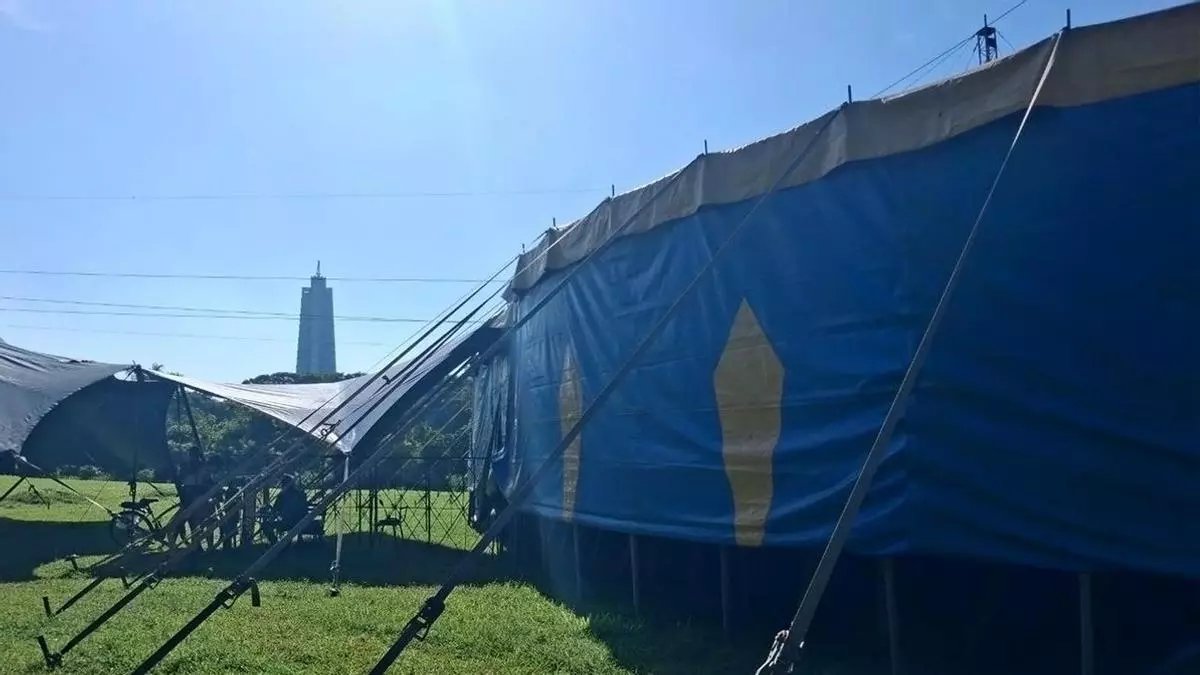
The circus tent set up just a few meters from the Council of State, with the tower of Revolution Square in the background. / 14ymedio
As a circus tent rises beside Revolution Square, blackouts and urban decay deepen Cubans’ isolation.
By Yoani Sanchez (14ymedio)
HAVANA TIMES — They have set up a circus in my neighborhood. Just a few meters from the Council of State, a blue tent now stands, and the tower of Revolution Square blends into the horizon with the yellow stripes crowning its roof. Children wander curiously around the area, and the neighbors have not missed the opportunity to joke about the clowns and illusionists who always seem to proliferate nearby.
“If they’re the animal trainers, then we’re the animals,” an elderly woman warns me as I approach the open space where, even this Saturday, the hammering of preparations still echoed.
I arrived here via Hidalgo Street. Earlier, I passed by the ration-market bakery, with its endless line of people carrying empty bags. I had to dodge a stream of sewage water gushing from a manhole and winding its way for more than a hundred meters. Garbage also stretches for entire blocks in what was once an area where greenery and tall apartment buildings dominated the landscape. Not anymore.
Nuevo Vedado is now, like much of Havana, a succession of mountains of trash, broken streets, and weary faces.
“They didn’t cut our power all night,” another neighbor tells me with relief. He says it quietly, almost in a whisper, as if afraid of alerting the Electric Company that our building managed to sleep through an entire night for the first time in weeks. You almost start to feel guilty for having so many hours of electricity. When I woke shortly after four in the morning and stepped onto the rooftop, I saw several buildings near Colon Street submerged in darkness.
“Those are the victims of our light bulbs being on,” I told myself.
In my building, fewer and fewer people use the elevator. The fear of becoming trapped during a blackout discourages anyone from entering that metal box, which turns into a sauna the moment the power goes out. Some residents spend entire days without leaving their apartments because of knee pain and other ailments make it impossible to climb up and down the stairs.
The energy crisis has a largely invisible face: immobility and social isolation.
Thousands, hundreds of thousands of Cubans across the island have gradually lost contact with friends, acquaintances, and even relatives because getting around has become too difficult.
A friend who lives in Central Havana tells me that an elderly man in her building died of “loneliness.” She says it just like that, bluntly, as though desolation had already found its way into the Cuban medical glossary as an official cause of death.
“He stopped going out,” she explains. “He used to stand in line at the bank to collect his pension, but his legs hurt too much, and he couldn’t remain standing for hours.”
Then a social gathering where he met with other retirees to listen to boleros or dance danzón was canceled. The lack of electricity has shut down performances, discussion groups, and social events. It has silenced many conversations as well.
“In the end, he would just stand at the window watching people walk by on the street. He could go weeks without speaking to anyone.”
The day they found him dead, the neighbors themselves had to pay for his cremation.
“I’ve kept the urn with his ashes to see if the only son he had ever comes back to Cuba, but for now we don’t even know how to locate him.”
Abandonment and lack of communication kill, without a doubt.
After walking around the circus grounds, I head toward La Timba. I cross several of its pothole-ridden streets and its low houses, so different from the twelve-story buildings I left behind. I pass in front of the National Theater.
Everything is silent and empty.
There was a time when it was rare for a weekend to pass without one of its halls being surrounded by children coming to see a performance. Now only the echo of silence remains.
A woman asks me for the time just as I begin descending the main staircase of the complex.
We spend a few minutes talking about the weather, the blackouts, and how terrible public transportation has become. She fires off one quick sentence after another, barely stopping to breathe. She seems to have been holding them in for far too long.
“Oh, dear, it’s just that I don’t have anyone left to talk to,” she apologizes.
And then I think that this may be one of the most devastating consequences of Cuba’s crisis: the epidemic of loneliness spreading everywhere.
First published in Spanish by 14ymedio and translated and posted in English by Havana Times.
Read more from Cuba here at Havana Times.