- by croatiaweek
- June 5, 2026
-
in
News
(Photo: Svetište Predragocjene Krvi Kristove/Facebook)
ZAGREB, 5 June 2026 – A major structural restoration is currently underway at the Parish Church of the Holy Trinity in Ludbreg, a significant pilgrimage site known for housing the relic of the Precious Blood of Christ.
The works, valued at €2 million, are being financed by the Ministry of Culture and Media of the Republic of Croatia, and involve extensive reinforcement of the church’s vaults, internal and external walls, as well as its tower.
The church, which dates back to the 15th century, has suffered structural wear over time, including damage caused by earthquakes.
The primary objective of the ongoing works is to ensure the building is structurally stable and resistant to future seismic activity.
According to project representatives, the restoration is focused on securing the historic monument for long-term preservation while maintaining its cultural and religious significance.
Construction works began at the end of January, with completion expected in November.
Archaeological Discoveries During Works
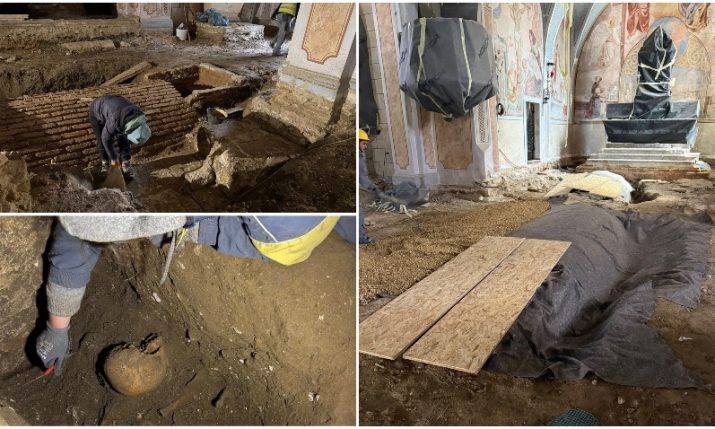
As the restoration progressed, the site has revealed significant archaeological findings, prompting additional research and analysis, HRT reported.
Workers and archaeologists uncovered human remains in newly discovered graves inside the church, which are now being prepared for further study.
The discoveries are expected to contribute to a deeper understanding of the church’s historical development and the wider history of the town.
Project experts confirmed that what was initially thought to be a single crypt has now been identified as six separate crypts within the church structure.
(Photo: Svetište Predragocjene Krvi Kristove/Facebook)
In addition, Roman-era structural remains have been found at the site, further highlighting its historical importance.
Evidence of Earlier Church Structures
Archaeological investigations have also identified walls and structural elements believed to belong to an earlier church, likely from the Gothic period. These structures appear to have been partially built using large Roman stone blocks.
Researchers note that the findings are consistent with the site’s location within the area of the former Roman settlement of Lovia, adding further historical context to the discoveries.
Expert Insights on the Site
The project’s construction and supervision team emphasised the dual importance of the works: structural safety and archaeological preservation.
(Photo: Svetište Predragocjene Krvi Kristove/Facebook)
They noted that the complexity of the site has led to deviations from the original construction schedule, as new discoveries continue to emerge during excavation and reinforcement works.
The church in Ludbreg is also an important pilgrimage destination, serving as the centre of the Sanctuary of the Precious Blood of Christ in Shrine of the Precious Blood of Christ in Ludbreg.
Local parish leadership highlighted that the site continues to attract visitors due to its religious importance and long-standing tradition of pilgrimage.
(Photo: Svetište Predragocjene Krvi Kristove/Facebook)
Alongside the works in Ludbreg, a broader programme of cultural heritage preservation is currently underway in the region.
Across the area of the Diocese of Varaždin, a total of 36 religious buildings are currently being restored using funding from the Ministry of Culture and Media.