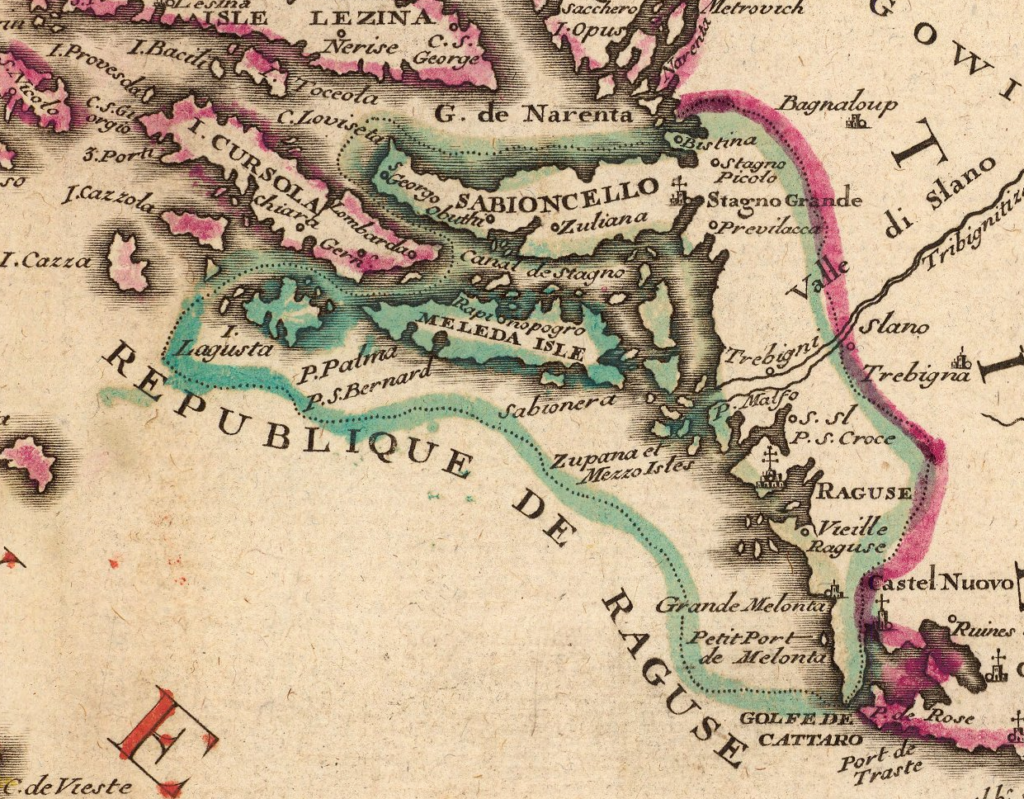
July the 28th, 2026 – Turning the clock back to July 1377, we saw how the ever-diplomatic Dubrovnik organised the isolation of new arrivals in order to combat the plague.
In July of the aforementioned year, the former Great Council of the Republic of Dubrovnik adopted a decision requiring people arriving in the city (and then autonomous state of Ragusa) from plague-affected areas to undergo a period of isolation before entering the city or its surroundings.
trentina – strict isolation for a period of one month
Dubrovnik was one of the most important medieval trading centres on the Adriatic. Its wealth depended on shipping, merchants and goods arriving from across the Mediterranean and the European hinterland. Those same connections also carried infectious diseases. After the Black Death swept through Europe in the mid-14th century and caused catastrophic issues, the authorities faced a clear problem. A complete ban on foreign arrivals and goods would have protected the population but would also have severely damaged an economy based on trade. Instead they introduced a compromise.
Arrivals from infected regions were not allowed to enter Dubrovnik immediately. Index writes that they had to spend a fixed period separated from the local population so that any symptoms of disease could appear. The initial isolation period lasted 30 days and was known as the “trentina”.
dubrovnik tried to stop the disease at the city gates
Isolation was carried out at Cavtat and on nearby islets such as Mrkan; later Bobara and Supetar were also used. The underlying principle was that a person who showed no signs of illness after a sufficiently long interval posed a substantially lower risk of introducing infection. Medieval physicians had absolutely no knowledge of the bacterium Yersinia pestis, which was identified much later at the very end of the 19th century. They did, however, observe from experience that the disease spread through contact and the movement of people, and that symptoms could appear only after a delay. Dubrovnik therefore tried to stop the disease at the gates rather than respond only after an outbreak inside the city.
Rules were strict. People from affected areas had to complete the prescribed isolation, and contact between Dubrovnik residents and those in isolation was limited, creating a sanitary buffer.
dubrovnik’s decision eventually became a global practice in epidemiology
The period was later extended from 30 to 40 days. The modern word “quarantine” derives from the Italian quaranta (forty). The precise reason for choosing 40 days is not certain; explanations range from medical observation to the symbolic importance of the number in Christian tradition.
In subsequent centuries Dubrovnik developed a more elaborate system, including lazarettos where travellers, merchants and goods could complete the required period of observation before entry. The arrangement allowed trade to continue under controlled conditions rather than forcing a choice between an open city exposed to disease and a completely closed one without commerce.
The 1377 decision is regarded as one of the earliest organised applications of a practice that later became a standard method of epidemic control worldwide.
Subscribe to our newsletter
the fields marked with * are required