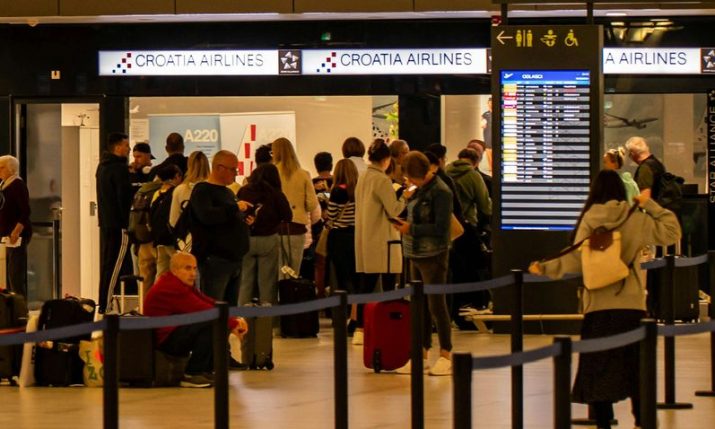
Zagreb Airport
DUBLIN, Ireland, 17 July (Croatia Week) – Croatian Deputy Prime Minister and Minister of the Interior Davor Božinović has called for stronger international exchanges of security information and closer operational cooperation in the fight against organised crime, warning that criminal networks operate globally and increasingly use the same logistical, financial and digital systems as the legitimate economy.
Speaking at an informal meeting of EU interior ministers in Dublin on Thursday, Božinović said the European Union’s response to increasingly sophisticated criminal organisations must be equally connected and coordinated.
“Criminal networks do not stop their activities at the borders of the European Union. Therefore, the exchange of security-relevant information cannot stop at its borders either,” Božinović said.
The meeting focused on the fight against organised crime, the future of European visa policy and efforts to combat drug trafficking through the European Ports Alliance.
Božinović stressed that tackling the most dangerous criminal networks requires the full use of available tools, including police and judicial cooperation, financial investigations and the confiscation of criminal assets.
He also backed a stronger role for Europol and Eurojust in international information exchange, analytical support and operational coordination.
The Croatian minister highlighted the importance of cooperation with Western Balkan countries, saying that Croatia’s joint operational activities demonstrate on a daily basis that trafficking and other organised criminal networks can be effectively tackled only through partnership and coordinated action.
He also supported the development of a common European framework for the secure exchange of information with trusted third countries in law enforcement and border management, based on the principle of reciprocity.
Božinović said timely access to high-quality information was essential for protecting the EU’s external borders, combating terrorism and tackling organised crime.
He added that completing the European architecture for the interoperability of information systems remained a key precondition for the security of the Schengen area.
Entry/Exit System highlighted
The meeting also discussed the EU Entry/Exit System (EES), which Božinović described as the result of almost a decade of joint work by EU member states and European institutions.
He said the system had already demonstrated its value in protecting the Schengen area by helping to detect identity fraud more quickly, improve monitoring of the lawful stay of third-country nationals and strengthen overall security through the immediate exchange of data between member states.
Božinović called for continued investment in the modernisation of border infrastructure and information systems.
Visa policy and security
The future of European visa policy was another topic discussed in Dublin.
Croatia believes visa policy should remain both an instrument of international cooperation and an important tool for protecting the security of the European Union.
“Visa-free travel is not an automatic right, but a privilege based on trust, meeting security criteria and responsible behaviour by partner countries,” Božinović said.
He added that the EU needed more effective mechanisms to respond when its security and interests were threatened.
A meeting of the European Ports Alliance, dedicated to tackling drug trafficking, was also held on the margins of the ministerial meeting.
Božinović warned that maritime drug trafficking had become a security challenge for the entire logistics chain, rather than solely for police and customs authorities.
Croatia is strengthening cooperation between police, customs and the private sector through the participation of the ports of Rijeka and Ploče in the European Ports Alliance. The aim is to improve information exchange, risk analysis and the prevention of drug smuggling.
Božinović said the urgency of the issue was further underlined by a new Europol report, according to which drug trafficking is the most common form of criminal activity involving almost one-third of the 731 most dangerous criminal networks identified in the European Union.
European seaports remain key entry points for cocaine trafficking into the European market.
The informal meeting in Dublin continued discussions on strengthening European internal security ahead of the full implementation of the EU’s new legislative framework in the areas of migration, border management and the fight against organised crime.