- by croatiaweek
- July 28, 2026
-
in
News
(Photo credit: Archaeological Museum of Istria)
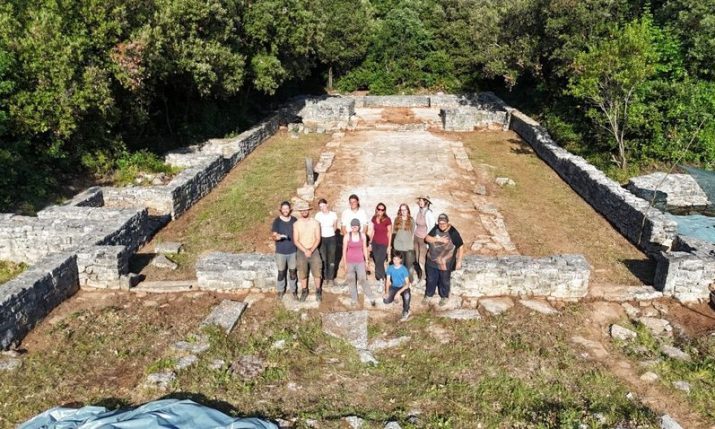
ZAGREB, 28 July (Hina) – Early Christian floor mosaics dating from the 5th century have been rediscovered during follow-up archaeological research at the St Andrew church and monastery complex in Betiga near Barbariga in Istria County, with conservation and restoration work planned after digital documentation is completed.
The research was carried out from 25 May to 7 June by the Archaeological Museum of Istria and the Department of Christian Archaeology at Friedrich-Alexander-Universität Erlangen-Nürnberg.
Its aim was to rediscover and document mosaics uncovered during excavations in the 1970s and create full digital documentation of the site, including a 3D model made using laser scanning and photogrammetry.
The Betiga church complex is one of Croatia’s most important Early Christian sites outside the late antique urban centres of the period. A memorial three-lobed chapel was built around the grave of an unknown local saint in the early 5th century and decorated with a floor mosaic.
(Photo credit: Archaeological Museum of Istria)
Between the 5th and 7th centuries, the complex expanded to include a three-nave basilica, baptistery, mausoleum, atrium with a portico and cistern, and was later dedicated to St Andrew.
This year’s research uncovered a black-and-white mosaic in the memorial chapel and a polychrome mosaic in the basilica’s central nave. The mosaics feature geometric and floral motifs, including ivy tendrils, lotus flowers and the tree of life, and contain four preserved inscriptions.
(Photo credit: Archaeological Museum of Istria)
Systematic excavations at the site were conducted by the Archaeological Museum of Istria from 1975 to 1979, when the mosaics and numerous architectural elements, fragments of Early Christian liturgical and pre-Romanesque furnishings, and other movable finds were discovered.
One inscription mentions Felicianus and Ingenua, believed to have commissioned the mosaic and possibly the memorial chapel itself, suggesting that the building may originally have been dedicated to All Saints. A 9th-century pre-Romanesque stone inscription confirms that the complex was later dedicated to St Andrew.
(Photo credit: Archaeological Museum of Istria)
Three inscriptions in the basilica refer to donors who financed the mosaics, including the priest Dalmatius, who funded around 26 square metres of mosaic, and the wealthy couple Aquilinus and Urania, and Florentius, who also contributed to the decorated floor.
The Archaeological Museum of Istria said new damage had appeared on the mosaics since the last conservation work in the late 1970s and early 1980s, and restoration would begin soon.
(Photo credit: Archaeological Museum of Istria)
Further research is planned for 2027, when work will expand to the former monastery rooms. After restoration, the site will be opened to visitors by prior arrangement with the Archaeological Museum of Istria.