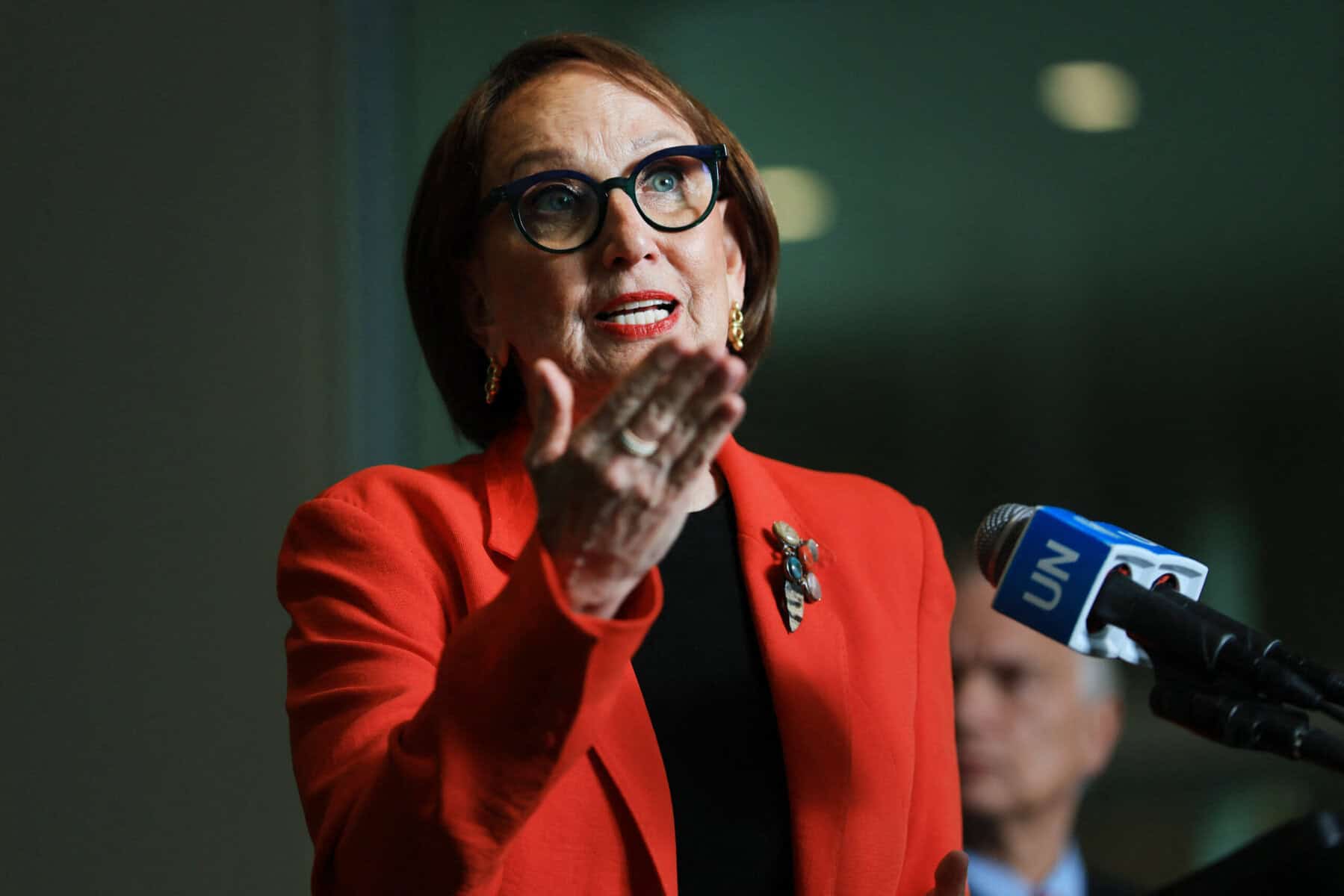
Former Costa Rican Vice President Rebeca Grynspan again finished first on Friday in the UN Security Council’s seventh informal vote in the race for secretary-general, while the new Emirati candidate delivered a disappointing showing. In a closed-door vote, the Security Council’s 15 members anonymously marked each candidate as “encourage,” “discourage” or “no opinion.”
Grynspan, who took leave from her position at UN Trade and Development (UNCTAD) to campaign, received 11 “encourage” votes and four “discourage” votes, according to a diplomatic source. Diplomat Lana Nusseibeh, who recently entered the race and was appearing on the ballot for the first time, received seven “encourage” votes, six “discourage” votes and two “no opinion” votes.
Argentina’s Rafael Grossi, the current director general of the International Atomic Energy Agency, received nine “encourage” votes, four “discourage” votes and two “no opinion” votes. Former Guyanese Foreign Minister Carolyn Rodrigues-Birkett received eight, six and one, respectively. Both finished ahead of the Emirati candidate.
Unlike the previous round, this vote did not use different-colored ballots to distinguish the votes of the Security Council’s five permanent members. In that previous round, none of the seven candidates avoided a negative vote from at least one of the countries with veto power: the United Kingdom, France, the United States, China and Russia.
Former Senegalese President Macky Sall subsequently withdrew, and Nusseibeh, 48, entered the race. Candidates may join at any point until a selection is made. Until then, she had served as minister of state at the UAE’s Foreign Ministry and as special envoy to the United Nations and the European Union. She previously served as the UAE’s ambassador to the UN from 2013 to 2024. Several human rights organizations have opposed her candidacy, accusing her country of financing paramilitary forces in Sudan.
To succeed Portugal’s António Guterres, whose second term ends at the close of this year, a candidate must secure nine votes and avoid a veto. Once a consensus is reached, the candidate’s name will be submitted to the General Assembly, which in practice follows the Security Council’s recommendation.
Under a tradition of geographic rotation that is not always observed, Latin America is laying claim to the position. Meanwhile, numerous countries are pushing for a woman to lead the UN for the first time.