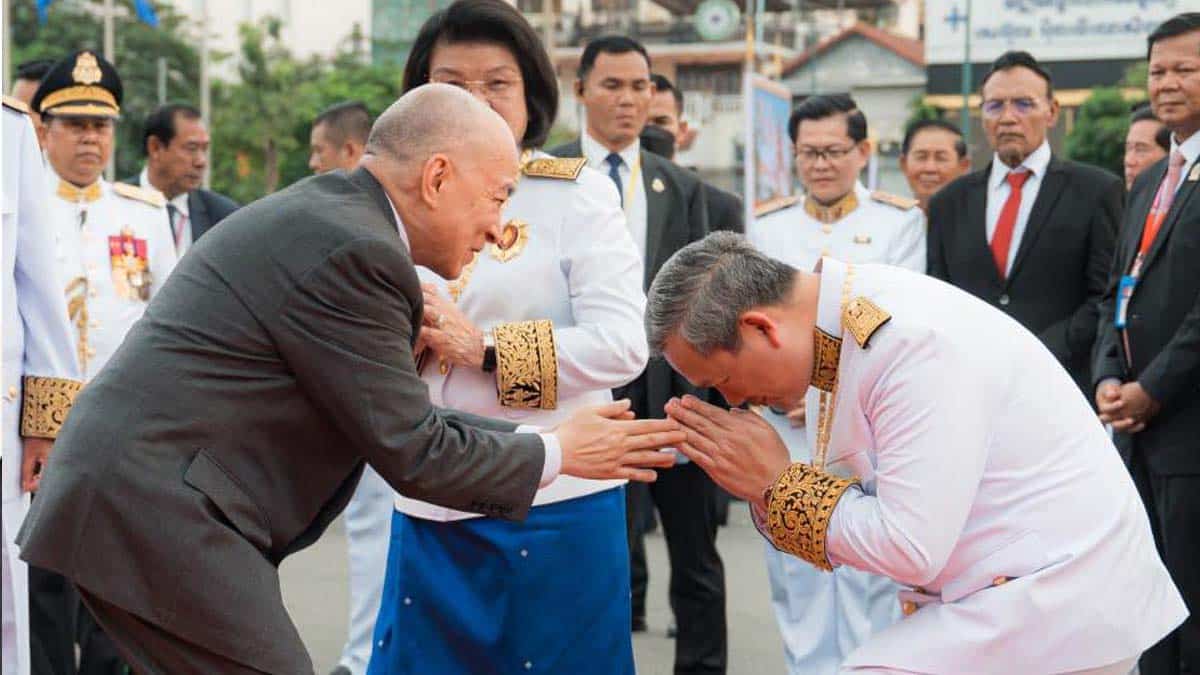
Observers say Cambodia’s King Norodom Sihamoni’s recent decision to hand over two royal estates to Prime Minister Hun Manet was a deliberate move to safeguard the monarchy’s heritage and ensure the people remember the legacy of both the late King Father and the current monarch.
Social commentator Vorn Chanlout wrote on Facebook that the gesture demonstrates a model of leadership that prioritizes the nation and its citizens over personal gain. He added that if Phnom Penh’s ruling elite had a sense of conscience, they might follow the King’s example by returning assets acquired through corruption and criminal activities to the state.
Vorn Chanlout described the King as “the most humble monarch in the world,” saying that not only is he incomparable to other kings, but that even Cambodia’s most powerful political figures cannot match his moral example.
On November 8, 2025, King Norodom Sihamoni issued a royal decree granting Prime Minister Hun Manet stewardship over two royal estates in Phnom Penh, instructing the government to preserve and convert them into national museums and heritage sites.
According to the royal decree, the Taksina royal estate, covering 2,843 square meters, and the Pokkul royal estate, spanning 3,539 square meters, are both located in Village 3, Chatomuk commune, Daun Penh district. The King ordered the government to maintain and renovate these sites for future generations after his passing.
Following the royal decision, Senate President Hun Sen and Prime Minister Hun Manet jointly expressed their gratitude, praising the King for his continued generosity toward the nation. Their statement emphasized that King Sihamoni has consistently contributed his own resources for the welfare of the Cambodian people.
Article 7 of Cambodia’s Constitution states that the King “reigns but does not govern” and serves as Head of State for life. The monarch is inviolable and cannot be accused or prosecuted.
However, the relationship between the royal palace and the ruling Cambodian People’s Party has not always been smooth. In 2018, Hun Sen publicly criticized the King in a dispute involving the Royal Group’s CNC television station, declaring that he feared neither the company’s owner, Kith Meng, nor the Queen Mother herself, insisting that “even she could not protect him.”
The latest royal gesture, observers say, reflects a deeper effort by the monarchy to reinforce its cultural and historical role at a time when political power remains concentrated in the hands of the ruling family.