
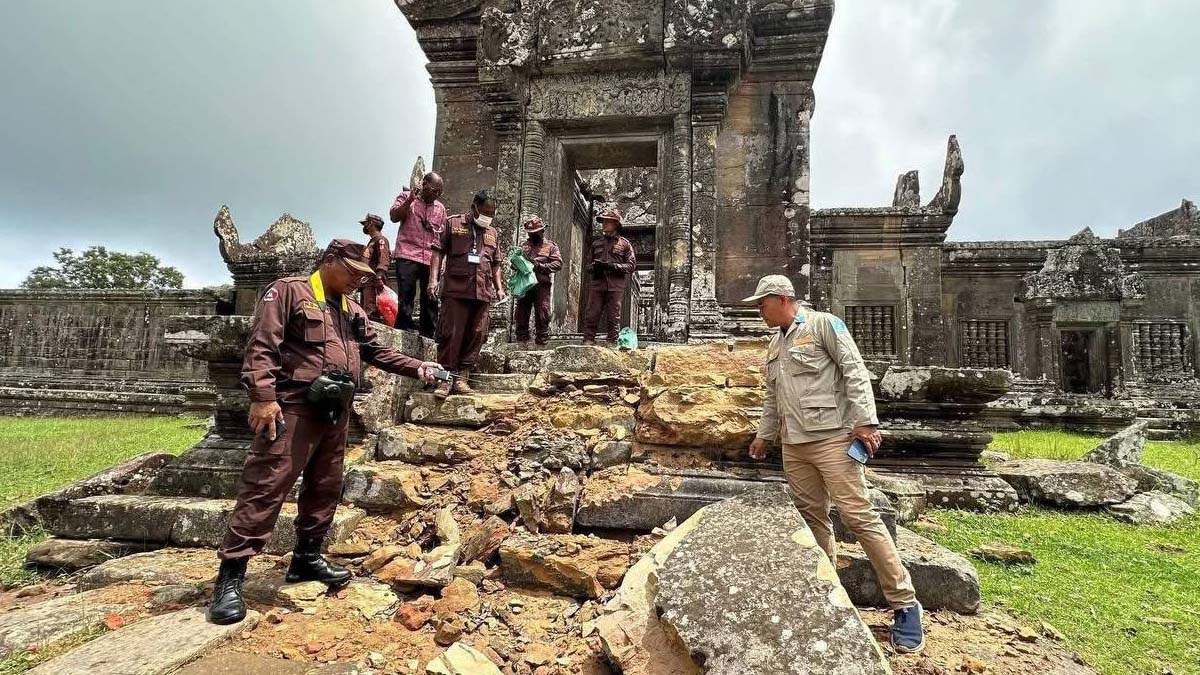
A leading researcher of Khmer Rouge era crimes has suggested that Thailand’s recent military actions against Cambodia may be driven by lingering resentment over its long-running legal defeat in the Preah Vihear temple case.
Youk Chhang, executive director of the Documentation Center of Cambodia, said the use of heavy weaponry by Thai forces, including F-16 fighter jets, to strike areas around Preah Vihear temple could reflect an intention to settle old grievances dating back more than six decades.
Writing on his Facebook page on Tuesday, Youk Chhang accused the Thai military of showing disregard for the laws of war designed to protect civilians and cultural property. He said attacks affecting Preah Vihear temple in particular demonstrated what he described as contempt for rulings by the International Court of Justice, which awarded sovereignty over the temple to Cambodia after a long-standing dispute with Thailand.
Cambodia’s Ministry of National Defence first raised allegations that Thai forces damaged the temple, which the Ministry of Culture later echoed.
Youk Chhang said the Thai government’s support for military actions that violate Cambodian territory, including the destruction of cultural heritage, showed a clear failure to uphold obligations under a ceasefire agreement brokered by the United States and ASEAN.
He added that Thailand had committed serious violations of international law on multiple occasions and said accountability would be necessary, even if delayed, to preserve peace and regional security in the long term.
His comments followed reports that Preah Vihear temple suffered extensive damage during more than 20 days of fighting between Cambodian and Thai forces in recent weeks.
Cambodia’s Ministry of National Defence said Thai forces carried out more than 40 attacks on the Preah Vihear area between December 7 and December 27, 2025. Other Cambodian border areas were also struck during the same period.
The ministry said weapons used by Thai forces during what it described as a second phase of the conflict included mortars, 155 millimetre artillery, toxic smoke, tanks, bomb dropping drones, cluster munitions, DTI 2 rocket launch vehicles, DK 106 guns, suicide drones, and DTI 1G rocket systems, alongside ground troops.
Thailand’s Khaosod newspaper reported in late December 2025 that the Thai Second Army Region had targeted the Preah Vihear area, saying the operation aimed to destroy a crane near the temple entrance that was allegedly being used to install signal jamming or counter-drone equipment.
On December 10, 2025, UNESCO reminded all parties of their obligations under international law, including the 1954 Hague Convention on the Protection of Cultural Property and the 1972 World Heritage Convention, during armed conflict.
Cambodia Mine Action Centre director Heng Ratana said munitions cleared in the Preah Vihear area included a wide range of ordnance, such as 105, 106, and 104 millimetre shells, 42 millimetre rounds, cluster bombs, and M85 submunitions.
During the border clashes, Cambodia’s armed forces also used BM-21 Grad multiple launch rocket systems firing 122 millimetre rockets at Thai military positions. Thailand’s The Nation newspaper reported on December 22, 2025, that four BM-21 rockets landed in civilian areas of Ubon Ratchathani and Sisaket provinces.
Thailand has denied deliberately targeting the Preah Vihear temple. Thai military spokespeople have said strikes were aimed at clearly identified military targets, not the temple itself.
Preah Vihear temple sits atop the Dangrek mountain range along the Cambodia-Thailand border. The site has been at the centre of disputes for around 70 years, intensifying after Cambodia gained independence in 1954, when Thai forces moved into the area.
In 1962, the International Court of Justice ruled that Preah Vihear belongs to Cambodia. A second ruling in 2013 reaffirmed Cambodian sovereignty and ordered Thailand to withdraw all military and security personnel from the temple and its surroundings. The site was inscribed as a UNESCO World Heritage Site in July 2008.


