Synopsis: Youth exchanges and dialogue can help overcome nationalist resentment and heal bilateral divisions after border fighting, says expert.
Education, dialogue and people-to-people exchanges are essential to rebuilding trust between Cambodia and Thailand following their 2025 border clashes, a national reconciliation expert said, adding that unchecked nationalist resentment could deepen divisions.
Ly Sok Kheang, director of the Anlong Veng Peace Center, an affiliate of the Documentation Center of Cambodia (DC-Cam), said both countries must prioritise justice, equality and mutual understanding while encouraging younger generations to overcome historical grievances.
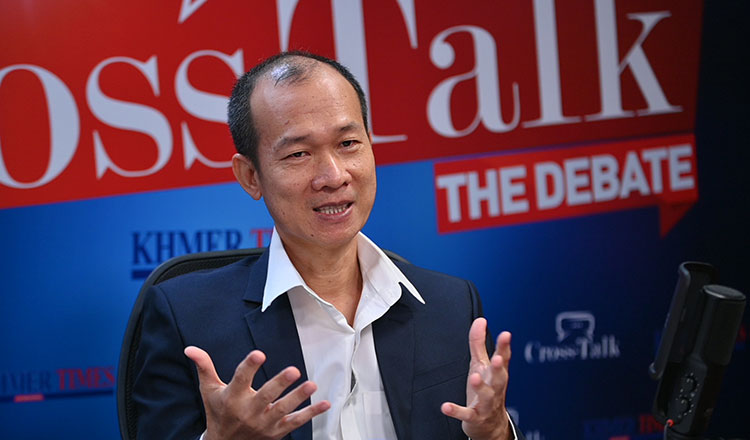
Speaking on Khmer Times’ Cross-Talk programme, Sok Kheang said the clashes in 2025 created divisions and distrust. He added that neighbouring countries could de-escalate tensions through education, humanitarian activities and dialogue.
“I believe that the clashes and the events from May and July through December 2025 have created a deep division and mutual distrust that will be difficult to repair,” he said. “However, we still hold hope that, as neighbouring countries, we can resolve our issues and de-escalate tensions through education.”
He said rebuilding relationships required trust at government and community levels, adding that reconciliation could not be achieved through diplomatic arrangements alone.
“What matters most is building mutual trust as fellow human beings – people-to-people and state-to-state. Building trust and mutual understanding is paramount,” he said.
He said reconciliation must be grounded in justice and equality while territorial disagreements remain unresolved.
Sok Kheang said historical factors and differing interpretations of maps should be addressed through mutual respect and verification by bilateral technical committees rather than unilateral actions.
“If one side acts purely out of unilateral assumptions or whims – for example, claiming ‘this is my land’ and bulldozing back and forth without proper verification from the bilateral technical committees, it makes things very difficult,” he said.
He said the dispute should be resolved through existing legal and diplomatic mechanisms, including treaties, conventions, agreements and joint declarations.
“A politician who is able to avoid conflict is a skilled and strong politician,” he said, adding that armed resistance should only become necessary when Cambodia had no alternative to defending its sovereignty and territorial integrity.
Lessons from Cambodia’s reconciliation experience
Drawing on Cambodia’s experience of overcoming divisions after the Khmer Rouge regime, Sok Kheang said education could help younger generations understand history without inheriting resentment.
He said the Anlong Veng Peace Center focused on genocide prevention and promoting mutual non-resentment by documenting the experiences of people who lived through the 1975-1979 regime.
Survivors experienced suffering, including forced labour, starvation, trauma and the loss of family members. The centre places importance on preserving individual accounts as part of the historical record.
Its guidebook contains methodologies for teaching Khmer Rouge history, including inviting survivors into classrooms and assigning students to interview family and community members who lived through the period.
Teachers guide students in preparing questions and conducting interviews, allowing them to explore history through first-hand accounts rather than relying solely on textbooks.
Sok Kheang said avoiding labels helps prevent divisions between former members and victims.
“We no longer categorise people by saying this person is a former cadre or Khmer Rouge member, or a killer or perpetrator, or that person is a victim. Instead, we refer to everyone collectively as ‘survivors’,” he said.
He said people who served under the former regime and those who suffered under it experienced hardships in different forms, while subsequent generations are all descendants of survivors.
He said the Extraordinary Chambers in the Courts of Cambodia (ECCC) provided a judicial mechanism for determining criminal responsibility.
He said people who have not been tried should not face collective judgement but should be treated as ordinary citizens with equal rights under the Constitution.
His experience in Anlong Veng, where he estimated that 70% to 80% of the population had been members or fighters of the Khmer Rouge movement, demonstrated the importance of building trust with former members and their families.
The centre organises peace study tours involving university students from Phnom Penh, including those from the Royal University of Phnom Penh, the Royal University of Law and Economics and the National Institute of Education. They are grouped with local students from Anlong Veng, including descendants of former Khmer Rouge members, to explore history and learn together.
Sok Kheang said such encounters build connections and mutual understanding among young people from different backgrounds.
Youth must not inherit nationalist resentment
Applying these lessons to Cambodia-Thailand relations, Sok Kheang said younger generations would play a decisive role in determining whether bilateral relations improved or deteriorated.
He said the border clashes have fuelled anti-Thai sentiment in Cambodia, reflected in boycotts of Thai products, border closures and disruptions to cultural and sporting exchanges.
He said anger must not become a permanent attitude, particularly given that the two countries remain neighbours.
“Sometimes reconciliation takes not just many years, but many generations,” he said, drawing parallels with the reconciliation process among Cambodians who lived through the Khmer Rouge period.
He said educators should help young people understand historical disputes without allowing nationalist emotions to develop into hostility towards entire populations.
“Therefore, we should educate and guide our youth not to let nationalist anger become so extreme that it leads to negative consequences for both sides,” he said.
He said encouraging young Cambodians to engage with Thai communities would be challenging while distrust remained strong. He added that future community development and humanitarian initiatives could provide opportunities for young people to work together and overcome those barriers.
“When we can overcome those hurdles, it brings us closer to recognising the fundamental truth that we are all human beings, and that we must talk to each other rather than use war to solve our problems,” he said.
As an example, Sok Kheang recalled the Anlong Veng Peace Center’s “Walk on the Dangrek Mountain Range”, a sporting event that attracted around 2,000 Cambodian and Thai participants. They ran together while exchanging knowledge about history, peace and prosperity along the border.
He said similar initiatives could be revived when bilateral relations improved, helping restore goodwill through direct engagement.
Critical thinking to counter online tensions
Sok Kheang said teachers share responsibility for preventing future divisions, adding that education in a country that had experienced war and genocide must emphasise rejecting resentment and preventing the recurrence of genocide.
He said an uncompromising attitude of hatred towards Thailand would be unsustainable and could undermine future reconciliation.
Social media is another concern, as online platforms have become sources of information while exposing users to insults, accusations and inflammatory exchanges.
He said citizens should develop critical-thinking skills and avoid blindly believing or sharing information from a single source.
“Smart information consumption is crucial, rather than taking a single source, blindly believing it, and sharing it further,” he said.
Users should assess the credibility of information, examine its context and seek independent verification before drawing conclusions, he added.
Sok Kheang said he had previously led training courses involving professors from the United States and Canada to equip participants with analytical thinking, comprehension and independent research skills.
He said people should avoid relying on anonymous writers and fake social media accounts that circulate fabricated information and fuel misunderstandings.
He said the public should rely on factual information supported by research.
Sok Kheang said Cambodians and Thais must transform their anger over the conflict into motivation for education, personal development and constructive cooperation.
“Anger exists on both sides, but we should transform that anger into motivation for our youth to study, develop themselves, learn to work together and take on challenges independently,” he said.
He added that historical issues should be examined and debated objectively, while efforts must be made to prevent incitement that could lead to misunderstandings, flawed analysis and poor decisions.